
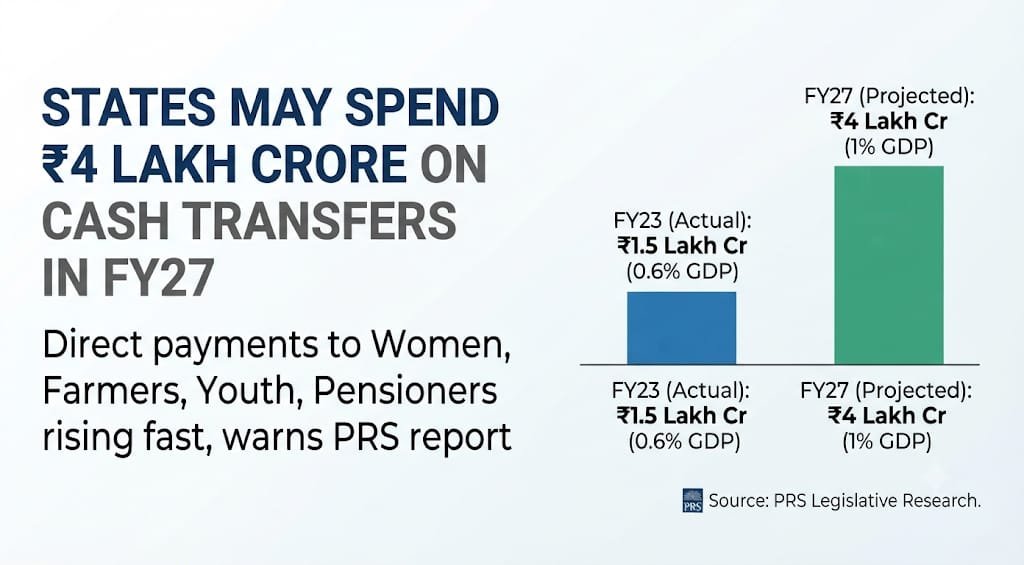
State governments across India are expected to spend about ₹4 lakh crore on unconditional cash transfer schemes in 2026-27, according to the latest report by PRS Legislative Research. This amount is roughly 1% of India’s GDP. It is a sharp increase from 0.6% of GDP, or about ₹1.5 lakh crore, in 2022-23. In simple terms, states are setting aside a much larger share of their money to directly give cash to selected groups of people.
Unconditional cash transfers are payments made by state governments without asking beneficiaries to meet a work, purchase or production condition. These schemes mainly cover women, farmers, youth and social-security pension beneficiaries. Pension beneficiaries include elderly people, widows and persons with disabilities. The PRS report examined 128 such identified schemes, though it clarified that the actual expenditure could be higher because the list is not exhaustive.
The growing cost of these schemes is visible in the wider state budget. Spending on subsidies and transfers rose from 16% of states’ revenue receipts in 2018-19 to 21% in 2023-24. Revenue receipts are the regular income that states receive through taxes and other sources. When a larger part of this income goes towards subsidies and cash transfers, less money remains for roads, schools, hospitals, drinking-water projects and other long-term public services.
Cash transfers have grown much faster than subsidies. Between 2018-19 and 2023-24, transfers increased at an annual rate of 24%, while subsidies grew at 12%. This means direct cash support is now becoming one of the biggest financial commitments for many state governments. Power subsidies and unconditional cash transfers together account for the largest share of expenditure on subsidies and transfers in several states.
The rise in cash transfers has also coincided with a widening revenue deficit for states. A revenue deficit means that a government’s regular income is not enough to meet its regular expenses. According to the PRS report, states’ revenue deficit increased from a post-Covid low of 0.23% of GDP in 2022-23 to 0.71% in 2025-26. The report links this pressure partly to the sharp increase in spending on cash-transfer schemes.
For ordinary families, these schemes can provide meaningful support. A monthly payment to a woman, a farmer or an elderly person can help manage household expenses, medical costs, school-related spending or farm inputs. In a time of rising prices, such transfers can offer immediate relief. This is why many state governments see direct cash support as an important welfare tool.
At the same time, the financial burden is becoming harder to ignore. When states commit large amounts every year to cash transfers, they need steady revenue to sustain those promises. If tax collections slow down or other expenses rise, governments may face difficult choices between continuing welfare payments and funding development projects. The report suggests that this growing welfare commitment could reduce the space available for growth-enhancing spending.
The timing is also politically important. Seven states Punjab, Uttar Pradesh, Gujarat, Goa, Uttarakhand, Himachal Pradesh and Manipur are scheduled to face elections in 2027. These states have together budgeted ₹35,333 crore for unconditional cash-transfer schemes in 2026-27. While cash transfers can genuinely help vulnerable households, their rapid expansion also raises questions about whether such promises are financially sustainable beyond election cycles.
The key issue is not whether cash support is useful, but how states balance it with other priorities. Direct transfers can reduce immediate hardship, especially for women, pensioners and low-income households. However, if their cost keeps rising faster than state revenues, governments may struggle to fund infrastructure, education, health care and job creation at the same level.
The PRS report therefore highlights a major shift in India’s state finances. Cash transfers are no longer a small part of welfare spending; they are becoming a central budget commitment. The challenge for state governments will be to protect the benefits that families receive while ensuring that rising transfer costs do not crowd out investment in services and infrastructure that support long-term growth.

