
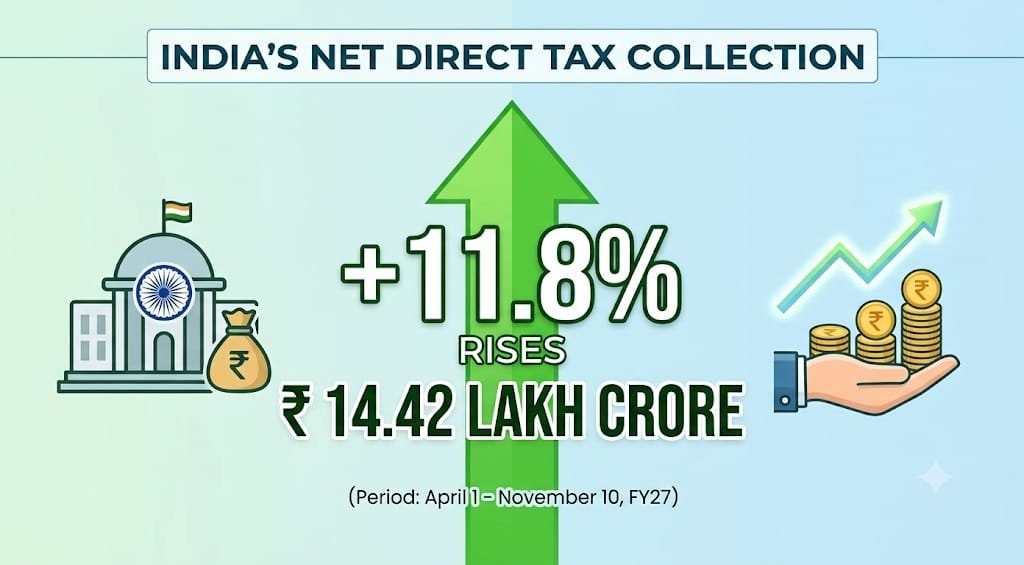
India’s net direct tax collection rose 11.8% to Rs 14.42 trillion between April 1 and November 10 in the current financial year. In more familiar terms, that is Rs 14.42 lakh crore available to the government after tax refunds.
Provisional figures released by the Central Board of Direct Taxes show that collections have reached 53.5% of the Rs 26.97 lakh crore budget target for FY27.
The increase offers an important picture of government finances, but the headline needs some explanation. Net collections do not rise only when people and businesses pay more tax.
They also depend on how much money the government returns as refunds. During this period, lower refunds helped net collections grow faster than the total amount collected before refunds.
Gross direct tax collection, which measures receipts before refunds are deducted, increased 5.2% to Rs 17.50 lakh crore. Refunds, meanwhile, fell 25.9% to Rs 3.08 lakh crore, compared with Rs 4.16 lakh crore in the corresponding period last year.
This difference explains why net revenue rose 11.8% even though growth in gross receipts was more moderate. The figures therefore reflect both higher collections and a smaller refund outgo.
Corporate tax remained the largest component, but its lead over non-corporate taxes narrowed. Net corporate tax collection increased 13.5% to Rs 7.27 lakh crore. Non-corporate tax collection rose 10.7% to Rs 7.05 lakh crore.
This second category includes personal income tax paid by individuals, along with taxes paid by Hindu Undivided Families and certain other entities. It should not be understood as salary-related income tax alone.
The longer-term change is particularly noticeable. Non-corporate taxes accounted for 48.9% of gross direct tax collections during the period, compared with corporate tax’s 51.1%. In the corresponding period last year, the non-corporate share was 45.8%.
These figures show that taxes collected outside the corporate sector are becoming increasingly important to the overall revenue pool, although corporate taxes still hold a slightly larger share.
Securities transaction tax, charged on specified securities-market transactions, showed almost no growth. Collections stood at Rs 45,798 crore, compared with Rs 45,846 crore a year earlier, a decline of about 0.1%.
This makes it an exception to the broader increase in direct tax receipts. Its performance also shows why the individual parts of the collection figures matter alongside the overall total.
The annual target remains another important measure. Net direct tax receipts are expected to grow around 13.5% in FY27 over the previous financial year’s actual collection of approximately Rs 23.70 lakh crore.
The 11.8% growth recorded so far is below that full-year growth requirement. Reaching more than half the annual target is progress, but it does not by itself establish whether the final target will be achieved.
The overall picture is one of rising revenue, a growing contribution from non-corporate taxpayers and a substantial fall in refunds. However, the figures remain provisional.
The clearest reading is that the government retained more direct tax revenue during the period, while growth in collections before refunds was considerably slower than the headline net figure suggests.

