
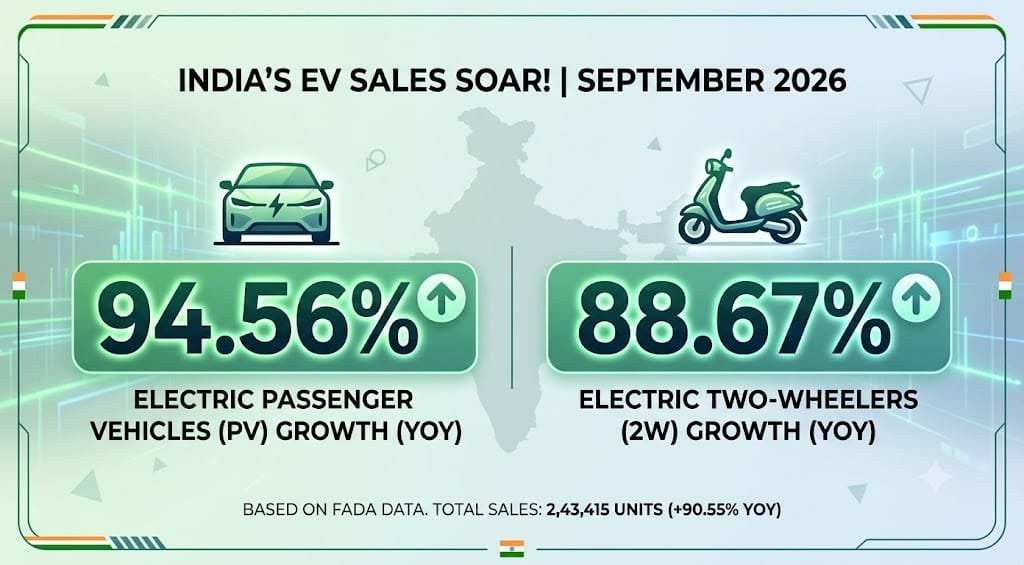
India’s electric vehicle (EV) market delivered a powerful performance in September 2026, indicating that electric mobility is gradually becoming a more familiar choice for Indian buyers. Retail sales of electric passenger vehicles and electric two-wheelers together reached 2,43,415 units during the month. This was an increase of 90.55% compared with the same month last year, when total sales stood at 1,27,990 units.
The growth was visible across both major segments. Electric passenger vehicle sales rose 94.56% year-on-year to 36,108 units in September 2026. In September last year, sales in this category stood at 18,567 units. Electric two-wheeler sales also recorded a strong increase of 88.67%, reaching 2,07,314 units compared with 1,09,423 units a year earlier.
The latest figures were compiled by the Federation of Automobile Dealers Associations, or FADA, using data from 1,468 of 1,469 regional transport offices. The numbers provide a broad picture of retail demand because they reflect vehicles registered and sold through dealerships rather than only factory dispatches.
Passenger electric vehicles formed one of the most encouraging parts of the September performance. Tata Motors remained the largest player, selling 14,791 electric passenger vehicles. Its sales increased by 100.72% compared with September 2025. This means Tata Motors sold more than twice the number of electric passenger vehicles it sold a year earlier.
Mahindra & Mahindra stood second with sales of 7,780 units, registering year-on-year growth of 95.82%. JSW MG Motor India sold 5,242 electric vehicles, an increase of 9.14%. Together, Tata Motors and Mahindra & Mahindra accounted for nearly 63% of electric passenger vehicle sales during the month, showing the strong position of established manufacturers in India’s growing EV market.
The rise in sales suggests that electric cars are gradually moving beyond a limited group of early buyers. Better model availability, rising fuel costs, greater awareness about running expenses and improving charging access are encouraging more customers to consider electric vehicles. New products and wider choices from companies such as VinFast, Kia and Maruti Suzuki are also expected to make the market more competitive.
Electric two-wheelers continued to provide the biggest volume support to the EV sector. TVS Motor Company led the category with sales of 54,037 units, recording year-on-year growth of 125.87%. Bajaj Auto followed with 48,429 units, while Ather Energy sold 30,533 units. TVS and Bajaj benefited from strong demand for electric scooters and motorcycles, supported by growing interest in lower running costs and convenient urban travel.
The wider passenger vehicle market also grew during September, but electric vehicles expanded at a much faster pace. Electric passenger vehicle penetration increased to around 13% from nearly 10% a year earlier. This indicates that electric vehicles are not only gaining in absolute numbers but are also taking a larger share of overall passenger vehicle sales.
The September figures therefore point to a clear shift in consumer behaviour. India’s electric vehicle market is still developing, but the sharp rise in sales shows that cleaner and more economic mobility is becoming increasingly relevant to households, businesses and manufacturers. As more models enter the market and charging facilities improve, electric vehicles may become a more common part of everyday transportation across the country.

