
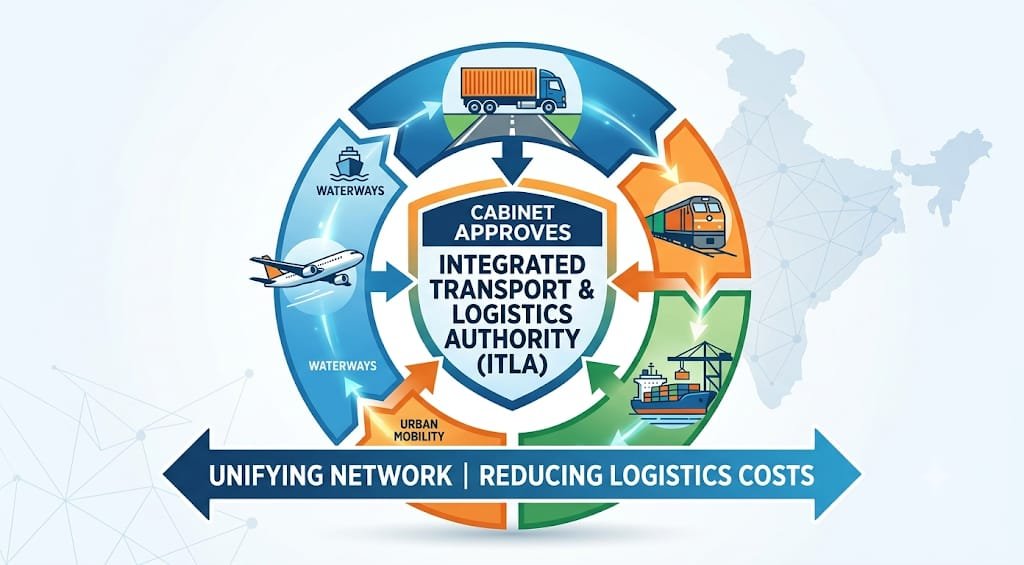
The Union Cabinet has approved the creation of the Integrated Transport and Logistics Authority, or ITLA, to improve the way India plans and manages its transport and logistics network. The decision is aimed at bringing different modes of transport, including roads, railways, ports, airports, inland waterways, coastal shipping and urban mobility, closer together under a coordinated system.
At present, transport projects are often planned separately by different departments. This can sometimes create delays, duplication of work and gaps between one mode of transport and another. The new authority is expected to bring these activities under one framework so that roads, railways, ports and other facilities can work more efficiently as part of a larger network.
The ITLA will function as the main institution for integrated transport and logistics planning in the country. It will bring policy research, project planning, project appraisal, monitoring, evaluation and data analysis under one platform. This approach is expected to make infrastructure decisions more organised and based on actual movement of people and goods.
One of the important responsibilities of the authority will be to examine government infrastructure projects costing ₹500 crore or more. Before such projects move forward, the ITLA will assess whether they fit into a wider multimodal transport plan. This means a new road, railway line, port or logistics facility will be evaluated not only as an individual project but also for its connection with other transport systems.
The authority will also monitor major transport projects during and after their completion. It will help identify delays, coordinate the resolution of problems and assess whether a project has achieved its expected benefits. Such monitoring could help improve the use of public money and make infrastructure delivery more effective.
The ITLA will prepare a long-term National Transport Master Plan covering different forms of transportation. It will also use information from GSTN e-way bills, FASTag, Vahan, GPS systems and urban traffic networks. By studying freight movement, traffic patterns and the origin and destination of goods, the authority can support better decisions on where new roads, warehouses, freight corridors and logistics hubs are needed.
The government also expects the authority to support research and innovation in transportation and logistics. It will assist in reviewing and updating the National Logistics Policy, 2022, while also promoting training, skill development and capacity building in the logistics sector.
The larger objective is to improve connectivity, reduce the cost of moving goods and strengthen India’s position in global trade. Better coordination among transport systems could make supply chains faster and more reliable for manufacturers, farmers, exporters, businesses and consumers.
The government has linked the creation of ITLA with India’s Vision 2047 and its aim of building a more efficient, modern and globally competitive logistics network.
The approval of the Integrated Transport and Logistics Authority marks an important step towards building a more connected and efficient transport system in India. By bringing roads, railways, ports, airports, waterways and urban mobility into a coordinated framework, the authority can reduce delays, improve project planning and lower the cost of moving goods.
Its focus on research, data-based decisions and regular monitoring may also help prevent waste and improve the performance of large infrastructure projects. If implemented effectively, ITLA could make India’s supply chains faster, support businesses and exporters, create better connectivity across regions and strengthen the country’s position as a major global logistics hub.

