
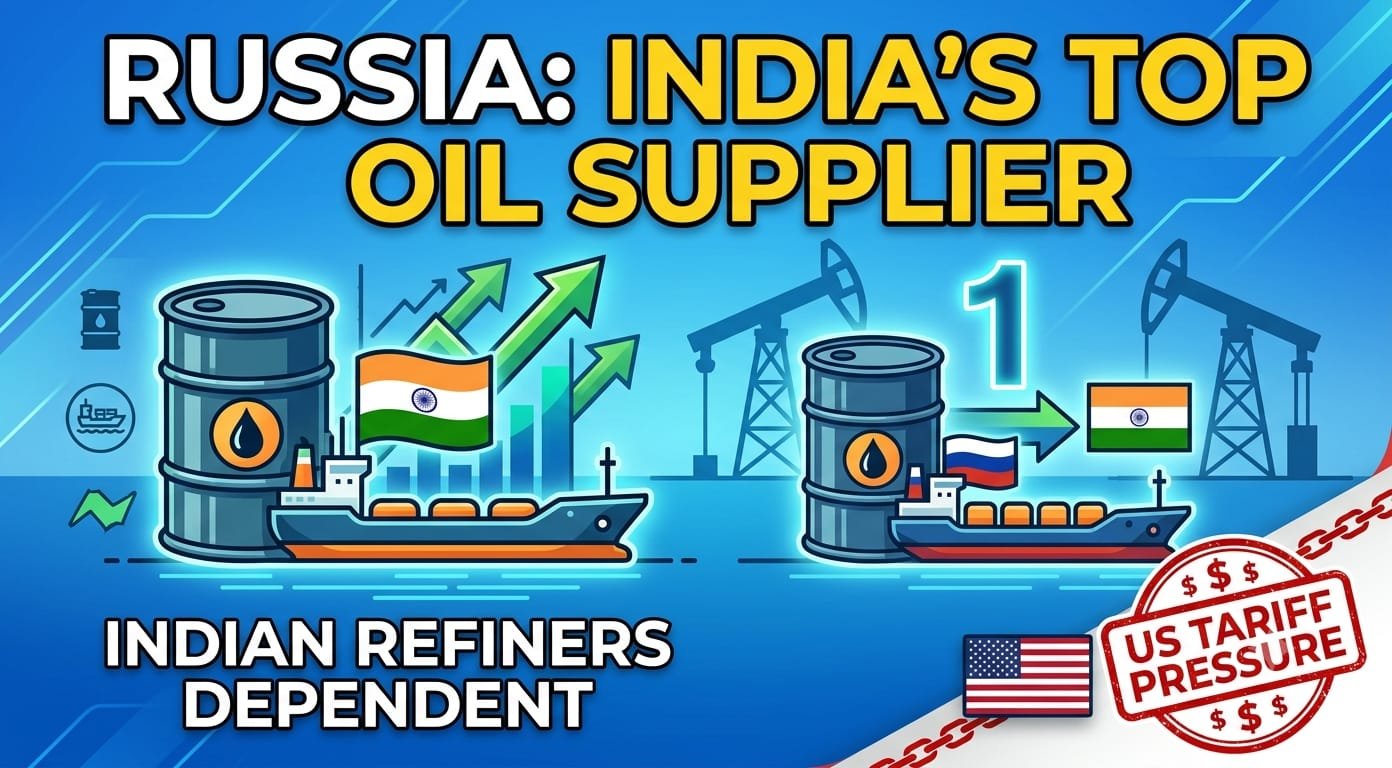
India continues to receive the largest share of its crude oil from Russia in September, even as pressure from the United States increases. Preliminary data reveals that Russia supplied around 1.742 million barrels of crude oil per day to India between September 1 and September 27.
This kept Russia ahead of Iraq, Saudi Arabia, the United Arab Emirates and Kuwait in India’s oil supply chain. The data was sourced from maritime intelligence and research firm Kpler and reported by Business Standard.
India imported an average of 5.251 million barrels of crude oil per day during the first 27 days of September. This was around 13 per cent higher than the average daily import of 4.654 million barrels recorded in August.
The rise suggests that Indian refineries remained active and that demand for crude oil continued to be strong. Higher refinery activity is also linked to increased domestic fuel requirements and favourable opportunities in the international refined fuel market.
Russia supplied the highest volume at 1.742 million barrels per day. Iraq was the second-largest supplier with 579,000 barrels per day, followed closely by Saudi Arabia at 570,000 barrels per day.
The UAE supplied 483,000 barrels per day, while Kuwait provided 333,000 barrels per day. This supplier mix shows that India is trying to keep several sources open, but Russian crude still remains the most important part of the supply basket.
The situation has become important because the United States is putting pressure on countries that continue to buy Russian energy. A recently approved Russia sanctions measure could allow US President Donald Trump to impose tariffs of up to 100 per cent on goods from countries purchasing Russian oil and gas.
Such a move could affect India’s exports to the American market and create additional pressure during ongoing trade discussions.
However, reducing Russian oil purchases immediately may not be easy. Indian refineries are designed to process different types of crude, and Russian Urals crude has been an important feedstock for many plants.
It is also available in large quantities and has often been economically attractive. Replacing around 2 million barrels per day of Russian oil would require extra supplies from other producers at a time when global crude availability is already under pressure.
Supply problems in West Asia have made the situation more complicated. Conflict-related disruptions have affected important shipping routes and created uncertainty around oil movement through the Persian Gulf and the Red Sea.
Brent crude prices also rose above $107 per barrel after the latest escalation in the US-Iran conflict. Since the conflict began at the end of February, Brent prices have increased sharply from around $71 per barrel. Higher crude prices can increase India’s import bill and put pressure on domestic fuel prices.
Experts believe Indian refiners will continue to keep their purchasing options flexible. Iraq and Saudi Arabia have increased supplies in September, helping to compensate for some changes in Russian volumes. Still, Russia remains the largest supplier because alternative sources cannot fully replace its crude at short notice.
If Middle Eastern supplies become more easily available in the future, Indian refiners may gradually increase purchases from nearby suppliers because transportation costs are lower and the crude is suitable for Indian fuel production.
The central issue is India’s energy security. A sudden fall in Russian imports could create a supply gap, raise costs and increase the possibility of fuel shortages.
Analysts therefore expect India to balance diplomatic pressure with the practical need to keep refineries running. Even a reduction of 20 to 30 per cent in Russian oil imports would leave India purchasing a substantial quantity from Russia.
For India, the current oil strategy is based on availability, price, refinery compatibility and national fuel security. Russia remains the leading supplier for now, but the situation could change if US sanctions are imposed, global supplies improve or West Asian exports become more reliable.
Until then, Indian refiners are likely to continue buying Russian crude while gradually expanding supplies from Iraq, Saudi Arabia, the UAE and other producers.

