
For years, insurance buyers were told that competition and market freedom would help bring down costs. But the experience after 2023 showed a different picture. In that year, IRDAI moved away from product-wise commission limits and allowed insurance companies greater freedom to decide how much they would pay agents, banks and brokers. The intention was to give insurers flexibility and encourage wider distribution. However, distributor payments began rising much faster than the insurance business itself.
Between FY23 and FY25, payouts to distributors in a representative life insurance sample increased by 125%, while new business premiums grew by only 28%. In general insurance, broker commissions rose by 173%, compared with premium growth of 37%. This gap raised an important question: was the extra money improving customer service, or was it mainly increasing the cost of selling policies?
Motor insurance showed the problem clearly. In FY25, vehicle manufacturers’ brokers and motor insurance service providers generated nearly ₹29,000 crore in premium and received around ₹7,050 crore as commission. Dealers could receive between 27% and 38% of the premium on new-vehicle insurance. Between FY23 and FY25, motor premiums grew by about 34%, but dealer and broker commissions jumped by nearly 259%. Since third-party motor insurance is mandatory, such high payouts created concern that customers were indirectly paying for distribution costs through higher premiums or reduced value.
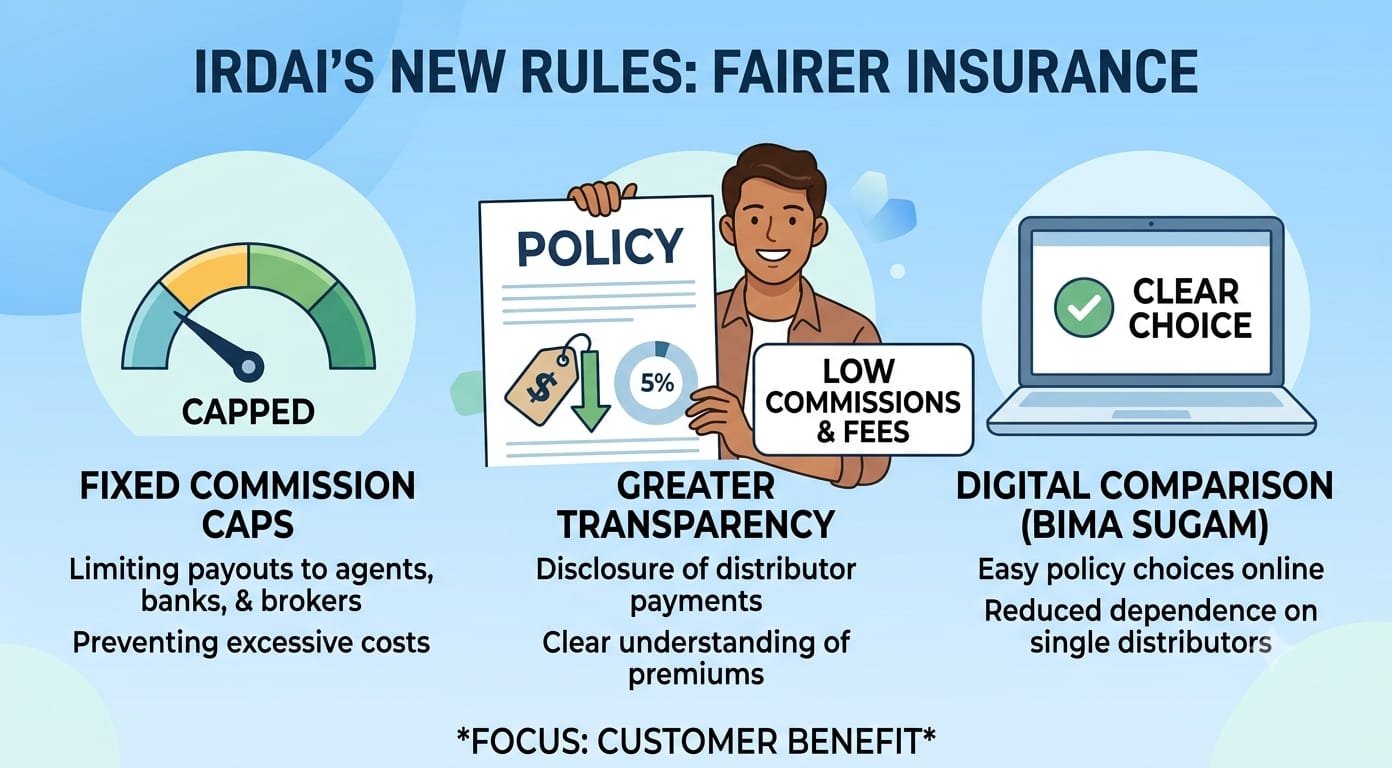
IRDAI’s consultation paper released on September 23, 2026, proposes bringing back hard commission limits. For new-vehicle third-party motor insurance, commission for distribution entities could become zero. For own-damage and related covers, the proposed ceiling is 5% for distribution entities. The regulator also wants technology, awareness and other connected expenses to be included within the overall limit so that companies cannot bypass the rules by shifting commissions into other forms of payment.
The proposed changes also target insurance sold through banks and non-banking finance companies. Banks working with several insurers received average payouts of around 33%, with some arrangements reaching 72%. NBFC payouts averaged about 42%, and much of their business was linked to credit-life insurance attached to loans. Borrowers often do not know how much of their premium is being paid to the lender. Greater disclosure and limits could make loan-linked insurance more transparent and reduce forced or unsuitable sales.
Bima Sugam is expected to become an important part of this change. The digital platform is intended to help customers compare policies from different insurers, with the platform fee reportedly limited to around 5% to 7%. This could reduce dependence on a single dealer, bank or broker and give policyholders a clearer view of prices, benefits and exclusions.
The reform is not simply aimed at cutting commissions. IRDAI has proposed linking payouts to the complexity of a product and the effort required to sell and service it. It has also suggested lower expense limits for insurers, better disclosure and action against mis-selling. The transition is likely to be gradual, with major changes proposed by FY28.
The central idea is simple: incentives should reward genuine advice and long-term service, not merely the sale of an expensive policy. If implemented carefully, the reforms could reduce hidden costs, improve customer choice and make insurance more trustworthy.
The challenge will be protecting small agents while ensuring that banks, brokers and large distributors do not gain more from a policy than the person who actually needs protection.

