
Rural India’s demand for vehicles remained stronger than expected in August 2026, despite weak and uneven monsoon rainfall. Data from the Federation of Automobile Dealers Associations showed that total automobile retail sales reached a record 24,23,201 units.
Sales grew 17.51% compared with August last year, although they declined 6.48% from July because of the seasonal monsoon slowdown and changes in the festive calendar. The stronger rural performance suggests that villages and small towns are continuing to support India’s automobile market even when rainfall creates pressure on farming activity and household spending.
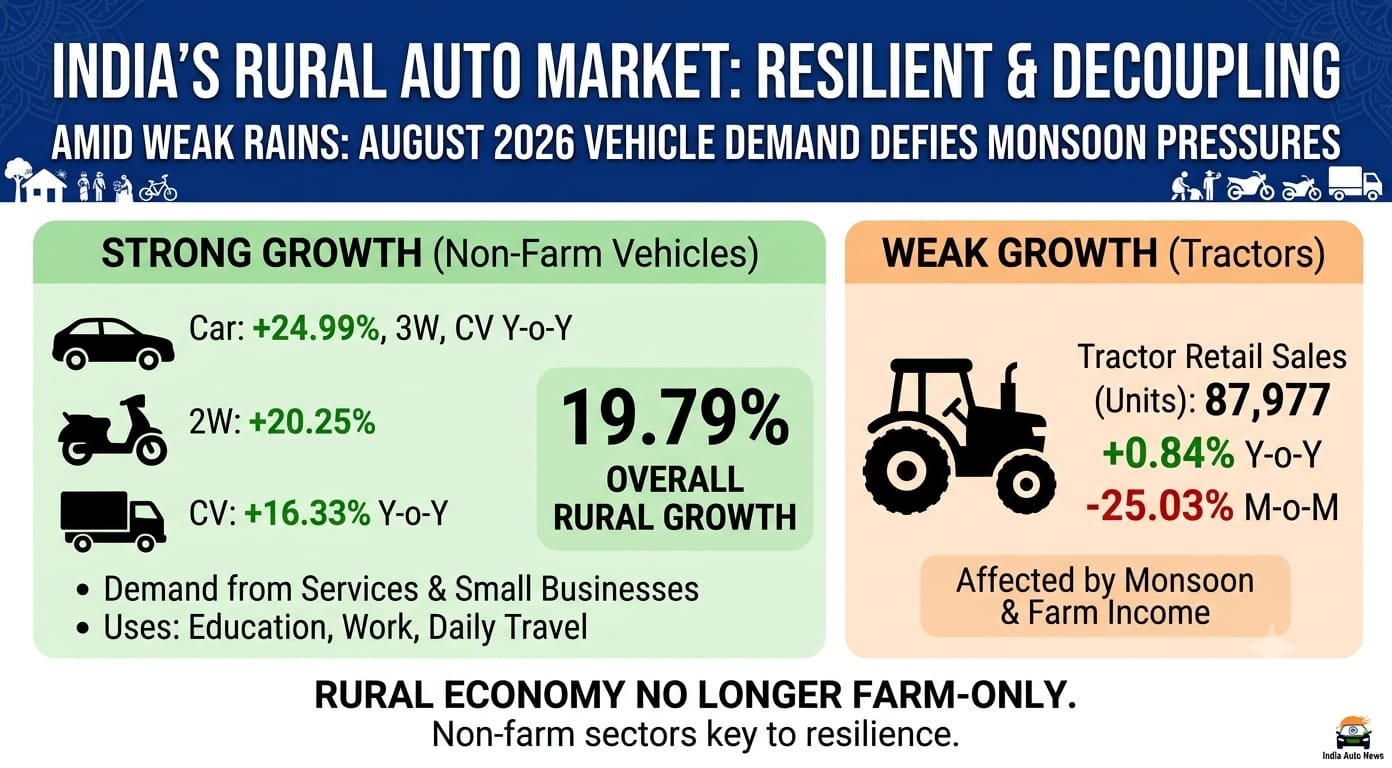
Rural vehicle retail sales grew 19.79% year-on-year, compared with 15.17% growth in urban markets. Rural passenger vehicle sales increased 24.99%, far ahead of the 10.93% growth recorded in urban areas.
Commercial vehicle sales in rural markets rose 16.33%, while rural three-wheeler sales increased 23.95%, even as urban three-wheeler sales declined. Rural two-wheeler sales also grew 20.25%, slightly higher than the 19.07% increase in urban markets.
These numbers show that demand for mobility remains strong in villages and small towns, where motorcycles, scooters, three-wheelers and commercial vehicles are used for farming, local business, education, work and daily travel.
The effect of weak rainfall was most visible in the tractor segment. Tractor retail sales stood at 87,977 units in August, recording only 0.84% year-on-year growth and falling 25.03% from July.
The all-India rainfall deficit widened to around 13%, while 14 states received less rainfall than normal. In some regions, heavy rainfall also affected dealership visits and vehicle registrations. Since tractors are closely connected with farming activity, sowing, crop conditions and farm income, the segment remains more sensitive to changes in the monsoon.
At the same time, the performance of other rural vehicle categories suggests that the rural economy is no longer dependent only on farm income. Goods transportation, construction, local employment, small businesses and everyday travel are helping maintain demand.
FADA President Sai Giridhar described this trend as rural demand “decoupling” from the monsoon, with farm-linked vehicle sales facing pressure while the wider rural economy continues to expand. Better crop prices in some regions, government support, welfare payments and higher rural spending may also be helping households maintain cash flow and continue purchasing vehicles.
The August data further showed that three-wheeler sales reached 1,22,281 units, rising 8.64% year-on-year and recording their best-ever August performance. Wheeled construction equipment sales increased 31.45% to 5,166 units, indicating continued activity in infrastructure and construction.
These purchases create business for dealerships, transport operators, finance companies, repair centres, spare-parts suppliers and manufacturers, thereby supporting employment and local incomes beyond the automobile sector.
The outlook, however, remains linked to rainfall, crop production and farm earnings. If dry conditions continue, tractor demand may face further pressure. Higher fuel prices, vehicle costs and loan rates could also influence future purchases.
For now, rural India’s automobile market remains resilient. Strong demand for passenger vehicles, two-wheelers, three-wheelers and commercial vehicles shows that villages and smaller towns continue to play a major role in driving India’s consumer economy, even as the weak monsoon creates challenges for the farming sector.

