
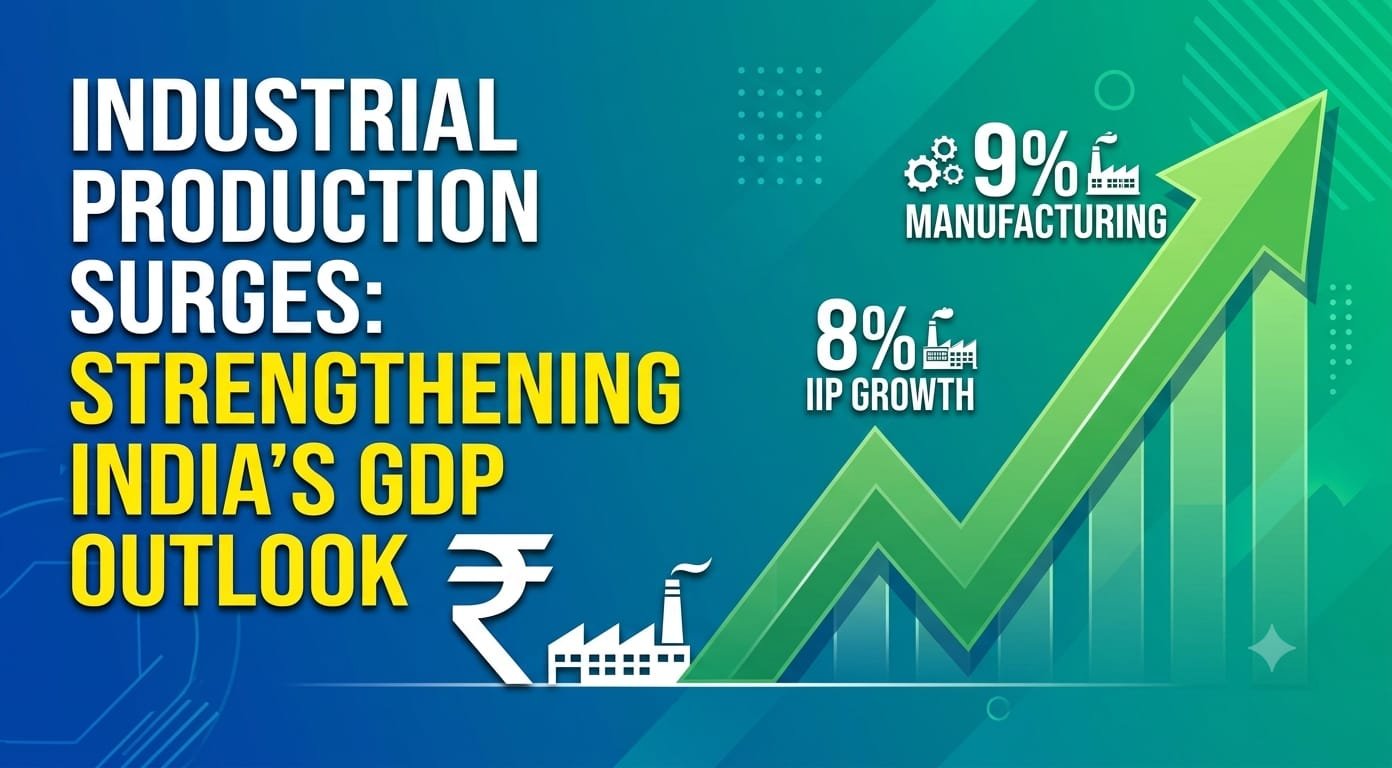
India’s latest economic data has provided an important answer to the debate around whether economic activity weakened sharply after June. The August Index of Industrial Production, or IIP, increased by 8% compared with the same month last year.
Manufacturing, which accounts for nearly three-fourths of the industrial index, grew by 9%. These numbers suggest that India’s economy continued to remain active even after the strong performance recorded in June.
The data becomes significant because the first quarter GDP debate had established the fact that India’s growth was on track. . India’s real GDP had grown by 7.8% in the April-June quarter of 2026-27.
Industrial output for the month of August along with exports, bank lending and manufacturing activity together indicate that the growth story has extended beyond first quarter.
At the same time, the picture is not completely free of concerns. The final HSBC India Manufacturing PMI for August stood at 52.8, lower than July’s 53.5 and slightly below the flash estimate of 52.9.
A flash PMI is an early estimate based on partial survey responses, while the final number is calculated after receiving more responses.
Therefore, the difference between 52.9 and 52.8 does not change the larger message- manufacturing was still expanding, but at a slow pace. A reading above 50 indicates expansion, while a number below 50 signals contraction.
The contrast between the IIP and PMI figures needs to be understood carefully. IIP measures actual industrial production, while PMI tracks business conditions such as new orders, output, employment and supplier deliveries. Both indicators measure different aspects of the economy.
August’s 8% IIP growth was helped by a favourable base effect because production had remained weak in August 2025 amid inventory adjustments before GST rate changes. In sequential terms, industrial output was 1.8% lower than July and manufacturing production fell 1.4%.
The composition of growth also matters. Consumer durables grew 11.1%, capital goods 16.9% and intermediate goods 13.7%. Electrical equipment and motor vehicles recorded particularly strong growth of 30.9% and 25.2%.
However, consumer non-durables grew only 2.1% in August and just 1.2% during April-August. This suggests that investment and selected big-ticket purchases are stronger than everyday household consumption.
The festive season will therefore become an important test. Higher demand could support production and help the economy maintain growth of 7-8%. But rising prices of electronics, metals, memory chips and freight may restrict household purchases. India’s economic story is consequently neither a collapse nor an effortless boom.
The data points to resilience, improving industrial capacity and continued expansion, but also warns that mass consumption must strengthen for growth to become broader and more durable.

