
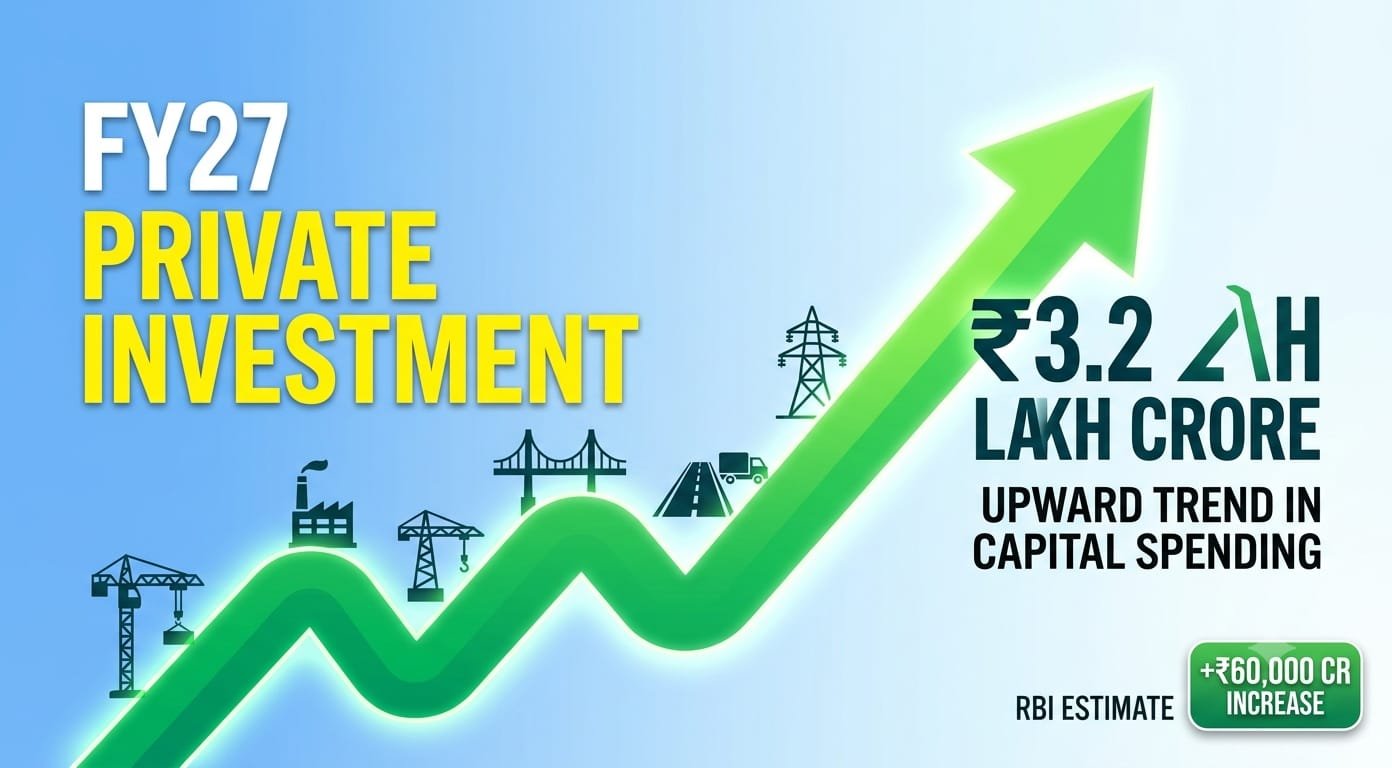
India’s private corporate sector may increase its capital spending to around ₹3.2 lakh crore in the financial year 2026-27. The estimate has been prepared on the basis of projects already in the investment pipeline.
It indicates that private companies continue to expand factories, improve infrastructure and create fresh production capacity, even as uncertainty remains in the global economy.
The expected investment is higher than the comparable capital expenditure of ₹2.6 lakh crore estimated for 2025-26. In simple terms, the proposed spending could rise by nearly ₹60,000 crore in one year. Such an increase is important because private investment supports construction, manufacturing, transport, power, employment and demand for goods and services across the economy.
The estimate covers projects financed through banks and financial institutions, external commercial borrowings and initial public offerings. These three sources provide a broad picture of how companies are arranging funds for new projects and expansion plans.
However, the estimate should not be treated as a final figure because complete information about projects that may receive approval during FY27 is not yet available. The actual investment could change as companies sanction new projects or delay existing plans.
The investment pipeline showed improvement during the previous financial year as well. Private companies increased their project intentions, suggesting that business confidence has gradually strengthened. Better demand, improved access to finance and the need to expand production capacity appear to be supporting this trend.
Infrastructure remains the biggest area of private investment. It accounted for 54.2 per cent of the total sanctioned project cost during FY26. This includes areas such as roads, transport, power, logistics and other facilities required for economic activity. Greater infrastructure spending can also help reduce business costs and improve the movement of goods across the country.
Another important feature is the strong share of greenfield projects. These are completely new projects rather than expansions of existing facilities. Greenfield projects accounted for nearly 89.2 per cent of the total sanctioned project cost in FY26. This suggests that companies are not only upgrading current operations but are also preparing to build new production bases.
The outlook remains positive, but global developments may affect investment decisions. Changes in energy prices, international trade conditions, interest rates and geopolitical tensions could influence the pace at which projects move forward. Even with these risks, the projected ₹3.2 lakh crore capex shows that India’s private sector may remain an important driver of growth in FY27.

