
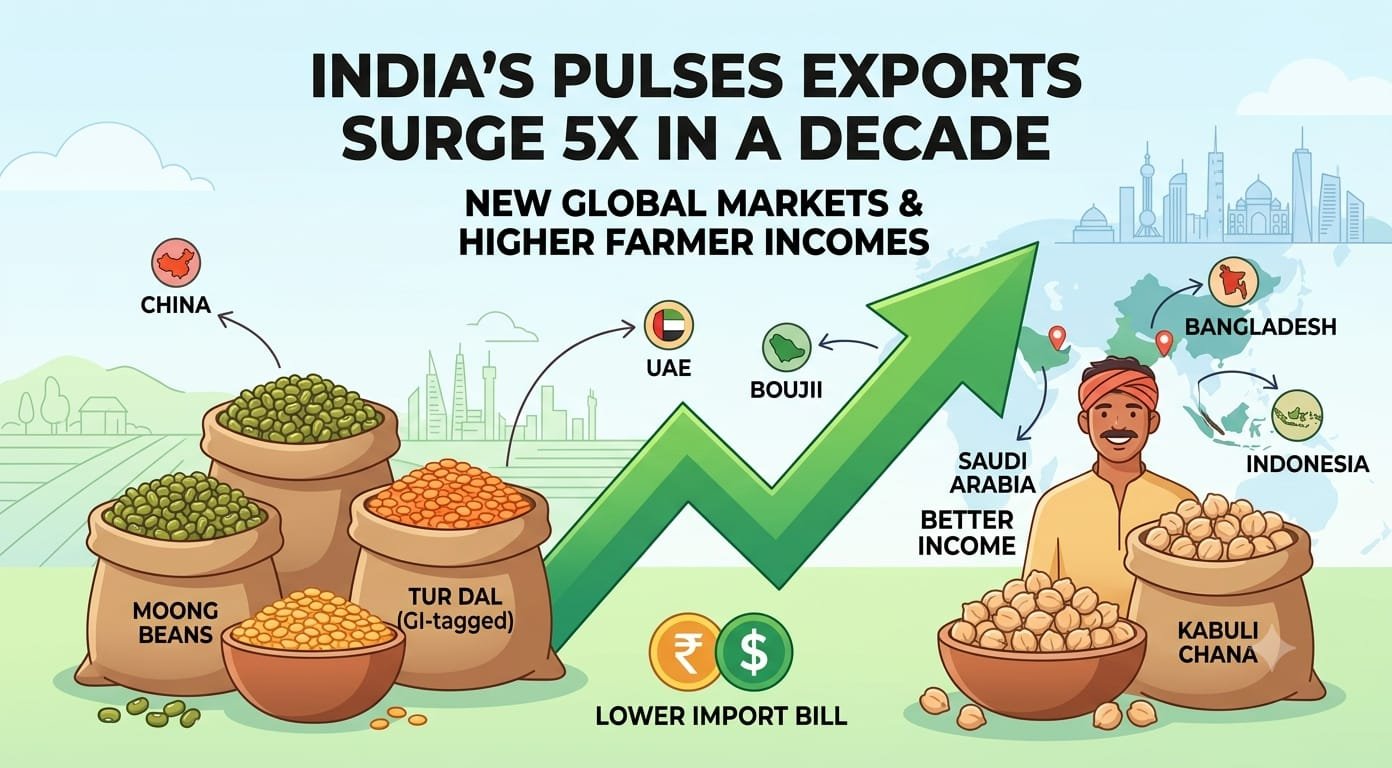
India’s story in pulses is no longer just about feeding its own people; it is increasingly about feeding the world while earning better returns for its farmers. Over the past ten years, the country’s pulses exports have risen five-fold in both value and volume, turning a traditionally import-dependent sector into a promising export avenue.
In the April–July window of the current financial year alone, pulses shipments jumped 45% in value to $452.27 million and 59% in volume to over 4.94 lakh tonnes compared with the same period last year. This momentum follows a trend where annual exports crossed one million tonnes and came close to the $1 billion mark in 2025–26.
A key highlight in this rise has been the growing appetite for premium, geographically indicated (GI) Indian pulses. Kalaburgi (Gulbarga) tur dal from Karnataka, known for its distinct taste and quality, recently made its way to the Maldives market.
Such GI-tagged products fetch farmers more than 30% higher prices in international markets compared to domestic sales, according to Union Commerce Minister Piyush Goyal. This shift is opening doors for small and marginal farmers to access global buyers directly, improving realisations without needing heavy processing or branding overheads.
The list of countries buying Indian pulses reads like a map of India’s deepening trade ties. China emerged as the largest buyer in 2025–26, followed by the United Arab Emirates, Bangladesh, Saudi Arabia, and Indonesia. Moong beans, in which India is self-sufficient, have seen particularly strong demand from China, while kabuli chana, tur dal, and lentils are finding steady buyers across the Middle East and South Asia.
Processed pulses are also part of this mix, allowing exporters to capture higher value and offset some of the foreign exchange spent on importing around six million tonnes of pulses annually to meet domestic needs.
Industry voices see this as a turning point. The India Pulses and Grains Association (IPGA) has called for a more favourable export policy, including incentives that could help India become a consistent global supplier in the coming years.
With overseas demand rising and domestic production holding firm in crops like moong, there is a case for calibrated liberalisation that balances local availability with export gains. For now, the data suggests that pulses are moving from being a vulnerability in India’s food basket to a strength in its agricultural trade story.
What makes this shift relatable is its human angle. Every tonne of tur dal or moong bean shipped abroad translates into better prices for farming households, more working days in rural processing units, and a smaller import bill for the nation.
As global buyers seek quality and traceability, India’s GI-tagged and region-specific pulses offer a natural edge. If policy support matches this market momentum, the next decade could see pulses not just as a staple on Indian plates but as a trusted Indian brand on tables from Dhaka to Dubai.

