
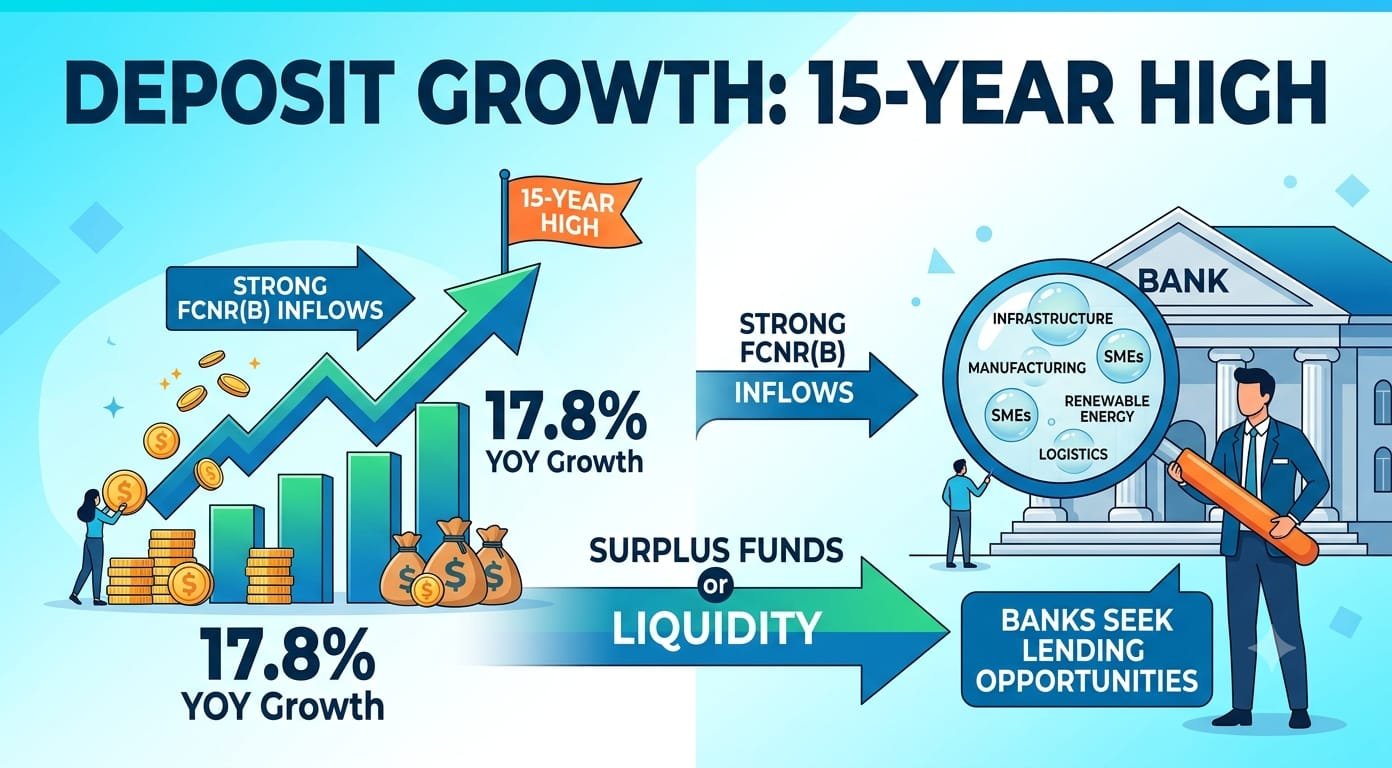
India’s banking sector is entering a new phase as deposit growth reaches its highest level in nearly 15 years. Deposits increased by 17.8% in the year ending August 2026, supported mainly by strong inflows into foreign currency non-resident bank deposits, commonly known as FCNR(B) deposits. The sharp rise has created a comfortable liquidity position for banks, but it has also brought a fresh challenge: finding suitable borrowers for the additional funds.
The recent growth is closely linked with the Reserve Bank of India’s decision to relax certain rules for FCNR(B) deposits. The change encouraged non-resident Indians to place more money with Indian banks. As a result, FCNR(B) deposits rose by around 12.4% between July 2025 and July 2026, compared with growth of less than 5% in the previous year. This sudden rise has helped banks strengthen their deposit base and improve their ability to lend.
However, the lending picture remains less active than the deposit picture. Bank credit growth stood at about 11.4% in August, while deposit growth was much higher. This difference means banks are receiving money faster than they are lending it. In simple terms, more funds are entering the banking system, but demand for loans is not increasing at the same pace.
Corporate borrowing appears to be the main area of weakness. Many large companies are still cautious about taking fresh loans because business conditions remain uncertain in several industries. Some companies are also relying on internal cash reserves, bond markets and other sources of finance instead of depending fully on bank loans. This has reduced the immediate need for traditional corporate credit.
The trend is visible in the difference between personal and business borrowing. Personal loans, including housing loans and consumer credit, have remained comparatively stronger. Corporate credit, however, has shown slower growth. Banks are therefore looking at sectors such as infrastructure, manufacturing, renewable energy, logistics and smaller businesses to improve loan demand.
The Reserve Bank has also introduced measures to manage the extra liquidity. A recent swap window worth around ₹1.43 lakh crore allowed banks to exchange dollar funds for rupees. This action supplied additional rupee liquidity to the financial system. Another swap facility of nearly ₹33 billion was linked to foreign currency inflows. Such steps indicate that the central bank is carefully balancing foreign money, domestic liquidity and credit conditions.
For banks, excess liquidity can be helpful but may also create pressure. When large amounts of money remain unused, banks may need to reduce lending rates or offer more attractive terms to bring in borrowers. This can lower their interest margins. At the same time, aggressive lending without proper checks may increase the risk of weak loan quality in the future.
The situation also reflects changing conditions in the wider economy. Deposit growth has improved confidence in the banking system, while stronger personal borrowing suggests that household demand remains active. Yet corporate investment has not fully recovered, which is keeping business loan demand under control.
The coming months will show whether banks can convert their surplus deposits into healthy loans. If investment activity improves, the additional funds may support economic expansion. If companies remain cautious, banks could continue facing the difficult task of managing large deposits while waiting for stronger and safer lending opportunities.

