
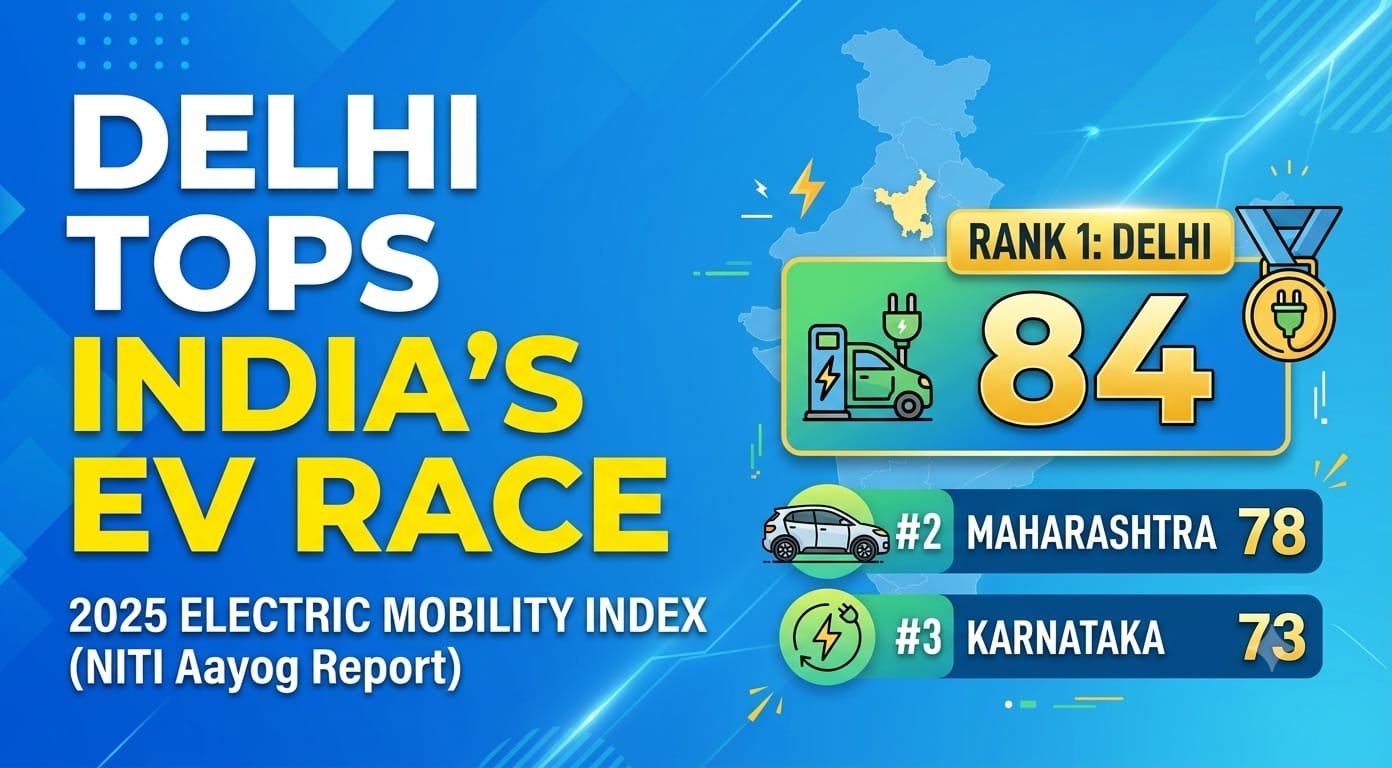
India’s shift toward electric vehicles has taken a clear shape, and the latest report from NITI Aayog puts numbers and names to that story. The India Electric Mobility Index (IEMI) 2025 ranks all 36 states and union territories on how well they are building an ecosystem for electric transport from policy to charging points to innovation.
Delhi has emerged as the top performer with a score of 84 out of 100, followed by Maharashtra at 78 and Karnataka at 73. These three stand out not just for having policies on paper, but for turning those policies into real-world results on the road.
The index is built around three big themes: how fast transport is getting electrified, how ready the charging infrastructure is, and how strong the research and innovation scene looks in each region. Transport electrification carries the heaviest weight—50%—because it directly measures how many people are actually buying and using EVs, and how much support they are getting.
In this category, only Delhi, Chandigarh, and Maharashtra qualified as “top performers,” showing that consumer acceptance and market momentum are still concentrated in a few places. Charging infrastructure, which accounts for 30% of the score, tells a slightly different story.
Here, Karnataka leads the country with a score of 97, thanks to a high charger-to-vehicle ratio, supportive subsidies, and clear building rules for installing charging points. Goa and Maharashtra also scored very high in this area, reflecting a more even spread of readiness when it comes to hardware on the ground.
Delhi’s overall lead comes from its exceptional performance in the third theme: EV research and innovation. With a score of 94 in this category, the capital scored highest for the number of EV startups, research initiatives, and patents filed.
This suggests that Delhi is not just adopting EVs but also helping create the ideas and businesses that will drive the next wave of electric mobility. Meanwhile, states like Madhya Pradesh showed remarkable improvement, jumping from 23rd place in 2024 to 7th in 2025, proving that focused efforts can quickly change a state’s position in the rankings.
The report also groups states into performance bands. Eight large states Tamil Nadu, Madhya Pradesh, Odisha, Andhra Pradesh, Telangana, Haryana, Rajasthan, and Uttar Pradesh are classified as “frontrunners,” scoring between 50 and 64. Another seven, including Gujarat, Punjab, Kerala, and West Bengal, are labeled “emerging performers,” with scores between 35 and 49.
This classification makes it clear that while many states have laid the policy foundation, the pace of actual implementation varies widely. The median score across all regions is just 40, and the full range stretches from 10 to 84, indicating that some areas are still in the very early stages of their EV journey.
Why does this matter? Road transport in India accounts for about 12% of the country’s energy-related carbon dioxide emissions. Shifting to electric vehicles is one of the most direct ways to cut that down while also reducing dependence on imported oil.
The numbers show the transition is gaining speed: EVs made up 8.25% of all vehicles registered in 2025–26, up from just 0.5% in 2018. In that year alone, nearly 2.5 million new EVs were added to Indian roads, a 25% jump from the previous year. Two-wheelers led the charge with 1.3 million units, followed by electric three-wheelers and a growing share of electric cars and commercial vehicles. E-buses, too, have seen strong adoption since 2021, especially in urban public transport.
Yet the report also points to persistent challenges. Limited charging infrastructure, scattered settlements in some regions, and a still-developing innovation ecosystem are holding back faster progress in many states.
The gap between policy and implementation remains wide in several places. With foundational EV policies now in place across most of the country, the next phase must focus on execution making sure charging points are where people need them, incentives reach the right users, and local industries are supported to grow.
The global context adds urgency. In 2025, electric cars made up about one-tenth of new car sales in the US, more than a quarter in the European Union, and over half in China. India’s 8.25% EV share shows room to grow, but also real momentum. The IEMI 2025 doesn’t just rank states, it offers a roadmap. For citizens, it explains why some cities feel more EV-ready than others. For policymakers, it highlights where to double down.
And for businesses, it signals where the next opportunities in clean transport will emerge. The India Electric Mobility Index 2025 shows Delhi leading the EV race, but wide gaps between states reveal uneven progress. With transport a major source of emissions, shifting to electric vehicles is both an environmental and economic necessity.
EV adoption has jumped from 0.5% to over 8% in under a decade, yet many states remain far behind. The real challenge now is turning policy into action building charging networks, delivering incentives, and supporting local industry. If states learn from top performers, India can set a global example for clean, inclusive mobility growth. The electric future is already here in parts of India; the task now is to make it everywhere.

