
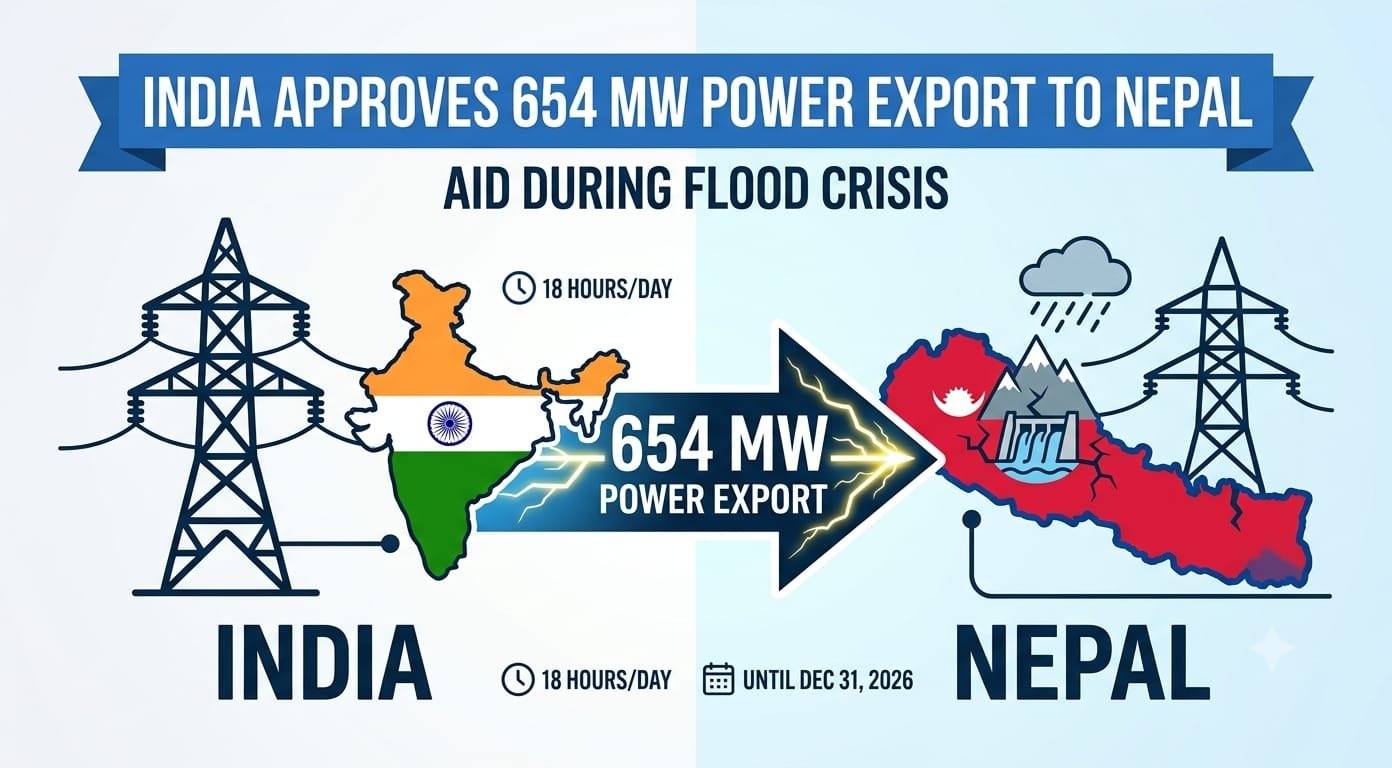
India has approved the export of up to 654 megawatts of electricity to Nepal as the neighbouring country faces a serious power shortage after devastating floods damaged several hydropower projects and transmission facilities. The decision is expected to provide immediate support to Nepal during a difficult period and strengthen the long-standing energy relationship between the two countries.
According to the approval issued by India’s Ministry of Power, electricity will be supplied to the Nepal Electricity Authority for 18 hours every day. The arrangement started on September 13 and will continue until December 31, 2026. Power will be available between midnight and 6 pm, allowing Nepal to meet a large part of its daily electricity requirement during the coming months.
The approved supply has been divided between two important transmission routes. India can export up to 600 MW through the Muzaffarpur-Dhalkebar 400 kilovolt double-circuit transmission line. An additional 54 MW can be supplied through the Tanakpur-Mahendranagar 132 kilovolt single-circuit line. Together, these two routes can carry up to 654 MW of electricity to Nepal.
The decision has become necessary because Nepal’s hydropower sector suffered extensive damage after flash floods in the Trishuli and Lhende Khola river basins on August 26. The floods damaged local infrastructure, affected power stations and disrupted electricity transmission. The damage reduced Nepal’s available generation capacity by around 550 MW, creating an urgent need for additional electricity imports.
Nepal depends heavily on hydropower for its electricity needs. Under normal conditions, rivers and hydropower plants provide a major share of the country’s power. However, when floods damage generating stations, roads, bridges and transmission lines, electricity production can fall sharply. Repairing such facilities can take considerable time, particularly in mountainous regions where access is difficult and weather conditions remain challenging.
The additional electricity from India is therefore expected to help Nepal avoid a deeper power shortage. It can support homes, businesses, hospitals, offices and industries while damaged hydropower projects are gradually restored. Reliable electricity is especially important during the winter months, when demand can rise and domestic generation may remain under pressure.
The arrangement also reflects the growing importance of energy cooperation between India and Nepal. The two countries already share power transmission links, and electricity trade has become an important part of their bilateral relationship. India has been supporting Nepal’s power requirements through cross-border transmission networks, while Nepal has also been working to expand its electricity exports to India when domestic generation is higher.
The latest approval is meant to address Nepal’s immediate requirement rather than create a permanent arrangement. The Ministry of Power has said that the quantity of electricity to be exported from January 2027 will be reviewed in December 2026. This means the supply level could be changed depending on the condition of Nepal’s hydropower facilities, domestic electricity production and future demand.
The decision is unlikely to affect electricity supplies within India, according to a power ministry official quoted by Business Standard. The official said that the reduction in hydropower flows from Nepal would not have any significant impact on India’s domestic electricity availability. This is important because India is providing support to Nepal without creating a major risk to its own power supply.
The export of 654 MW represents more than a commercial transaction. It demonstrates how connected the energy systems of neighbouring countries can become during a crisis. When floods or other natural disasters disrupt generation in one country, cross-border transmission networks can help reduce the impact on ordinary people and essential services.
For Nepal, the immediate priority will be restoring damaged hydropower plants and transmission infrastructure. Until that work is completed, electricity imports from India can help keep the country’s economy and daily life running. For India, the arrangement offers an opportunity to deepen regional energy cooperation and provide practical assistance to a close neighbour at a critical time.

