
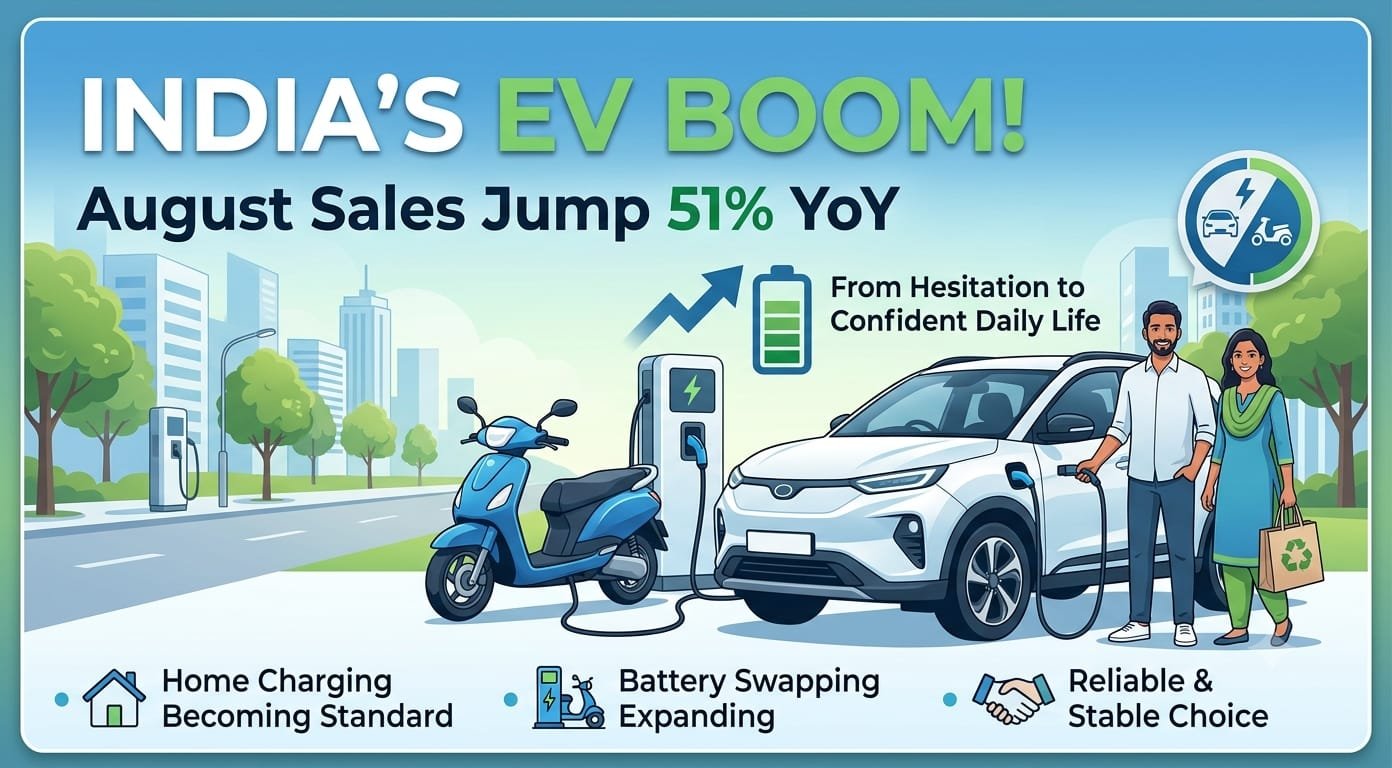
India’s electric vehicle market recorded a striking 51% year-on-year growth in August 2026, reflecting a broader shift in how people perceive and use electric mobility. While sales dipped slightly compared to July due to regional transport office closures during festivals like Onam and Rakshabandhan, the underlying demand remained strong.
Electric car registrations stood at 29,687 units, and electric two-wheelers sold by the top five listed companies reached 160,000 units, marking a 69% annual increase. This surge was largely powered by companies like Bajaj Auto and TVS Motor, which saw their electric two-wheeler sales jump by 235% and 91%, respectively.
Even though Ola Electric reported a 29% year-on-year decline, the overall sentiment across the sector stayed positive, with major players like Tata Motors, Mahindra & Mahindra, and JSW MG Motor working to expand production capacity to meet sustained demand.
A key reason behind this confidence is the rapid improvement in battery-related infrastructure and convenience. Just 1.5 to 2 years ago, many potential buyers held back due to worries about charging access, battery life, and service support.
Those apprehensions have now largely eased. Batteries are being integrated into everyday systems more seamlessly, whether it’s swappable battery stations for two-wheelers in urban neighbourhoods, home charging setups becoming standard in new housing projects, or public charging points appearing along highways and in city centres.
This ecosystem shift has turned EVs from a novel experiment into a stable, practical choice. People no longer see electric vehicles as risky or inconvenient; instead, they view them as a normal part of daily commuting, shopping trips, and even inter-city travel. The perception has moved from “Will it work?” to “It just works.”
This transformation is also visible in the numbers. Electric two-wheeler penetration held steady at 10.7% in August, well above last year’s levels, even as monthly fluctuations occurred. Tata Motors remained the top EV carmaker with 12,984 registrations, followed by Mahindra & Mahindra at 6,367 and JSW MG Motor at 4,568.
Behind these figures lies a quiet revolution in how energy is stored, delivered, and used. Battery technology has become more reliable, costs have come down through local manufacturing and scale, and financing options have made EVs accessible to a wider audience.
At the same time, government incentives, state-level policies, and private investments have created a supportive environment where charging is no longer a hurdle but a routine part of life.
What makes this moment different from earlier EV pushes is the sense of stability. Two years ago, the market was volatile; sales would spike and then drop, often tied to subsidy announcements or short-term promotions. Now, growth is driven by genuine consumer choice.
Families are buying electric scooters for school runs, delivery partners are switching to electric bikes for lower running costs, and urban professionals are choosing electric cars for their quiet rides and lower maintenance. The narrative has shifted from “saving the planet” to “saving time, money, and hassle.” This practical appeal is what’s sustaining the momentum even when monthly numbers dip slightly due to external factors like holidays or supply chain adjustments.
Looking ahead, the trajectory appears robust. Companies are commissioning new greenfield plants, expanding assembly lines, and investing in battery recycling and second-life applications. This signals long-term commitment, not just short-term gains.

