
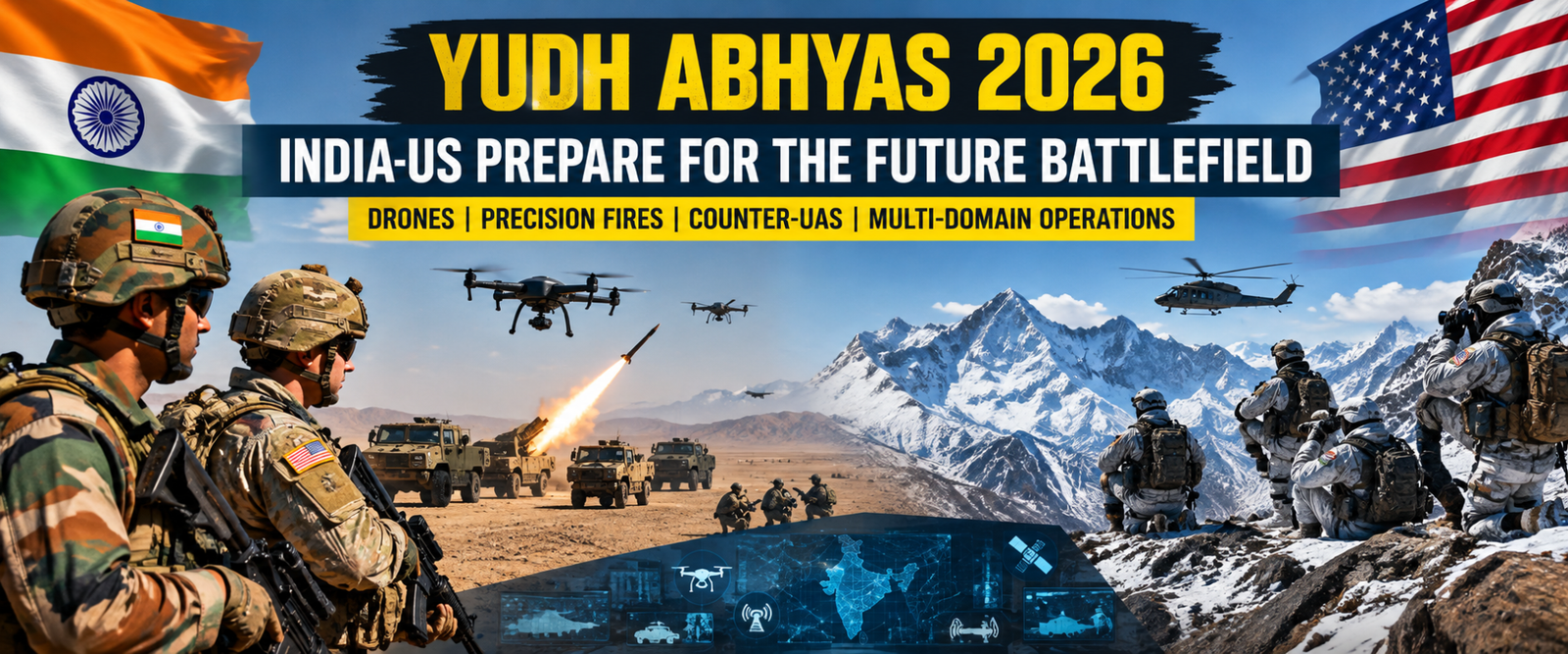
The latest edition of Exercise Yudh Abhyas has moved beyond the traditional format of a bilateral military drill. Conducted at the Mahajan Field Firing Range in Rajasthan and Auli in Uttarakhand, the 22nd edition brought Indian and US troops together across desert and high-altitude environments, combining conventional firepower with drones, counter-unmanned systems, air assault and multi-domain operations. The exercise concluded on 28 September after nearly three weeks of joint training.
The significance of Yudh Abhyas 2026 lies less in the number of weapons displayed and more in how the two militaries are adapting to a battlefield increasingly shaped by unmanned systems, precision fires, electronic warfare and networked operations.
From conventional exercises to multi-domain warfare, the training saw incorporation of drones, autonomous systems and emerging technologies. Around 600 personnel from each country participated in the exercise. Training included Integrated Battle Groups, mountain and semi-mountainous operations, cold-weather warfare, brigade-level command-post exercises and counter-UAS activities.This reflects a wider transformation in modern warfare. Armies are no longer preparing only for engagements involving infantry, tanks and artillery. Small unmanned aircraft can provide persistent surveillance, identify targets and attack personnel and equipment, while electronic warfare and networked command systems can influence how quickly a force detects and responds to threats.
The exercise saw a fine example of how firepower meets technology. The Mahajan field training phase of the exercise offered a visible demonstration of this approach. Indian systems including the Pinaka multiple rocket launcher, M777 ultra-light howitzer, Dhanush artillery system, L70 air-defence guns, Swathi weapon-locating radar and AH-64E Apache helicopters operated alongside US capabilities including HIMARS and the M-LIDS counter-UAS system. The significance of such training is not simply that different weapons were deployed together. Interoperability requires common procedures for identifying targets, sharing information, coordinating fires and conducting operations while using different equipment and following separate national command structures.
A joint live-fire demonstration on 24 September brought artillery, air defence, counter-drone and aviation capabilities into the same training environment. Indian and US personnel rehearsed the coordination required to move from target detection to engagement. For India, the exercise also provided an opportunity to demonstrate the growing role of indigenous systems such as Pinaka, Dhanush and Swathi alongside American platforms.
One of the most contemporary elements of Yudh Abhyas was its emphasis on countering unmanned systems. The US Army deployed the Mobile Low, Slow, Small Unmanned Aircraft Integrated Defeat System (M-LIDS). The system combines detection, command-and-control and kinetic and non-kinetic means of defeating small unmanned aircraft. Indian personnel received familiarisation with the system and exchanged counter-UAS tactics and procedures with their US counterparts.
The emphasis is significant because the proliferation of inexpensive drones has altered the economics of battlefield surveillance and attack. Large formations, artillery positions and logistics nodes can now be exposed to persistent observation by relatively low-cost platforms.
The two-location format added another dimension to the exercise. At Auli, troops trained in mountain and cold-weather conditions, including small-unit tactics, indoor firing, rappelling and other high-altitude activities. Indian and US soldiers also conducted a combined air-assault operation involving the Indian Army’s Dhruv Mk III helicopter.
At Mahajan firing range, the emphasis was on desert warfare, artillery, long-range fires, aviation and counter-drone capabilities. Training across contrasting environments is important because interoperability cannot be established through equipment demonstrations alone. Troops need to understand how their partners plan, communicate and make decisions when terrain, weather and operational conditions change.
Yudh Abhyas has been conducted since 2004 and has become an established component of India–US military engagement. Its importance now extends beyond the exercise itself. Repeated exercises allow both armies to develop familiarity with each other’s tactics, techniques and procedures. They also create opportunities to identify practical challenges in communications, command coordination and joint planning.
This represents a gradual shift in India–US defence cooperation from platform-based engagement towards greater operational familiarity.
The most important takeaway from Yudh Abhyas 2026 is the changing definition of military readiness. The exercise combined infantry and mountain warfare with precision fires, rocket artillery, helicopters, drones, counter-UAS systems and battlefield surveillance. It also incorporated multi-domain concepts involving areas such as space and cyber operations.
As warfare becomes increasingly shaped by unmanned systems, precision fires, information networks and rapidly changing battlefield conditions, exercises such as Yudh Abhyas provide a practical setting for preparing soldiers for that reality.

