
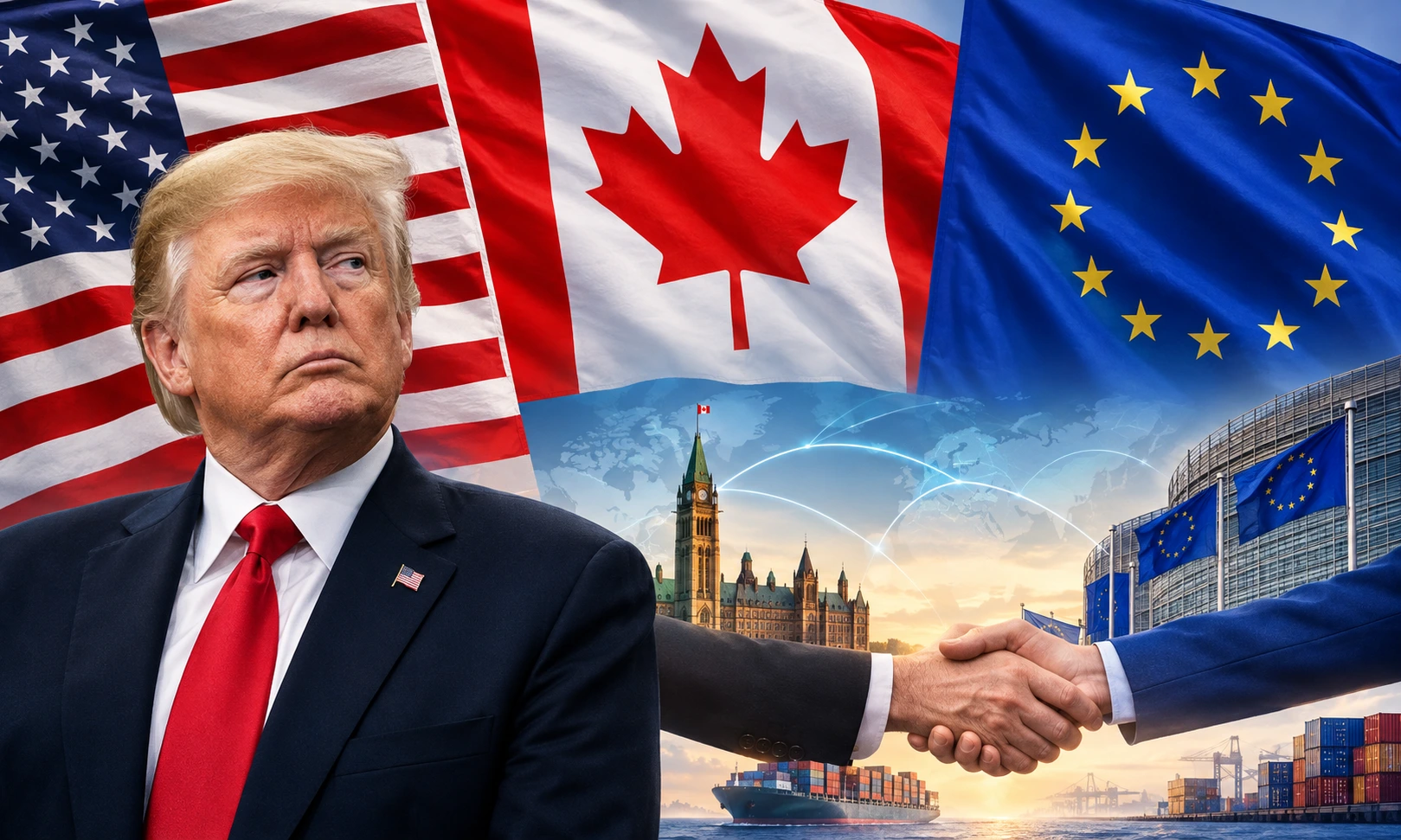
Canada is undergoing a significant foreign-policy and economic recalibration, and the European Union is emerging as one of its most important new partners. At the centre of this shift is a deteriorating relationship between Canada and the United States under President Donald Trump.
Prime Minister Mark Carney’s government is not seeking to replace the US overnight. Still, it is trying to reduce Canada’s dependence on its southern neighbour by building stronger economic, political and security links with the European Union.
The latest development came this week when European Commission President Ursula von der Leyen floated the idea of making Canada the EU’s first associate member. The proposal has no established legal framework yet and would require negotiations among EU member states, but its symbolism is significant. Carney welcomed the idea while addressing the European Parliament in Strasbourg on Thursday, September 17, and called for a comprehensive strategic alliance between Canada and Europe.
Trump’s tariffs changed the equation
For decades, Canada’s economic relationship with the US has been overwhelmingly important. But Trump’s tariff policies and his repeated comments about Canada becoming the “51st state” have encouraged Ottawa to rethink that dependence.
Canada sends the majority of its exports to the US, making it particularly vulnerable to American trade policy. The Trump administration’s use of tariffs has therefore become more than a commercial dispute for Ottawa, it has raised questions about economic sovereignty and strategic dependence. Canadian officials have increasingly argued that the country needs more diversified markets and more resilient supply chains. Canadian PM Carney’s government has consequently set its sights on Europe.
Europe already offers a foundation
This is not a relationship being created from scratch. Canada and the EU already have the Comprehensive Economic and Trade Agreement, or CETA, which has been provisionally applied since 2017. EU-Canada trade in goods and services exceeded €130 billion in 2025, while trade in goods had increased by more than 76% between 2016 and 2025.
In March 2026, Canada and the EU also launched negotiations for a digital trade agreement. Both sides have identified trade diversification, secure supply chains and economic resilience as major priorities.
That gives Ottawa something it desperately needs, an alternative economic relationship that already has institutions and agreements behind it.
The Canada-EU relationship is now moving beyond trade
The Canadian-EU partnership is also expanding into defence, technology, critical minerals, artificial intelligence and energy.
In February this year, Canada signed an agreement allowing it to participate in the EU’s €150-billion SAFE defence procurement instrument. Canada has also been involved in EU defence initiatives through Permanent Structured Cooperation (PESCO).
Carney has proposed deeper cooperation on critical minerals, AI, digital commerce and energy security, including Canada’s potential role as a supplier of LNG and hydrogen to Europe.
This matters because Canada possesses resources that Europe needs, while Europe offers Canada access to a huge advanced market and additional strategic partnerships.
Canada is not joining Europe
There are major limitations to Canada joining the European Union. Associate membership is an undefined concept, and the EU has never previously created such a status for a country. Some European governments have already expressed reservations about the terminology and the practical implications.
Nor can Europe realistically replace the United States immediately. Geography, integrated supply chains, defence cooperation and intelligence links make the US indispensable to Canada.
So Canada’s European pivot is better understood as diversification rather than abandonment of America.
That is where Trump sits at the centre of the story. His tariffs, pressure on Canada and confrontational rhetoric have accelerated a debate that had already begun, whether Canada should remain overwhelmingly dependent on the US or build a broader network of partners.
Ironically, Trump’s attempt to push Canada closer to America may have contributed to Ottawa looking across the pond instead.

