
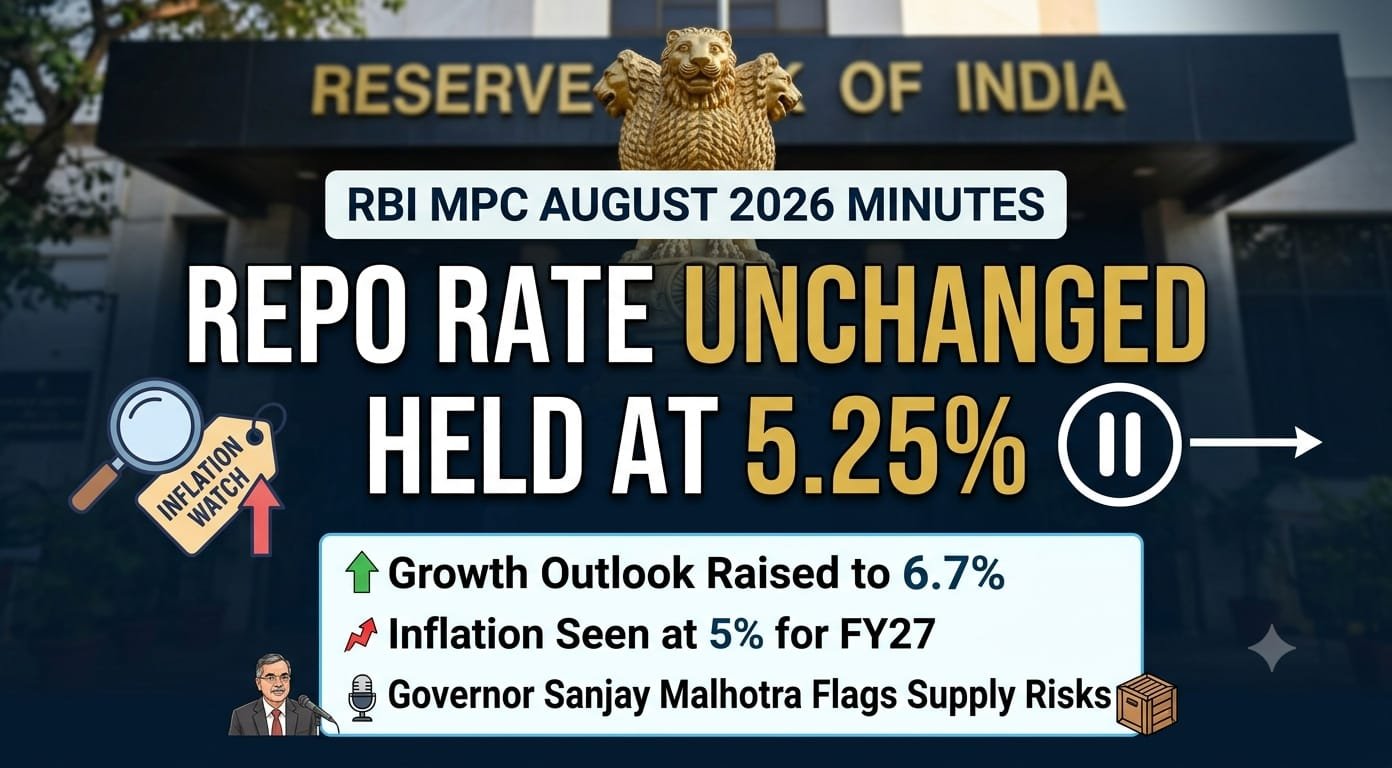
The Reserve Bank of India’s Monetary Policy Committee meeting held in early August 2026 has kept the repo rate unchanged at 5.25 per cent, marking another pause in the Central bank’s rate cycle as officials adopt a wait-and-watch policy on inflation.
The decision came unanimously from the six-member panel chaired by RBI Governor Sanjay Malhotra, with the committee retaining its neutral policy stance while closely monitoring price trends in the coming months. What makes this policy review noteworthy is the careful balance struck between supporting economic growth and containing inflation pressures that have been driven largely by supply-side factors rather than excessive demand. [
The minutes released from the August 5 meeting show Governor Malhotra expressing a preference for waiting until more certainty emerges on the inflation trajectory before considering any recalibration of the policy rate.
The Governor noted that elevated inflation readings at the time were primarily due to supply shocks, particularly in food and fuel segments, with limited signs that price pressures were becoming broad-based across the economy.
This assessment aligns with the RBI’s projection that headline inflation would average 5 per cent for the full financial year 2026-27, with quarterly readings expected at 4.7 per cent in Q2, peaking at 5.9 per cent in Q3, and then moderating to 5.5 per cent in Q4.
Core inflation, which excludes volatile food and fuel items, was projected to remain moderate at around 4.3 per cent, suggesting that underlying demand pressures remained contained.
On the growth front, the MPC marginally raised its real GDP growth forecast for FY27 to 6.7 per cent from the earlier 6.6 per cent, reflecting stronger-than-anticipated domestic economic activity.
This upward revision signals confidence in India’s economic resilience despite global uncertainties including volatile crude oil prices, geopolitical tensions in West Asia, and an uncertain international trade environment.
The neutral policy stance retained by the committee indicates that future rate decisions will remain data-dependent, with officials assessing incoming information on inflation, growth, and global developments before making any policy adjustments.
The supply chain dimension of inflation emerged as a key concern during the discussions. Food prices and fuel costs were identified as the main drivers pushing headline inflation higher, with the monsoon season and El Nino weather patterns flagged as major risks that could affect agricultural output and goods availability.
When supply chains face disruptions, whether from weather events or global commodity price swings, the movement of goods gets affected and availability becomes tighter, which naturally pushes prices upward.
The RBI’s view that inflation pressures were largely supply-driven rather than demand-driven meant that aggressive rate hikes were not seen as the appropriate response, since monetary policy tools work better on demand-side inflation than on supply shocks.
Within the MPC, some members signalled that a rate hike could emerge if inflation peaked higher than expected or if risks materialised on the upside.
Deputy Governor inputs in the minutes suggested that a rate hike case could emerge as inflation approached its Q3 peak of 5.9 per cent. However, the consensus view remained that more clarity was needed on the persistence of inflation prints, the forecast trajectory, and the likely levels to which inflation would normalise before any policy tightening was considered.
This cautious approach reflects the RBI’s commitment to bringing headline inflation in line with its 4 per cent target over the medium term while avoiding premature tightening that could hamper growth momentum.
For households and businesses, the unchanged repo rate means borrowing costs and deposit rates are expected to remain stable in the near term. Home loan EMIs, personal loan rates, and working capital financing costs would not see immediate upward pressure from this policy decision.
At the same time, savers and depositors should not expect significant improvements in fixed deposit rates unless inflation dynamics shift or the RBI changes its stance in future meetings. The stability in rates provides a predictable environment for financial planning, even as inflation remains a concern for household budgets, especially on food and fuel expenses.
Looking ahead, the RBI’s inflation and growth projections suggest a soft landing scenario where price pressures ease after the third quarter while growth remains robust.
The key risks to this outlook include monsoon performance, global crude oil price movements, and the evolution of food supply chains across the country.
If supply-side conditions improve and goods availability normalises, inflation could moderate faster than projected, giving the RBI more room to maintain its accommodative posture.
Conversely, if supply disruptions persist or global commodity prices surge, the case for policy tightening would strengthen, potentially leading to a rate hike in subsequent MPC meetings.
The August 2026 MPC decision thus reflects a calibrated approach where growth support and inflation control are balanced carefully, with the central bank keeping all options open while waiting for more data to emerge on the inflation trajectory and supply chain dynamics.

