
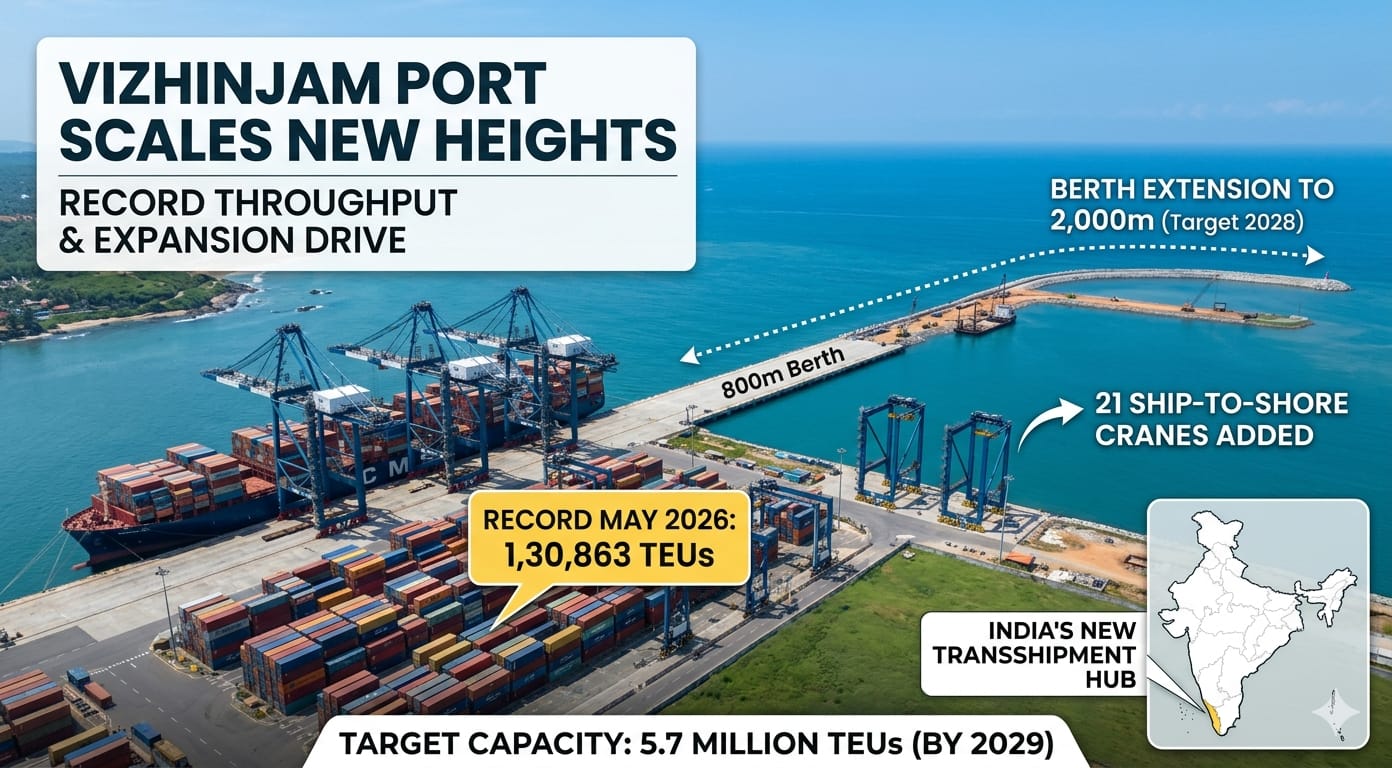
A deep-water terminal in Kerala handles 1,30,863 TEUs in May 2026 and moves ahead with a massive expansion by 2028
Vizhinjam International Seaport in Kerala is moving ahead at a fast pace, and its latest numbers show how quickly the port is growing. In May 2026, the port handled 1,30,863 TEUs, which became its highest monthly throughput so far, even though the terminal was already working beyond its normal stacking capacity.
The interesting part is that this growth has not yet slowed the operation. For the last six months, the port has been handling much more cargo than its designed monthly stacking capacity of 34,000 TEUs, and officials say the movement of goods has remained smooth without major congestion or delay. This shows that the port is not only handling more volume, but also managing it with better planning and coordination.
To keep operations stable, the port has been using extra space in the new EXIM container yard and even the sides of the access road leading to the national highway for temporary stacking. This kind of arrangement helps the terminal continue work while cargo keeps increasing, which is important for any fast-growing port. The phase now underway is meant to turn this pressure into long-term strength.
The expansion plan is a major one. The current 800-metre container berth is being extended to 2,000 metres by December 2028, which would make it one of the longest container berths in the country. The breakwater is also set to grow from 2.96 kilometres to about 4 kilometres, and this will be done through sea reclamation rather than by taking additional land. In simple terms, the port is making room for bigger ships and more of them at the same time.
More equipment is also being added. The plan includes 21 ship-to-shore cranes and 45 yard cranes, which will help the port load and unload containers faster and handle heavier traffic more efficiently. This is important because larger ports are judged not just by size, but by how quickly they can move cargo in and out.
The road and rail links are also part of the larger story. Delays in connectivity projects have slowed the start of EXIM cargo operations, but the Adani Group has completed an interim road link to the NH Bypass and is waiting for approval from the National Highways Authority of India to start using it. Rail connectivity is also progressing, with Konkan Railway expected to build the 9-kilometre link from Karamana to Vizhinjam at an estimated cost of ₹1,500 crore, with completion targeted for 2028.
For Kerala and for India’s shipping sector, this matters beyond one port. Vizhinjam is increasingly being seen as a serious transshipment hub that can reduce dependence on foreign ports for container handling. The larger capacity target of 5.7 million TEUs by 2029 underlines how strongly the project is being positioned for the next stage of maritime trade growth.
In simple terms, Vizhinjam is no longer just a promising new port. It is already setting records, managing pressure well, and preparing for a much bigger role in India’s trade future.

