
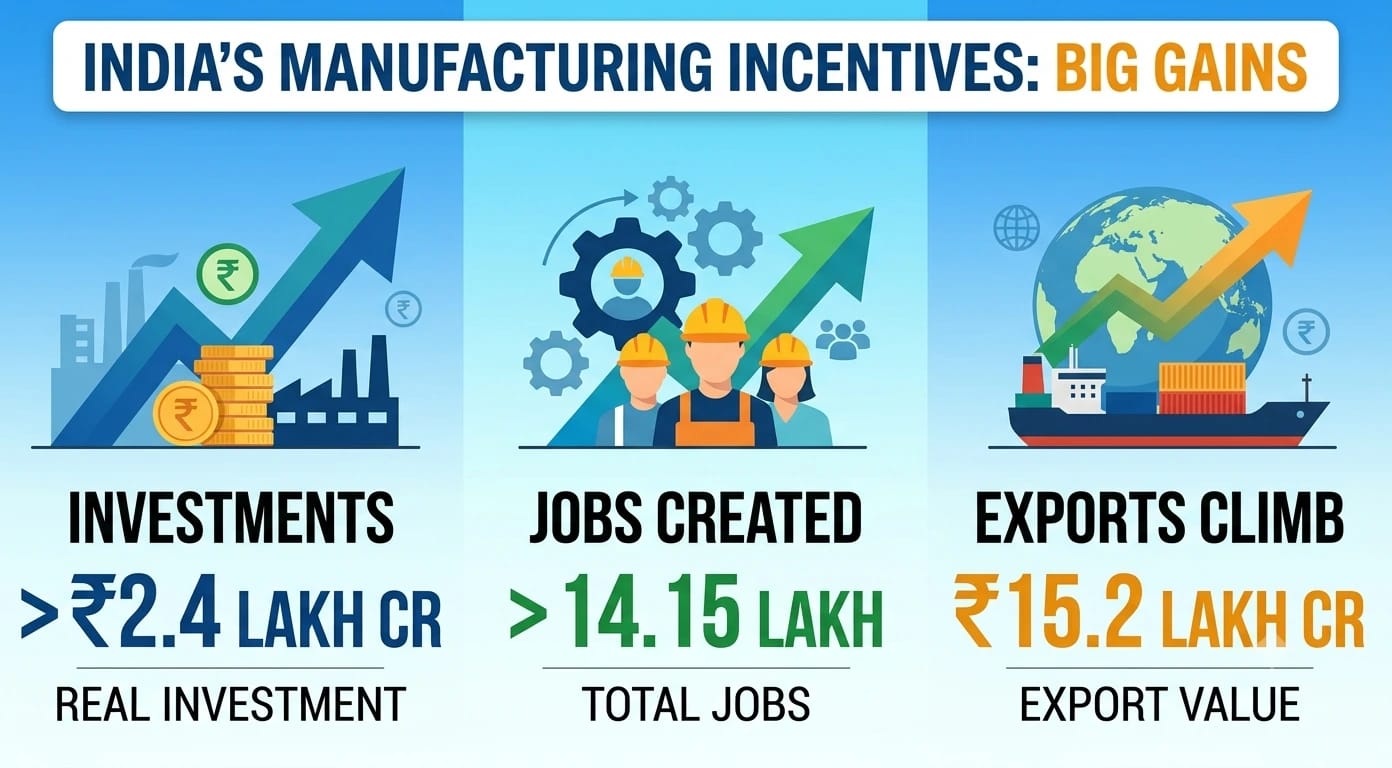
A major manufacturing push has brought in more than ₹2.40 lakh crore in real investments and created over 14.15 lakh jobs by March 2026. The same effort has helped exports climb to ₹15.2 lakh crore, showing that locally made goods are finding strong demand at home and abroad.
The PLI scheme, or Production Linked Incentive scheme, is a government programme that rewards companies for making and selling more goods locally. Covering 14 key sectors, it offers a percentage of extra sales as an incentive to encourage investment, technology upgrades, and local sourcing. By tying payouts to actual output, the scheme has helped scale up capacity, reduce imports, and boost exports. It has also attracted investment and created jobs across factories and supply chains. In short, the PLI scheme turns higher production into direct support for manufacturers.
The story starts with a reward system that pays companies for making and selling more. This design encouraged firms to set up new lines, upgrade plants, and source more locally. As a result, 892 applications were approved, and cumulative production and sales reached ₹22.66 lakh crore, with value addition at ₹14.15 lakh crore. That rise in value addition means more work and higher skills stayed within the local economy instead of going out as payments for imported parts.
Sector-wise, the largest share of investment went into high-efficiency solar modules, which took in ₹64,873 crore. Next came pharma drugs at ₹45,158 crore, and automobiles with auto components at ₹44,326 crore. Speciality steel followed with ₹23,896 crore, while large-scale electronics manufacturing saw ₹20,580 crore.
At the smaller end, drones and drone components received ₹595 crore, IT Hardware 2.0 got ₹908 crore, and medical devices attracted ₹1,151 crore. These numbers show that both big, heavy industries and emerging tech areas received support, with capital flowing where capacity could be expanded quickly.
Jobs grew across direct roles in factories and indirect roles in services and supply chains. Around 8.5 lakh direct jobs and over 5.5 lakh indirect jobs were created, with much of the indirect hiring coming from electronics, IT hardware, and solar modules.
The food products sector generated the most employment at 3,29,200 jobs, reflecting its labour-intensive nature, while advanced chemistry cell battery manufacturing created the least at 1,245 jobs, pointing to a more automated setup.
The spread of employment across sectors helped different communitiesurban and ruralby opening work in production, logistics, packaging, quality checks, and maintenance.
Exports tell a powerful part of the story. From ₹4 lakh crore in fiscal year 2024, shipments rose to ₹6.5 lakh crore in fiscal year 2025 and then to ₹15.2 lakh crore in fiscal year 2026, a jump of about 280% in just two years.
This surge signals that goods made under the incentive plan met global standards and found buyers overseas, which brings in foreign earnings and strengthens the overall economy. With more local production, supply chains became steadier, reducing delays and making products more reliable for everyday use.
The incentive outlay was planned at about ₹1.91 lakh crore to unlock much larger private capital. By linking payouts to actual sales growth, companies were guided to focus on scale, quality, and efficiency.
The result was a broad lift in manufacturing activity, with more vendors getting involved in components, packaging, testing, and distribution. Such a ripple effect explains why employment kept rising even as exports accelerated, because more hands were needed to keep lines running and to move goods to markets.
Among the fourteen sectors covered, the mix ranged from electronics, pharma, and autos to solar, speciality steel, textiles, food processing, telecom gear, white goods, and drones. This wide coverage meant that growth was not limited to one industry but spread across many, creating balance and resilience.
Sectors like solar, with the highest investment, also supported cleaner energy goals, while pharma and medical devices helped improve access to healthcare products. Automobiles and auto components, with their deep supply chains, brought in many small and medium suppliers, which is a key reason for strong indirect job creation.
Taken together, these numbers paint a picture of a manufacturing push that has moved well beyond its early, modest beginnings into something with real, measurable impact on jobs, factory output and trade.
What started as a scheme with a fixed financial outlay has, over time, generated investment and export figures that go far beyond that original number, while also creating employment for lakhs of people across many different industries.
Whether this pace of growth can be sustained in the coming years will depend on continued policy support, steady global demand and the ability of local manufacturers to keep scaling up production, but for now, the trend line clearly points upward.

