
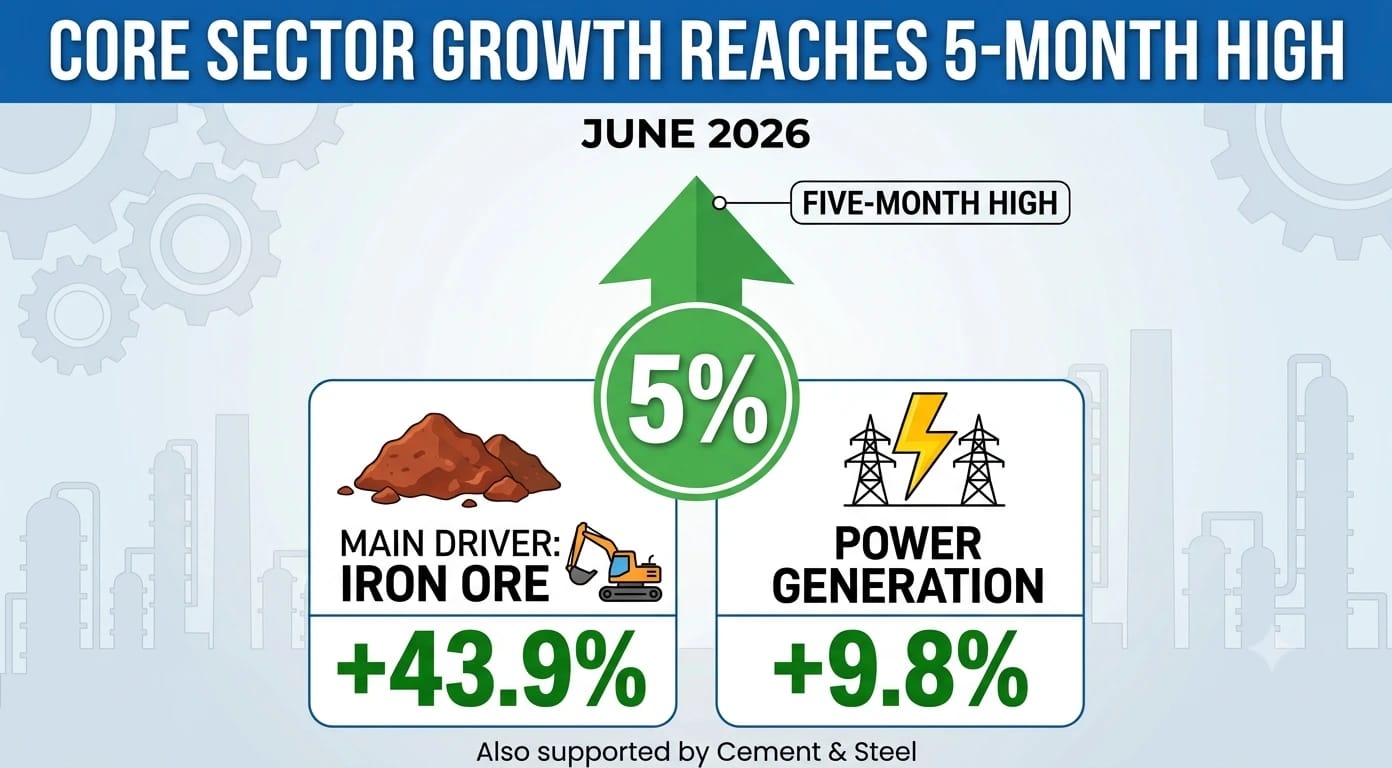
The core sector of India showed a stronger performance in June 2026, with growth rising to 5% and touching a five-month high. The rise came mainly from iron ore, electricity, and cement, while some energy-linked sectors continued to face pressure.
The latest figures also arrived through a revised industrial index, which now uses a new base year and includes iron ore for the first time, making the overall picture look different from earlier reports.
The revised Index of Core Industries now covers nine sectors instead of eight, and the base year has been changed to 2022-23 from 2011-12. This update has reshaped the measurement of core industrial output and also changed earlier growth estimates.
Under the new series, growth for 2024-25 has been revised down to 4.3% from 6.9%, while the estimate for 2025-26 has been raised to 3% from 1.1%. This means the numbers are being read through a fresh statistical lens, which gives a more recent view of industrial activity.
Iron ore became the biggest reason for the June pickup. Its output jumped 43.9% in June 2026, helped by a weak base from the previous year, when production had fallen sharply.
The sector now has a 4.9% weight in the revised index, so even though its share is not large, its strong growth had a visible effect on the final number. The inclusion of iron ore also reflects its importance in manufacturing and industrial development, which is why it has been added to the core list in the new series.
Electricity generation also supported the rise, climbing 9.8% in June. Demand for power increased because of high temperatures and rainfall deficit in some regions, which pushed up electricity use across households and industry.
Cement output matched that same 9.8% growth, showing stronger activity in construction and infrastructure-linked demand. Steel also grew by 4.6%, adding another positive signal for basic industrial production.
At the same time, not every sector moved in the same direction. Oil, natural gas, refinery products, and fertilizers remained under pressure in June, showing that the recovery was not broad-based. Coal was one of the few energy sectors to post growth, rising 1.4% after a period of decline. This mixed trend suggests that the improvement in the core sector was real, but still uneven across industries.
The overall message from the June data is simple. Industrial activity improved, but the rise came mainly from a few strong sectors rather than a wide-based jump across the board. The new index makes iron ore and updated weights part of the story, so the latest growth number should be read with that change in mind.
From an observation point for the business and policy, this matters because core sector data often gives an early signal of how the wider economy may behave in the months ahead.
In simple terms, June brought a better reading for the industrial base, but the recovery still looked selective. Power demand was strong, mining improved, and construction-related activity held firm, while several fuel-linked sectors stayed weak. That kind of balance often points to a turning point that is improving, but not yet fully settled.

