
The government is preparing a major revision of its Industrial Production Index, and this change matters because the economy has changed a lot in the last decade and a half.
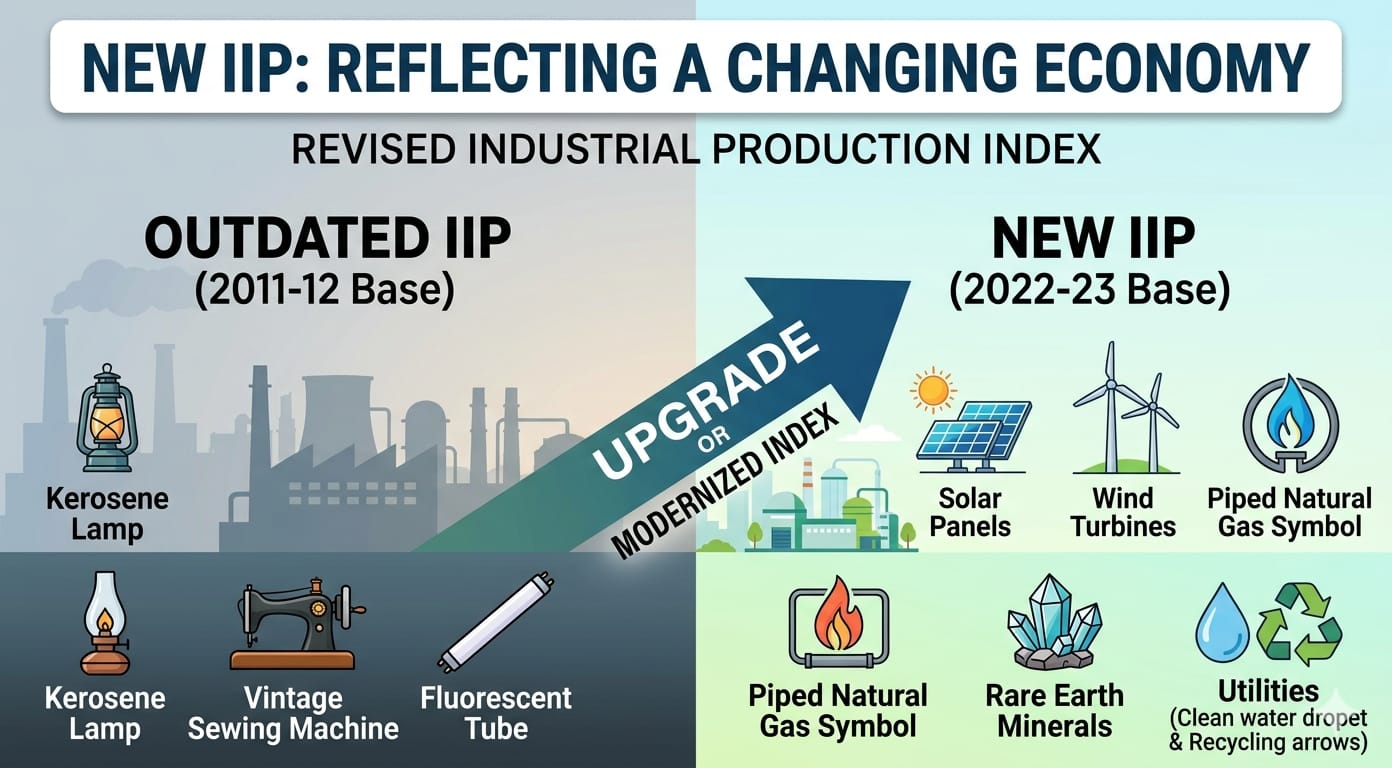
The old index was built on an older picture of industry, while today’s economy includes new activity in clean energy, utilities, minerals, and modern services linked to production. In simple words, the index is being updated so that it can show the real shape of industry in India, not an outdated version of it.
This is important because an index like IIP is used to understand how factories, mining, electricity, and related sectors are performing.
If the basket of items stays the same for too long, the numbers can slowly lose their relevance, just like using an old map to navigate a newly built city.
That is why the panel has recommended changing the base year from 2011-12 to 2022-23, so the system starts from a more recent and realistic starting point. With this, the data should better reflect what India actually produces today.
One of the biggest changes is the expansion of the item basket from 407 groups to 463 groups. The manufacturing list will also be updated, with 120 new item groups added and 64 removed. This means the index will now include products and sectors that were not properly represented earlier, while old items that have lost importance will no longer occupy space in the measurement.
For example, rare earth minerals, minor minerals, piped natural gas, water supply, sewerage, and waste management are being brought into the index because they now play a bigger role in the economy.
At the same time, some older products are being dropped, such as kerosene, fluorescent tubes, sewing machines, and some other legacy items.This does not mean these products have no value, but rather that they are not central enough today to define the overall industrial picture.
The logic is simple: if industry changes, the measuring system must also change. Otherwise, the index may fail to capture where growth is really happening.
The update also shows India’s energy transition very clearly. Electricity generation will now be split into renewable and non-renewable categories, which is important because the country is adding more solar, wind, and other clean power sources.
Similarly, piped natural gas is being tracked separately, showing how energy consumption patterns are moving away from only traditional sources. In the same way, the inclusion of water supply, sewerage, and waste management shows that utility services are becoming a more visible part of industrial life.
There is also a technical improvement in how the index may be built. The panel has recommended a chain-linked framework, which means weights can be updated regularly instead of staying fixed for too long.
This matters because industries do not stay the same; some expand fast while others shrink. A chain-based system can reduce the problem of outdated weights and make the index more responsive to new production trends.
The move is not just about numbers; it is about better economic truth.When policymakers, businesses, and media look at industrial data, they want a tool that matches the present, not the past.
So, this revision should help India measure manufacturing, mining, and utilities in a more accurate way and make the index more useful for planning and analysis. In that sense, the refresh is not a small technical edit, but a necessary step for a fast-changing economy.

