
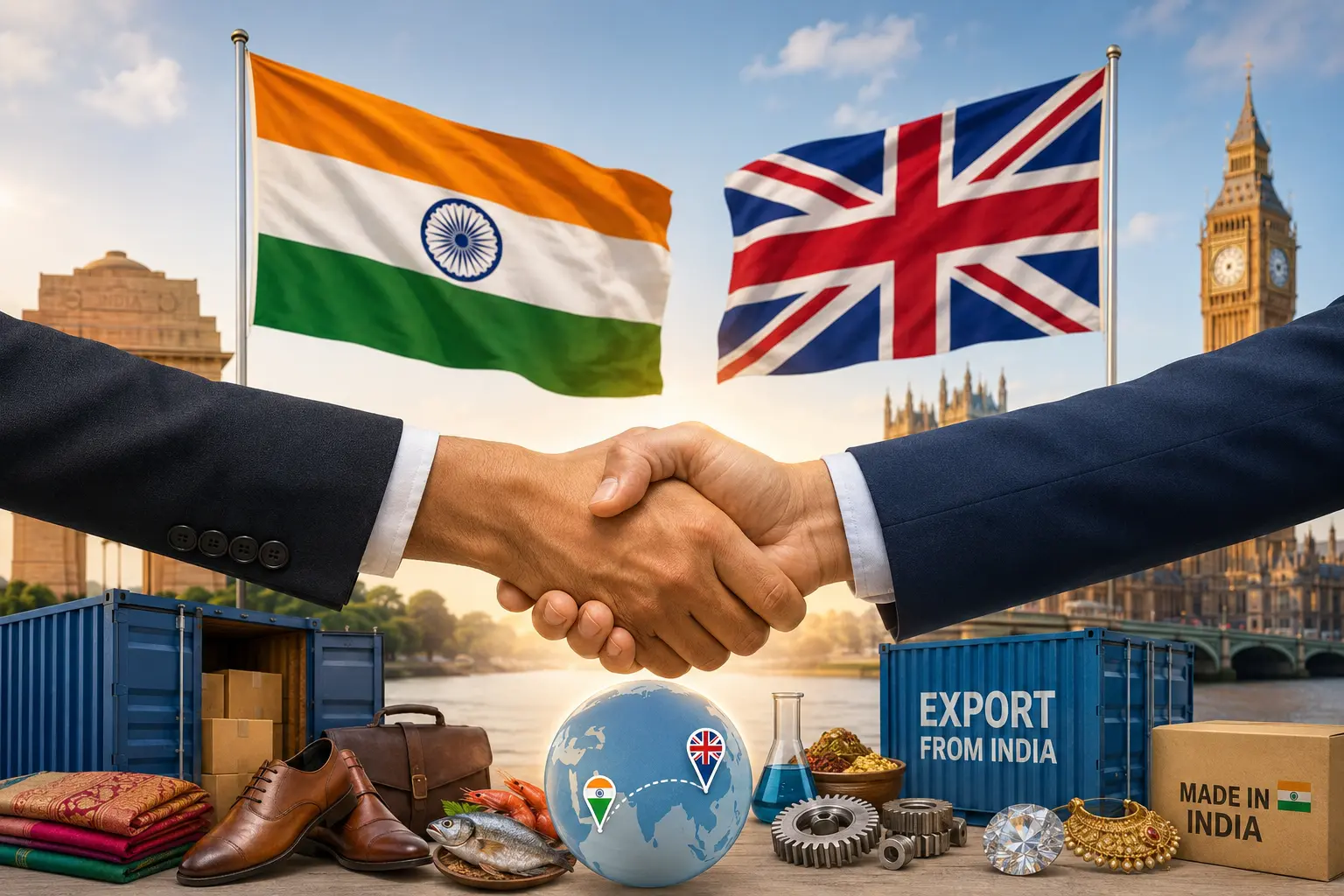
A major trade agreement has now come into effect, between two of the biggest economies in the world, India and the United Kingdom. The Free Trade Agreement will give many Indian exports easier entry into the UK market and will open new opportunities for businesses, workers, and consumers.
The India-UK Free Trade Agreement has now come into effect, and this is a big moment for trade between the two countries. In simple words, many products made in India can now enter the UK with much lower or zero duty, which can make them cheaper and more competitive there. The deal is being seen as one of the most important trade openings in recent years because it gives Indian exporters a stronger chance in a large and rich market.
This agreement is officially called the Comprehensive Economic and Trade Agreement, or CETA, and it was signed earlier before taking effect today. The key idea is easy to understand, when import taxes fall, products can move more freely, and sellers can offer better prices. That can help businesses expand, create more orders, and support jobs in export-linked sectors.
One of the biggest benefits is duty-free access for about 99% of tariff lines on Indian exports to the UK. That means a very wide range of goods can now go there without the old duty burden, including textiles, leather and footwear, marine products, engineering goods, chemicals, processed food, gems and jewellery, and several other labour-intensive products. For many exporters, this is like getting a fresh opening in a market where price matters a lot.
For sectors such as textiles, leather, footwear, processed food, marine products, engineering goods, and chemicals, this can be especially useful. These are the kinds of products where even a small cut in duty can make a real difference in sales. If a buyer in the UK can get the same product at a lower price because the duty is gone, the Indian exporter gets a better chance to win that order.
The agreement also matters because it is not only about goods. It also improves access for services and professionals, which means Indian workers and service providers can get more opportunities in the UK market. Some reports also mention a social security arrangement for temporary workers, which can reduce the extra burden on short-term professionals working there. This makes the deal broader than a simple export tariff cut.
At the same time, the UK also gets easier access for some of its exports into the Indian market, although that part is phased and balanced in different ways. Items like Scotch whisky and automobiles are often mentioned in the deal because their duties are reduced gradually instead of all at once. That is important because it shows the agreement tries to support trade while still protecting sensitive sectors.
For exporters, the next step is not just excitement, but preparation. They will need to meet quality rules, documentation standards, and market expectations in the UK, because duty-free entry alone does not guarantee success. In real life, buyers care about supply regularity, product quality, branding, packaging, and compliance, so businesses that prepare well are more likely to benefit from this opening.
For ordinary people, the effect may be seen indirectly through more trade, stronger factory activity, and possibly more jobs in export-heavy industries. If orders rise for garments, leather products, food items, or engineering goods, then more work can flow into production units, transport, logistics, and related services. That is why this agreement is being described as a growth opportunity rather than just a trade headline.
In short, this FTA is a major step because it lowers barriers, improves market access, and gives many Indian exporters a better chance to compete in the UK. It will not change everything overnight, but it can become a strong support system for businesses that are ready to scale up and meet global standards.

