
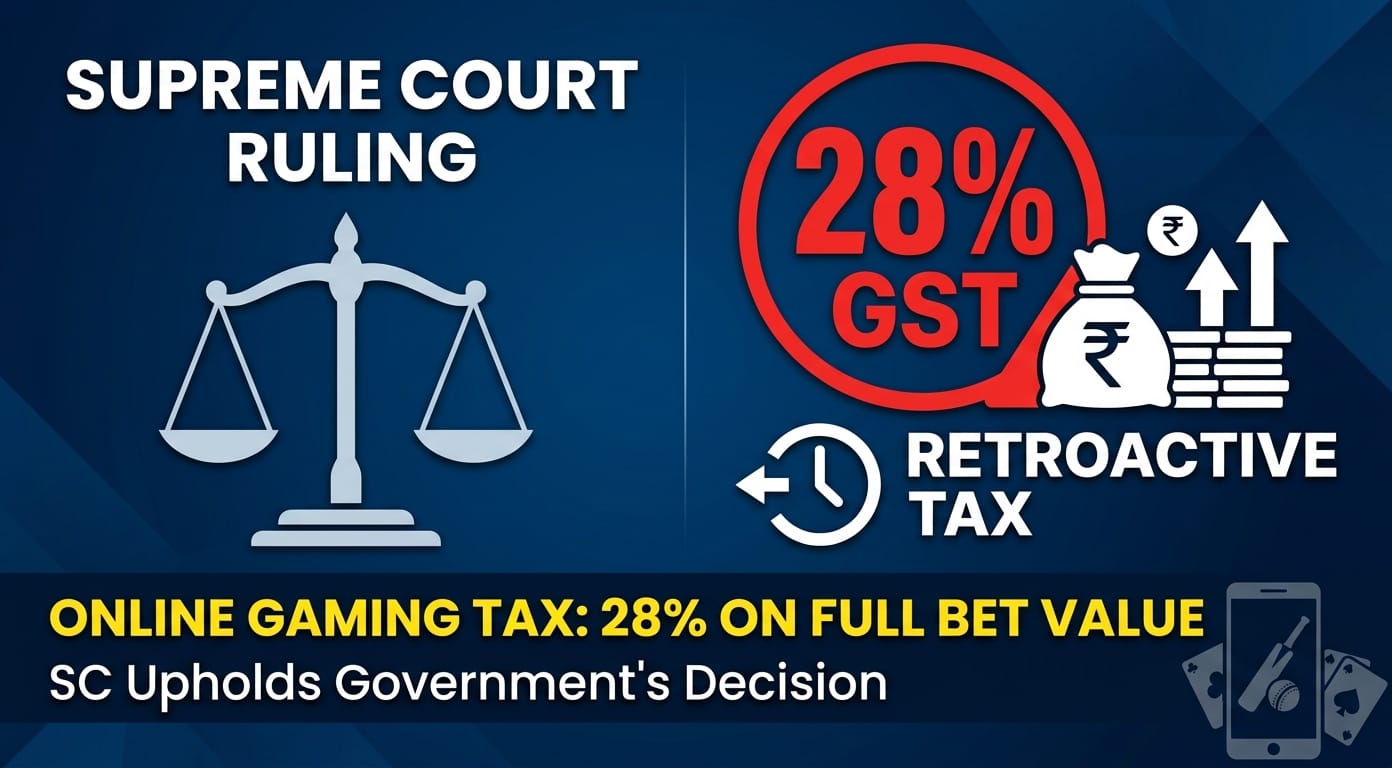
The Supreme Court has delivered a major decision that changes the future of online gaming. On May 27, 2026, the highest court in the country upheld the government’s decision to charge 28% Goods and Services Tax on online gaming companies, and this tax applies to past transactions as well.
This means gaming platforms now face tax demands totaling over ₹1 lakh crore for money that users deposited or bet on their apps before the ruling.The bench of Justices JB Pardiwala and R Mahadevan said online gaming companies are not merely intermediaries helping players connect, but are actually suppliers of a taxable service.
This ruling settles a long-running debate about whether online games should be taxed like betting and gambling. Gaming companies had argued that many of their games, especially fantasy sports and skill-based games like rummy and poker, should not be treated the same as games of chance.
The court rejected this argument, stating that once money is staked on an uncertain outcome, even skill-based games become betting and gambling for tax purposes. The court explained that these activities create what is called an actionable claim, which is taxable under GST laws governing betting and gambling transactions .
The 28% tax is charged on the full value of bets or deposits made by users, not just on the commission or fees that gaming companies earn. Before this clarification in August 2023, many companies had been paying tax only on their platform fees, which was a much smaller amount.
This change means if a user deposits ₹1,000 to play a fantasy cricket game, the entire ₹1,000 is now subject to 28% GST, not just the ₹50 or ₹100 that the platform keeps as its fee. This fundamental shift in how tax is calculated is what has created such a huge financial burden for the industry.
The retrospective nature of this ruling is particularly significant. When Parliament amended the Central GST Act in 2023 to define online money gaming clearly, the amendment was written to apply backwards to earlier transactions .
The Supreme Court confirmed that this amendment was clarificatory in nature, meaning it simply explained what the law always meant, so it applies to past events too. This is why companies now face tax demands for periods before 2023, interest and penalties that could make the total amount even larger.
The impact on the gaming industry has been severe. Reports indicate that several companies have already shut down operations because they could not handle the financial pressure
Those that remain open must now review their balance sheets, recalibrate their business strategies, and find ways to pay the massive tax bills.
Experts describe this no longer as a legal litigation issue but as a balance-sheet event that will fundamentally change how the industry operates. Looking ahead, the tax rate is expected to increase further to 40% from September 2025, adding even more pressure on companies that are already struggling.
Beyond the tax issue, the court also upheld the right of state governments to ban online betting and gambling. Laws in Tamil Nadu, Karnataka, and Kerala that restrict or prohibit online money gaming, including skill-based games like rummy and poker, were confirmed as valid.
This means states can continue to enforce these bans if they choose to, giving them significant control over whether online gaming operates in their territory.
For players and ordinary people who enjoy online gaming, this ruling means the landscape is changing. Some gaming platforms may stop operations entirely, while others might pass on the tax cost to users through higher entry fees or reduced prize pools.
The games themselves have not been banned nationwide, but the financial rules around them have become much stricter. Anyone who plays fantasy sports or online games for money should expect to see changes in how these platforms operate, how much it costs to play, and which apps remain available.
The Supreme Court’s decision brings clarity to a confusing area of law but also creates significant challenges for an industry that had been growing rapidly.
The judgment confirms that online gaming with monetary stakes falls under betting and gambling for tax purposes, establishes that platforms are suppliers not intermediaries, and validates the government’s right to collect tax retrospectively. These changes will reshape the online gaming sector for years to come, affecting everything from business models to player experiences.

