
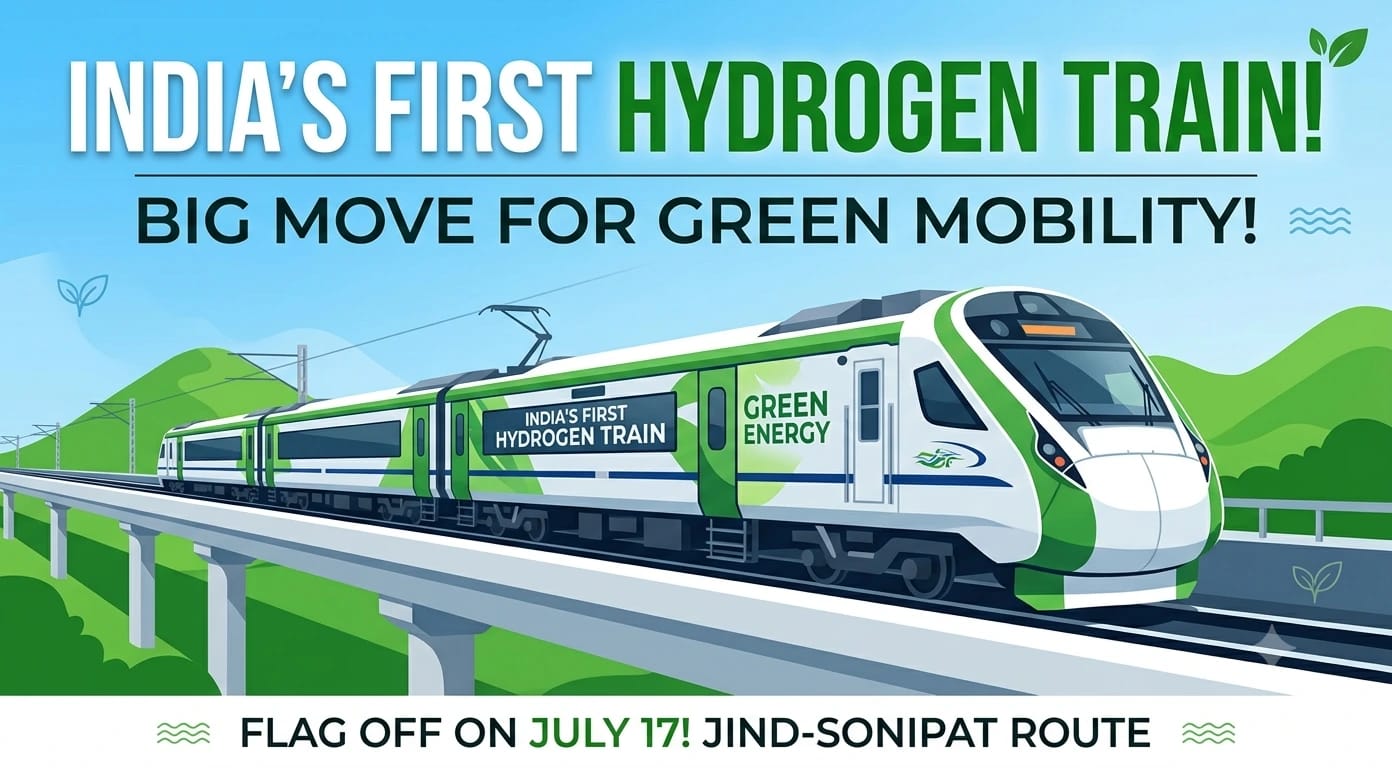
The first hydrogen-powered train is now ready for launch, and this is a big moment for rail travel in the country. Prime Minister Narendra Modi is scheduled to flag off the train on July 17, and the service will begin on the Jind-Sonipat route in Haryana. The project has drawn attention because it shows how railways are trying to move away from diesel and toward cleaner fuel systems.
This train is not just about a new route. It is about a new technology that uses hydrogen fuel cells to create electricity for motion. In simple words, the train carries hydrogen, and that hydrogen helps power the train without burning diesel in the usual way. The main result is a cleaner journey, with water vapour and heat as the main by-products instead of smoke from fossil fuel use.
The route chosen for this service is Jind to Sonipat, and the total distance is about 89 kilometres. According to the Railway Board’s schedule, the train will leave Jind at 7:40 am and reach Sonipat at 9:40 am during regular service. On the return trip, it will leave Sonipat at 10:40 am and reach Jind at 1:00 pm. The train will stop at 12 intermediate stations, including Jind City, Gohana, Butana, and Barwasni.
The train has been designed as a 10-coach hydrogen-powered DEMU set, and it carries 682 seats with a total passenger capacity of 2,600. During trials, it reached a higher speed, but the regular operational speed has been fixed at 75 kmph.
That means the train is being introduced in a controlled and careful way, which is important because this is still a pilot project and not yet a full-scale national rollout.
A major part of the project is the hydrogen plant at Jind, where hydrogen is produced using electrolysis. This is an important detail because electrolysis is also linked to green hydrogen generation.
In simple terms, if the electricity used in that process comes from cleaner sources, the fuel can become part of a lower-pollution transport system.
Safety is also being treated seriously. For the first three months of operation, trained technical personnel will travel with the train to handle any issue during the journey.
This shows that railway authorities want the first service to run smoothly and safely, especially because hydrogen-based rail travel is still new for most passengers.
This launch matters because it is not just a train event, it is also a message about future transport. Railways are trying to show that modern transport can be cleaner, smarter, and less dependent on diesel.
For passengers, it may still feel like a normal train ride, but behind the scenes it represents a major shift in how train energy can work.
There is also one point to keep in mind that the July 17 run is being described as a special inaugural service, while the date for regular passenger service has not yet been officially finalised. So the launch is important, but the full commercial pattern will become clearer after the inauguration. Even so, the train already stands as a symbol of technical progress and a fresh step in green mobility.
The simplest way to understand this story is to think of it as a test of the future. If this train performs well, it can open the door for more hydrogen-based rail projects later. If the system works smoothly, passengers may one day see more such trains running on selected routes.

