
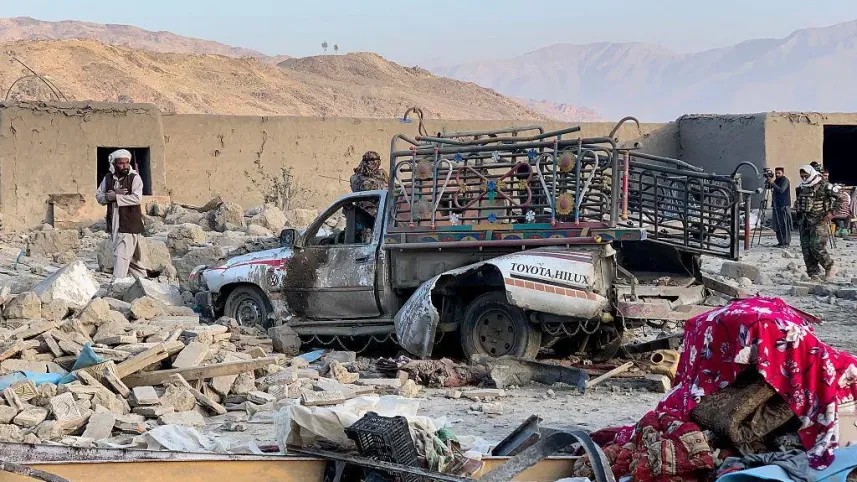
On the early morning of June 10, 2026, Pakistani military aircraft launched cross-border air strikes into eastern Afghan provinces – Khost, Kunar, and Paktika – hitting civilian and residential areas. According to Taliban chief spokesperson Zabihullah Mujahid, at least 13 people were killed, including 11 children, one woman, and an elderly man; 14 women and children were also wounded.
Pakistan acknowledged the strikes, saying they targeted militant infrastructure and killed 26 Tehreek-e-Taliban Pakistan (TTP) fighters as part of its Azm-e-Istehkam (Resolve for Stability) counterterrorism campaign. Information Minister Attaullah Tarar called the operation “precise and calibrated” against militant hideouts along the border, launched in response to recent attacks inside Pakistan. He rejected civilian casualty reports as propaganda and asserted the strikes hit designated militant targets only (a June 9 TTP attack in Peshawar that killed six Frontier Constabulary personnel and abducted eight was also cited as the trigger).
The air strikes mark a renewed escalation after weeks of calm following intense cross-border hostilities in late February and early March 2026. Relations between the two neighbours have been strained since the Taliban’s 2021 Kabul takeover. Pakistan accuses the Taliban of failing to curb Tehreek-e-Taliban Pakistan, alleging terrorists operate from Afghan soil to attack Pakistan. The Taliban reject these claims, saying they do not permit any group to use Afghanistan to threaten other countries.
This flare-up continues an escalation cycle that began with Pakistani strikes on February 22 across eastern and southeastern Afghanistan, reportedly killing at least 18 civilians, including women and children. On February 26, Afghan forces responded under Operation Rad Al-Zulm (Repelling Oppression), attacking Pakistani military positions and capturing seven border posts in Kandahar. That same day, Pakistan launched Operation Ghazab lil-Haq (Righteous Fury), intensifying hostilities.
A May 12, 2026 UNAMA report documented at least 372 civilians killed and 397 injured in cross-border clashes during the first three months of 2026 – the deadliest first quarter since UN documentation began in 2011. UNAMA recorded 95 civilian-harm incidents; Pakistani forces were responsible in 94 cases. Airstrikes accounted for nearly two-thirds of casualties. One of the deadliest incidents occurred on March 16 in Kabul, when Pakistani airstrikes hit the Omid Drug Rehabilitation Hospital; UNAMA reported 269 killed and more than 122 injured. About 16,400 families were displaced in February – March. Amnesty International called for an independent investigation into the hospital strike.
On March 18, both sides agreed to a five-day Eid al-Fitr pause (midnight March 18/19 to midnight March 23/24), following mediation by Saudi Arabia, Qatar, and Türkiye. On March 26, Pakistan’s Foreign Office said Operation Ghazab lil-Haq would continue “until its objectives are achieved.” Informal peace talks in Urumqi, China (April 1-7), included China as host; both nations reaffirmed the UN Charter and the Five Principles of Peaceful Coexistence and agreed to avoid actions that could escalate tensions.
While talks proceeded, sporadic clashes continued along the 2,600-kilometre border. Between April 1 and June 9, at least 10 cross-border firing incidents were reported: 3 civilians and 58 terrorists killed; 11 civilians and more than 80 terrorists injured. The June 10 airstrikes added 13 civilian deaths.
On May 19, Prime Minister Shehbaz Sharif visited the Command and Staff College in Quetta and stated Operation Ghazab lil-Haq would continue with full resolve against terrorist proxies based in Afghanistan. The remark signaled Islamabad’s assertive stance: future attacks attributed to groups in Afghanistan would prompt military response. Without progress on cross-border militancy, tensions are likely to remain high, risking an extended cycle of confrontation.
Pakistan-Afghanistan border tensions have entered a dangerous new phase. With 372 civilian deaths in Q1 2026 and 13 more killed on June 10, Operation Ghazab lil-Haq’s objectives remain unachieved. The civilian toll – especially among children – has been severe, and independent investigations into the deadliest incidents are urgently needed.
Author Tushar Ranjan Mohanty is a Research Associate at Institute for Conflict Management

