
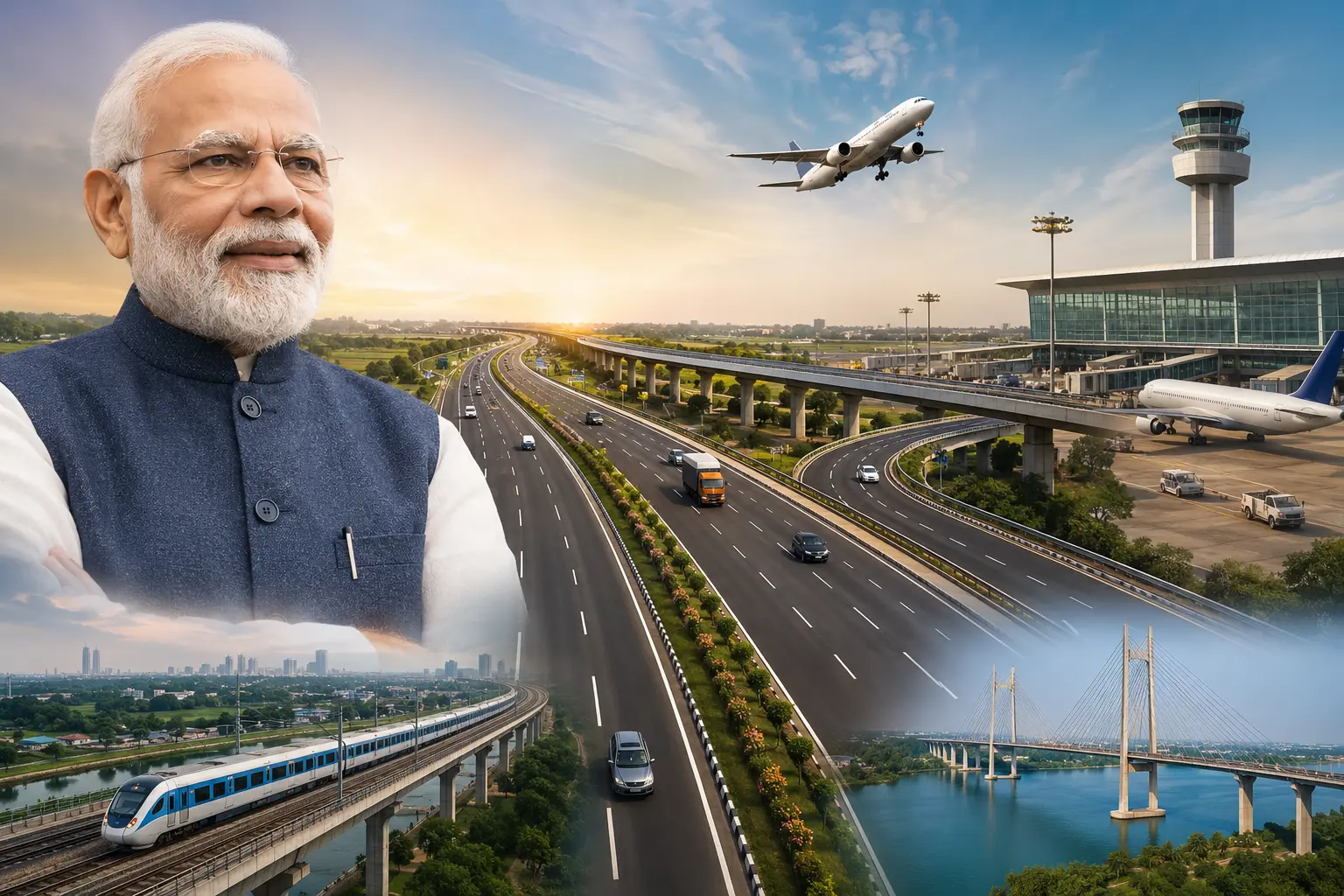
Though idiomatic in origin, the term ‘white elephant’ is widely used in public finance to describe inefficient capital investments that yield a negative net social return. This phrase is currently a preferred descriptor among public intellectuals and infrastructure critics questioning the long-term viability of mega-projects.
One thing the supporters of the Government and their staunch critics used to agree on was the rapid development in the infrastructure sector that the nation saw in the last decade. The recent metrics confirm consistent expansion in this sector. So the captious critics take a different stance, this time not attacking the ‘lack of infrastructure’ but the exact opposite, the ‘more of infrastructure.’
Historically, India’s infrastructure sector faced prolonged stagnation, largely driven by fiscal mismanagement, structural bottlenecks, and systemic inefficiencies in project planning and execution specifically. This trajectory shifted toward establishing a strong logistical foundation as a baseline for economic expansion. Priority was placed on comprehensive connectivity upgrades, spanning national highways, modernised rail and rapid transit systems, and expanded port and airport capacities to streamline supply chains before driving long-term economic acceleration. Because, for a nation with a per capita income under $3,000, there is no such thing as ‘too much development.’ Forgoing these capital-intensive projects right now guarantees long-term underconnectivity and economic stagnation, leaving the country lagging behind prospering adversaries.
The Expressway question
There is a fundamental flaw in how critics evaluate infrastructure. They arrive at a freshly built expressway, note that it carries fewer vehicles than a Mumbai arterial road, and announce the project a failure. This is the intellectual equivalent of planting an acorn, looking at it the next morning, and concluding that trees do not grow. Infrastructure is not a vending machine; you do not insert rupees and immediately receive economic output. It is a long game, a bet on a future that must first be made possible.
The United States learned this in the 1950s. When President Eisenhower signed the Federal-Aid Highway Act of 1956, committing the equivalent of approximately $250 billion in today’s money to build the Interstate Highway System, the programme was widely considered a boondoggle in its early years. Even then, critics worried about wasteful spending and empty stretches of concrete in rural America. Eisenhower’s successor, John F. Kennedy, doubled down on the programme anyway, and by the mid-1960s, it was clear that the sceptics were wrong. The Interstate Highway System became, in the words of the United States Department of Transportation, ‘the backbone of the economy’, carrying 71% of total freight by weight and 80% by value. An entire economic culture was born around it, hotels, logistics networks, manufacturing supply chains, and agricultural markets. None of that was visible when the first concrete was being poured in rural Illinois.
China’s story carries an even more instructive parallel. In the late 1980s and early 1990s, as China began building its expressway network, sections of new highway sat underutilised through underdeveloped provinces. Some roads in rural western China were criticised for serving more pigs than cars. Today, China operates the world’s largest expressway network, stretching over 1,90,700 kilometres by the end of 2024, connecting over 99% of cities with populations above 2,00,000. While global attention today is captured by China’s front-end tech and automated factories, the true backbone of its manufacturing dominance remains this hidden, hyper-efficient transport grid.
These expressways transformed the manufacturing sector by seamlessly linking raw materials in the deep hinterlands directly to major maritime export ports, slashing transit times from days to hours. This massive connectivity creates a formidable economic edge by drastically driving down freight costs; in China, uninterrupted multi-lane expressways allow heavy-duty long-haul trucking costs to hover at a highly competitive baseline of $0.018 to $0.024 per tonne-kilometer, while India’s average standard network across its wider, traditional highway grid sits at approximately $0.045 per tonne-kilometer. While India’s newly completed expressways achieve cost parity at $0.018 on direct premium corridors, its national network average remains higher due to ongoing modernisation bottlenecks on secondary state routes. The rural highways that once attracted mockery now form the logistical arteries of Alibaba and JD.com, proving that roads built into economic deserts became the reason those deserts bloomed. India’s critics of projects like the Bundelkhand Expressway would have called every one of those Chinese roads a White Elephant, too.
I mentioned the Bundelkhand Expressway, the 296-kilometer Expressway, built for approximately ₹14,850 crore across historically neglected districts like Chitrakoot and Banda, is currently the critics’ Exhibit A for ‘underutilised’ infrastructure. But they ask the wrong question. For a region defined for decades by drought, poverty, crime, and severe youth out-migration, expecting heavy traffic immediately misses the point: why would industry arrive before the road?
Investors will not build factories where Delhi is 14-hours away. The expressway has slashed that journey to under 6-hours, marking a socio-economical shift for a population that previously only exported its youth. The structural follow-through is already materialising. Modeled explicitly on Noida, the newly formed Bundelkhand Industrial Development Authority (BIDA) has already acquired over 24,000 acres, nearly 68% of its first-phase target, to serve as a major node on the Delhi-Nagpur Industrial Corridor, complete with a planned airport and expressway spur. Across the border, Madhya Pradesh has sanctioned a parallel industrial package targeting ₹24,240 crore in investments. These projects did not happen despite the expressway; they became conceivable because of it.
Another example is the 701-kilometer Mumbai-Nagpur Samruddhi Mahamarg, built for ₹45,000 crore across ten districts, prime target for many, eager to apply the ‘White Elephant’ label. But just like Bundelkhand, they misread its core purpose. For decades, Vidarbha and Marathwada existed as the neglected hinterlands of Maharashtra, structurally severed from Mumbai’s economic engine and defined by severe agricultural and industrial distress. Expecting immediate bumper traffic misses the point: why would capital ever venture into a region separated from the state capital by a grueling, 16-hour haul?
By slashing transit times to under 8-hours and cutting freight costs by up to 60 percent, the expressway has democratised Mumbai’s economic benefits for a population that felt entirely left behind. The corridor plugs Vidarbha’s rural production directly into the Jawaharlal Nehru Port and the Western Dedicated Freight Corridor. Backed by tens of thousands of crores in downstream investments, including the Eastern Vidarbha Expressway and the Nagpur-Gondia industrial link, the grid is actively connecting Gadchiroli’s mining belt to emerging manufacturing clusters around Nagpur. This corridor was not built for existing traffic; it was built to rewrite economic geography, proving that roads built into economic deserts are the reason those deserts bloom.
There is a specific order that is followed by traffic; that is, traffic numbers will follow industry, industry follows connectivity, and connectivity must be built first. This sequence is not a conjecture; it is the lesson of every developed nation that has ever built a road through an underdeveloped region. The point is not that every road succeeds; some genuinely do not. The point is that you cannot evaluate a road meant to catalyse a region’s development by measuring its traffic in year two of operation. An oak tree is not a failure because it is not providing shade in its first summer. The acorn was always the point.
The Airport argument
If the expressway debate is about roads nobody is using yet, the airport debate is about terminals nobody is flying from yet. The skeptics point to certain airports in Bihar, some barely operational, some beginning with 19-seater aircraft and minimal daily flights, and declare the government guilty of building vanity infrastructure for political optics.
Before engaging this argument directly, consider what the numbers show at the national level. In 2014, India had 74 operational airports. By March 2025, that number had grown to 160, more than doubled in a single decade, through the UDAN (Ude Desh ka Aam Nagrik) scheme, the National Civil Aviation Policy of 2016, and systematic investment by the Airports Authority of India. Under UDAN, 625 new air routes have been operationalised, connecting 88 previously unserved or underserved airports, benefiting over 1.51 crore passengers. India is now the third-largest civil aviation market in the world. The Prime Minister, at Wings India 2026(Asia’s largest civil aviation exhibition and conference), announced a target of 400 operational airports by 2047. These are not the numbers of a country building airports for no one, but the self proclaimed analysts, predictably, are unimpressed. Their argument has shifted from ‘India doesn’t have airports’ to ‘India’s airports have no flights.’
Historical precedents, however, offer a very different perspective. When China built airports across its western provinces in the 1990s and early 2000s, facilities in remote, underpopulated regions that drew criticism from Western economists for their near-empty terminals, nobody was calling them visionary. They are now the entry points to some of China’s fastest-growing tourism and manufacturing corridors. The Kunming Changshui International Airport, once considered a peripheral facility in a peripheral province, today connects Southwest China to Southeast Asia. The infrastructure arrived before the demand, and then the demand arrived.
The same logic applies to an airport in Kushinagar, or Deoghar, or Purnea. The Deoghar Airport in Jharkhand, inaugurated in 2022, covering six districts and drawing from parts of Bihar and West Bengal, was immediately branded as excess rather than access. Yet within months, district officials were noting a visible uptick in business visitors, with industrialists beginning to take the region seriously precisely because it had air connectivity. In Bihar, before 2019, there were just two operational airports. Today, Darbhanga alone has crossed 17 lakh passengers in under three years of operation, has been joined by Spice Jet, IndiGo, and Akasa Air, and is being expanded with a ₹912 crore terminal and a cargo hub, all because the government built the airport before the crowd arrived.
This is the point that the analysts miss entirely. Airports are not just terminals; they are trust signals. When the government builds an airport in a district that has no immediate demand for one, it is sending a message to the private sector: ‘We are here for the long game, and so should you be’. An investor choosing between two underdeveloped regions will almost always back the one with the airport, not because the airport generates revenue today, but because it signals state commitment and reduces investment risk. That is precisely the kind of credibility that turns a backward district into the next investment destination. There is a larger vision at stake, too. The India being built today is one where Darbhanga and Deoghar are not permanently destined to be afterthoughts to Delhi and Mumbai. The airport is how you ensure that the Tier-3 of 2026 has a fighting chance of becoming the Tier-1 of 2050, and that the gap between them does not become a chasm that no future government can bridge.
Conclusion
The people labeling India’s infrastructure projects as underutilised are operating on a flawed theory of how nations develop. They imagine an economy that grows first and then demands infrastructure, as though factories, tourists, and freight arrive by magic. History, however paints a different picture. The United States did not wait for the Sun Belt to grow before laying the Interstate Highways; those roads are precisely why the region grew. China did not wait for Yunnan to become prosperous before connecting it to the national grid; the connection is what made prosperity conceivable. South Korea did not wait for Busan to become a logistics hub before investing; the investment created the hub.
For India, with a per capita income still below $3,000, pausing these projects means locking in a two-speed nation where capital only flows to the already-connected. Bundelkhand’s historical tragedy was never a lack of resources or human potential, it was a total lack of connectivity. The expressway is the first serious attempt to remedy that isolation. Similarly, the expanding runways in Bihar are a direct signal to the hinterlands that they are no longer an afterthought.
Building ahead of demand is not a localised gamble; it is the price of admission for global competitiveness. China’s underused corridors of the 1990s are today’s manufacturing hubs, and America’s Transcontinental Railroad of the 1860s integrated a unified domestic market before most of the towns it connected even existed. By anchoring regions like Vidarbha and Bundelkhand into national trade networks, these projects are actively rewriting India’s economic geography, ensuring that today’s isolated frontiers mature into tomorrow’s primary engines of industrial growth.
Author Aditya Sharma is an Economics graduate with a keen interest in infrastructure and comparative analysis, exploring the intersection of policy, human behaviour, and emerging trends.

