
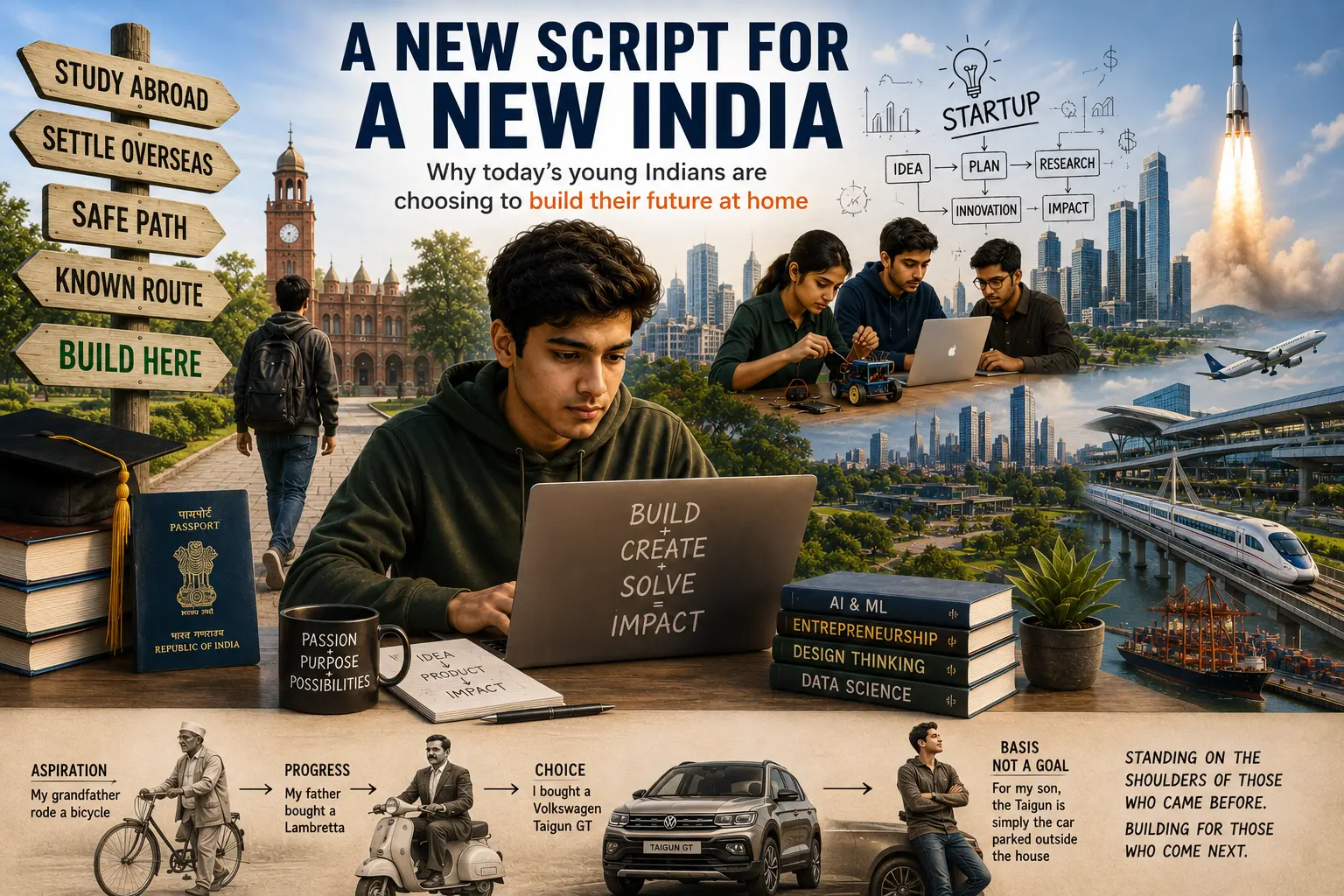
For decades, one of India’s most reliable exports has been tech talent.
The script was familiar. A bright student performed well in school, secured admission to a good university, often abroad, built a successful career and, in many cases, settled overseas. For much of India’s middle class, leaving was not merely an educational choice. It was a strategy for upward mobility, financial security and, often, generational transformation. That script has hardly disappeared. More than 13 lakh Indians continue to study overseas, and hundreds of thousands leave each year for higher education. The aspiration to compete globally remains very much alive. Yet over the last few years, I have found myself paying attention to the shift in the script.
In my work in tech ed, I interact with hundreds of students and parents. Some come from families that could comfortably finance an overseas education. Others would require substantial scholarships but are academically strong enough to secure them. Many are exactly the kind of students universities around the world would be delighted to admit. What caught my attention was not that these students have stopped looking abroad. It is that staying in India no longer seemed to be a compromise.
My son offers one example, but he is hardly unique. Many of his friends seem to be arriving at similar conclusions. A few years ago, studying abroad appeared to be the obvious next step for many of them. Today, a surprising number seem perfectly comfortable imagining their futures in India.
One conversation with my son’s counsellor has stayed with me. When the subject of overseas education came up, he dismissed it almost immediately. “It’s a waste of money,” he said. “I don’t understand the trade-off.” What struck me was not the conclusion but the question. Until recently a foreign degree was a self-evident investment. My son was evaluating the decision through an entirely different lens. He was not asking whether he could go but why he should.
The students asking these questions are not less ambitious than previous generations. If anything, they often appear more willing to take risks. They are more interested in creating, building and solving problems. Several are building products while still in school. Others are experimenting with startups, investing, content creation and technology projects long before they enter university. My son is working on an application that tracks news related to publicly listed companies and helps users understand how new developments may affect the stocks they own. A student I interacted with built a smart pill dispenser for his grandfather with Alzheimer’s so that he would not have to depend on others for his medication. Another one used AI to scan for early signs of cancer. Another wants to build affordable diagnostic kits for diabetes, so his grandmother doesn’t have to spend a thousand rupees every time.
None of this proves a trend. What it does suggest is that some young Indians are approaching the future differently from the generations that preceded them. The obvious question is why. I suspect the more interesting answer lies not in the students themselves, but in what they inherited.
My great-grandfather’s generation inherited a newly independent nation. My grandfather’s generation navigated scarcity. My parents’ generation pursued security. My generation benefited from liberalisation, expanding opportunity and a rapidly opening world. Over time, families accumulated assets, education, networks and opportunities that would have been difficult to imagine even a few decades earlier.
Parents, too, seem to be approaching these decisions differently. They have built stability and financial cushions. Increasingly, they seem willing to deploy that inheritance differently. Rather than urging their children towards the safest available path, some appear more inclined to support experimentation, entrepreneurship and risk. That perhaps is unsurprising. After all, what exactly were the previous generations working towards?
Today’s young people stand on top of the accumulated efforts of the generations that came before them. The progression is visible even in the small details of family life. My grandfather rode a bicycle. My father bought himself a Lambretta. I eventually bought a Volkswagen Taigun GT. The vehicles themselves are unimportant. The story lies in what they represented. For my grandfather, mobility was an aspiration. For my father, ownership represented progress. For me, the car was simply one choice among many. For my son, however, the Taigun is simply the car parked outside the house.
Every generation inherits the victories of the one before it and promptly takes them for granted. What one generation struggles to acquire becomes the next generation’s baseline. Many of us who grew up in the 1980s, 1990s and early years of liberalisation inhabited a very different India. Scarcity was not an abstract economic concept. It shaped everyday life. I still remember receiving a complete collection of Ruskin Bond’s works after ranking among the top candidates in my Master’s entrance examination. The book cost roughly four hundred rupees and felt like treasure. Ice cream occupied a similar category. It appeared at weddings, during holidays, after achievements or on occasional family outings. Nobody regarded this as hardship. It was simply what it was.
Scarcity does not always announce itself dramatically. Often it reveals itself through the things people value, preserve and celebrate. The country around us reinforced similar instincts. Economic reforms were opening doors, but certainty remained elusive. Many of us grew up through decades in which terrorist attacks and bomb blasts regularly intruded into public life. Stability carried prestige because stability itself was valuable.
The ambitions that emerge from such circumstances are usually rational. Security and predictability mattered, while risk was expensive. Gen Z and Gen Alpha have inherited a very different starting point. They inherited sufficiency, and sufficiency changes the consequences of failure. Four generations of accumulated progress have not simply expanded opportunity. They have raised the floor. A failed startup, a wrong career move, a few years spent pursuing an uncertain idea or an unconventional path no longer carry the same consequences they once did for many middle-class families. The result is a generation with a degree of risk elasticity that previous generations often lacked. Their grandparents could not afford many mistakes. Their parents could afford a few. Many of today’s students can afford considerably more mistakes, and that inevitably changes behaviour.
A few years ago, my three-year-old niece received a small pedal scooter. Delighted, she informed her friends that she would now be able to deliver things to them because she finally owned a scooter. Her understanding of scooters had been shaped not by family transport but by watching delivery riders bring groceries, food and packages to her doorstep. The story is amusing, but it captures something important. The iconic Humara Bajaj campaign – Buland Bharat ki Buland Tasveer – spoke to a generation for whom mobility represented aspiration. My niece belongs to a generation that takes mobility so completely for granted that the scooter has been reassigned to logistics. Children often reveal the assumptions of their age more clearly than adults.
Today’s young adults have grown up in a country that looks very different from the one their parents inherited. They have never known a world without the internet. They have never waited weeks for information. They inhabit the same digital universe as their peers across the world. They wear the same brands, watch the same content and participate in the same conversations. The distance has collapsed. For much of modern India’s history, the challenge was access: to information, products, opportunities and, in many cases, the wider world itself. These children were born into access. More importantly, they appear increasingly interested in what can be done with it. The evidence is visible in places both large and small.
Some of it is infrastructural. UPI has transformed payments at a scale that would have been difficult to imagine a generation ago. Indian digital public infrastructure has become a global case study. Chandrayaan landed near the Moon’s south pole. The Chenab Bridge now spans terrain that once seemed impossible to tame.
Some is economic. India today hosts nearly 1,800 Global Capability Centres employing close to twenty lakh people. More than one lakh startups have been recognised by DPIIT. Entire industries, from semiconductors and defence manufacturing to deep-tech and advanced engineering, are attracting levels of investment that would have seemed improbable only a decade ago.
Some is cultural. A decade ago, many urban consumers instinctively equated global with aspirational. That instinct appears weaker today. A Gully Labs sneaker can compete for attention with a Nike not because it is Indian, but because it resonates. Indian wear has re-entered urban wardrobes without apology. Yoga no longer requires foreign endorsement to be taken seriously. Public figures move through global spaces while remaining visibly and unapologetically Indian. What is striking is not that these choices are Indian. It is that they no longer require justification.
Whether the subject is clothing, brands, careers or entrepreneurship, the underlying instinct seems similar. They are making choices because they prefer them, not because they need to prove something. The shift is not merely cultural or economic. It is also reflected in how many young Indians perceive the country’s place in the world.
Some of the shift is strategic. Many in my generation grew up in the shadow of terrorism, insurgencies and recurring bomb blasts. Whether fairly or unfairly, there was often a perception that India was reacting to events rather than shaping them. Today’s students have grown up watching a country that increasingly projects agency. During the pandemic, India not only developed and manufactured vaccines for its own population but supplied them to countries across the world. That fact alone would have been difficult for many Indians to imagine a few decades earlier.
The importance of these developments lies not only in what they achieved, but in what they signalled. They shaped expectations. They shaped confidence. They expanded the realm of what seemed possible. Today’s students have witnessed something different. They have seen India build digital infrastructure at population scale, execute complex space missions, manufacture and distribute vaccines during a global crisis, and steadily expand its strategic and defence capabilities in an increasingly uncertain world. A nation can only pursue ambitious economic and technological goals if it possesses the ability and confidence to protect them. An entire generation has come of age watching a country that appears more willing to shape events rather than simply react to them. That inevitably influences how they think about what can be built here.
The most revealing part of my son’s comment was not his dismissal of overseas education. It was his certainty that he had alternatives. Earlier generations often focused on gaining access to existing systems. Many of the students I meet today appear more interested in deciding what to build with the opportunities already available to them. That may be one of the defining characteristics of the current generation. The consequences of that shift become visible far beyond education. Nowhere is this more visible than in engineering.
India’s problem was never simply a shortage of engineering talent. For decades, the country produced engineers at scale. The more interesting question was where that talent eventually went. The mismatch is visible even today. According to the India Skills Report 2026, employability among computer science graduates is roughly 80%, compared with around 62% for mechanical engineers and 55% for civil engineers. For years, large numbers of students from core disciplines migrated towards software, management and other sectors because that was where the opportunities existed.
Mechanical engineers prepared for CAT. Civil engineers moved into consulting. Electrical engineers joined software firms. IT services companies hired graduates from almost every discipline and retrained them for careers that often bore little resemblance to the subjects printed on their degrees. Students were not making mistakes. They were responding rationally to incentives. The software boom created extraordinary opportunities for mobility, wealth creation and professional growth. The landscape is beginning to change once again.
The question is not whether software was the wrong choice; it wasn’t. The question is whether the next phase of India’s development will require a broader distribution of talent. A country that wants to build things, make things and power things cannot afford to treat core engineering disciplines as an afterthought. You cannot build a nation that makes everything from pins to planes with software engineers alone.
Semiconductor manufacturing, advanced engineering, defence technologies, robotics, energy systems, industrial automation and deep-tech industries require a very different mix of capabilities. Building them will demand not only investment and policy support but also a sustained pipeline of talent willing to commit itself to these sectors. Talent alone is not enough. These sectors also need universities that train people for them, companies that create jobs and opportunities, and venture capitalists willing to fund new ideas. If more young Indians want to build businesses rather than simply join existing systems, then the ecosystem around them needs to help turn that ambition into reality. The semiconductor industry alone is expected to require hundreds of thousands of skilled professionals over the coming decade, even as policymakers acknowledge significant talent shortages in areas such as fabrication, packaging and process engineering.
If the students I am meeting are even partially representative of a broader shift, then the challenge is no longer simply producing graduates. It is ensuring that education, industry and government move in concert. Universities cannot continue preparing students for the economy that existed a decade ago. Industry cannot remain a passive recipient of talent. Government cannot pursue ambitious industrial missions without simultaneously developing the capabilities required to sustain them. To be fair, there are encouraging signs. The National Education Policy, AICTE reforms, Skill India initiatives, the India Semiconductor Mission and growing collaboration between academia and industry all point in the same direction.
The right conversations are taking place but are they taking place with sufficient urgency? For decades, the question was whether India could retain its talent. Many of today’s students appear to possess something previous generations had in far smaller measure: the freedom to imagine a wider range of futures without necessarily looking elsewhere. What may be unfolding is not a policy initiative but an inheritance.
The students entering higher education today stand atop the accumulated effort of previous generations. They inherited roads they did not build, technologies they did not invent, institutions they did not create and opportunities that scarcely existed a generation ago. They inherited the freedom to take risks their grandparents could not afford to take.
Above all, they inherited confidence. Not arrogance or certainty. The quiet confidence of a generation that has never known India only as a country of shortages. The implications here extend far beyond student mobility. A population that once optimised for admission increasingly appears willing to optimise for creation and is beginning to ask what it can build.
Can the institutions that helped create this confidence move quickly enough to match it?
Author Saryu Bansal is a communication and brand strategist, writer, and founder of Black Sheep & Co., a boutique strategic advisory specialising in brand, narrative, and positioning. Based in Chandigarh, she writes long-form essays on culture, identity, education, and the social narratives that shape modern India.

