
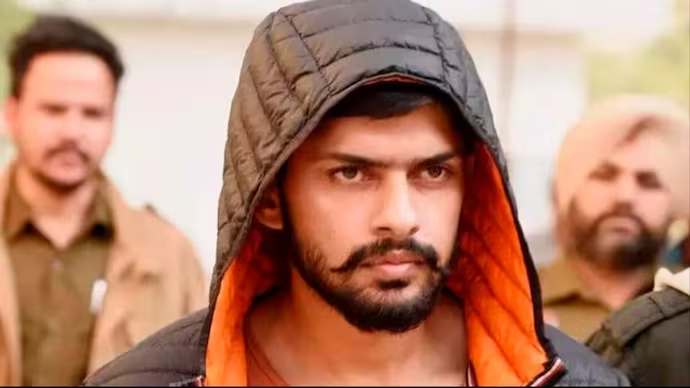
In a significant escalation of international law enforcement efforts, on July 7, 2026, the United States (US) Department of Justice unsealed three federal grand jury indictments, charging a total of 37 defendants connected to three India-based transnational organised crime syndicates. Operation Hard Ball involved coordination with Canadian, European, and other authorities and resulted in 24 arrests (including 11 in California, others in Indiana, Georgia, Canada, and Spain). With 7 persons already in custody, Law enforcement is looking for 10 fugitives (seven in the US, two in India and one in Europe). Enforcement agencies recovered 1,000 kilograms of cocaine, one kilogram of heroin, a dozen firearms, including machine guns, and USD 40,000 in cash. A total of 23 search warrants were executed in the Sacramento area, and 11 in the Los Angeles (L.A.) area.
Three major criminal groups were charged in L.A., centred on Punjab-based gangsters and their transnational operations involving racketeering, drug trafficking, extortion, and violence. The largest indictment targets Lawrence Bishnoi (33), a gangster long imprisoned in India, who is accused of directing a sprawling criminal enterprise across multiple continents from prison using smuggled cell phones and VOIP services, as well as his associate and designated terrorist Satinderjeet Singh aka Goldy Brar. Lawrence and Goldy Brar were close allies for a long time; reports from 2025 onward indicate a major split and ongoing gang war between the two factions, with Brar since aligned with Rohit Godaraagainst Bishnoi. However, in the context of the US charges, he is still treated as part of Bishnoi’s network. Separately, the Federal Bureau of Investigation (FBI) has declared a reward of up to USD 50,000 for information leading to Goldy Brar’s arrest. The indictment includes Rohit Godara, the leader of the Bishnoi gang in Europe, among nine defendants facing charges of racketeering conspiracy, Hobbs Act extortion and attempts, and drug trafficking of cocaine and methamphetamine. Prosecutors allege the group orchestrated murders, shootings, kidnappings, and extortions, including attempts to extort victims in L.A. and Thousand Oaks for USD 5 million via encrypted messaging apps like WhatsApp between December 2025 and January 2026. Significantly, Canada designated the Bishnoi enterprise a terrorist entity in September 2025.
A separate seven-count indictment charges Jaggu Bhagwanpuria (38), another imprisoned Punjab gangster and occasional rival, along with 16 co-defendants, for racketeering, murder-for-hire, kidnappings, weapons trafficking, and drug operations spanning the US, Canada, UK, Europe, Australia, and New Zealand, with funding allegedly derived from drug networks in L.A. and the Inland Empire in southern California as well as illegal firearms dealing. US prosecutors have accused Gurinderjit Singh Nagra, who was posted as Station House Officer (SHO) of the Tanda Police Station in Hoshiarpur district of Punjab, of assisting an extortion scheme linked to the Jaggu Bhagwanpuria network.
An eight-count indictment also targets Ravinder Singh Dhanda (57), aka Randy, aka Rolex, aka John Wick, of Vancouver, Canada, and co-defendants for smuggling and distributing hundreds of pounds of cocaine and methamphetamine weekly from Southern California into Canada, primarily using trucks.
The US Department of Justice highlighted the scale of the narcotics network operated by these criminal syndicates, stating that groups were involved in trafficking “hundreds of kilograms of cocaine and methamphetamine each week from the US into Canada.” According to the department, the drugs were transported through smuggling routes, with narcotics concealed in long-haul semi-trucks travelling from the Greater L.A. area – including L.A., West Covina, Ontario, Fontana, and Perris – towards the US-Canada border. The department further noted that criminal networks exploited legitimate commercial transportation channels to facilitate drug movement, including the use of farm trucks from working agricultural operations, to conceal narcotics during transit to Canada. The scale and complexity of these operations demonstrate the transformation of regional gangs into highly organised transnational criminal enterprises with established logistics, financial networks, and international supply chains.
A major aspect of the investigation is the alleged involvement of Lawrence Bishnoi and Goldy Brar in ordering the June 18, 2023, assassination of Hardeep Singh Nijjar, a prominent Sikh separatist leader, outside a gurdwara in Surrey, British Columbia (B.C.), in Canada. The syndicates linked to Bishnoi and his associates are accused of targeting members of the Indian diaspora, particularly in Canada and the US, including communities in California.
Operation Hardball represents a major setback for the leadership structure and operational capabilities of these networks while highlighting growing cooperation between US, Canadian, and international agencies in tackling transnational organised crime. The operation is expected to reduce immediate security threats faced by diaspora communities, particularly in areas such as Southern California, including L.A. and the Central Valley, as well as parts of B.C. The crackdown also affects the financial and logistical networks supporting these organisations and their drug trafficking routes. The case also highlights the changing nature of transnational crime, where regional gangs have evolved into international networks, and reflects strengthening law enforcement cooperation between the US, Canada, and other partner countries, despite ongoing diplomatic tensions. Enhanced intelligence sharing, coordinated investigations, and possible extradition efforts could play a crucial role in preventing these groups from rebuilding their networks. For India, the action reinforces long-standing concerns regarding gangsters and criminal elements operating from foreign territories, while also shifting attention towards the role of non-state actors in cases involving diaspora-related violence.
While the allegations unveiled in Operation Hard Ball have yet to be proven in court, the operation stands as a watershed moment in combating cross-border organised crime. The true and enduring impact of this indictment will, however, be judged by its long-term ability to structurally dismantle these violent networks and permanently depress criminal activity.
Note: The article is written by Ruchika Kakkar, Research Associate, Institute for Conflict Management.

