
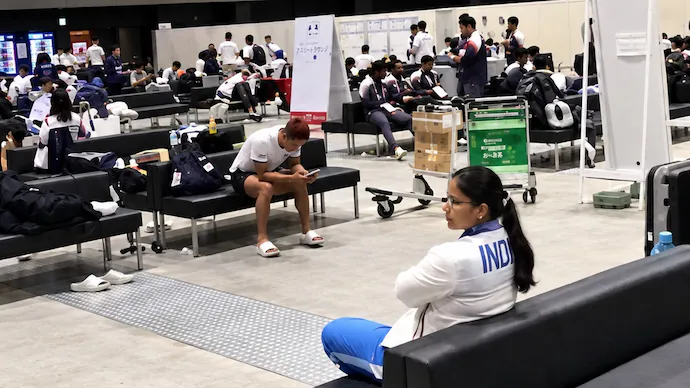
The 2026 Asian Games in Aichi-Nagoya, Japan, have run into a major crisis even before the opening ceremony, with athletes from several countries reporting problems ranging from delayed accommodation and transport failures to registration and accreditation issues. Visuals of athletes sleeping on the floors, stuck at the airport for hours, are becoming viral on social media.
On top of that, the food being served has also come under criticism, with athletes wondering how they will perform their best when they are not being given even nutritious food, or even enough food.
Asian Games athlete Varun Sanyal confirms the chaotic situation in Japan, with multiple athletes left stranded without proper accommodation.
Varun Sanyal will represent India in MMA at the Asian Games 2026. 🇮🇳 https://t.co/Tguc1ludIm— The Khel India (@TheKhelIndia) September 17, 2026
Thai Sepak Takraw Team Left Without Rooms at Asian Games
Thailand’s national sepak takraw team was forced to sleep on the floor of a cruise ship lobby after arriving in Nagoya for the 2026 Asian Games because their accommodation records were missing.
The athletes arrived on… pic.twitter.com/WNBPY5IRJ5— Thai Enquirer (@ThaiEnquirer) September 17, 2026
The most striking scenes have emerged around Nagoya, where athletes were reportedly left waiting for hours after arriving at the airport. A system failure meant that information for several athletes could not be located, preventing them from boarding designated shuttle buses. Some delegations were stranded for hours before arrangements were made.
Thailand’s Sepak Takraw team just had enough of the waiting for their rooms and decided to sleep on the floor instead, in an embarrassing image for the Japanese organisers.
The Indian contingent faced some of the greatest difficulties. Indian shooters reportedly waited nearly three hours for transport after reaching the airport and eventually reached their hotel around 4 am. The team was subsequently moved after the accommodation originally assigned to them was reportedly occupied by other participants. Some Indian athletes were also reportedly left waiting for rooms for several hours.
Accommodation has emerged as the biggest headache. Instead of constructing a conventional athletes’ village, organisers have opted for a combination of hotels, an Italian cruise ship and temporary container-style accommodation which has been described as like a slum. Around 4,000 participants are expected to stay aboard the cruise ship, while another 2,000 will use temporary units.
Complaints have gone beyond delayed check-ins. South Korean officials have criticised the temporary accommodation, including beds that are reportedly too short for taller athletes. There have also been cases where coaches, male and female athletes and team officials were assigned rooms together because of allocation problems.
Even Japan’s own team has reportedly been forced to consider backup hotel arrangements. Organisers have attributed the difficulties partly to the number of participants rising from an expected 15,000 to around 17,000 after additional sports were included.
With the opening ceremony scheduled for September 19, the organisers now face the task of fixing these logistical problems quickly and ensuring that athletes can focus on competition rather than accommodation and transportation. However, so far, these Asian Games have hurt Japan’s image of good management and having a high standard while hosting these events. In the interest of cost-cutting, have Japanese organisers gone too far and are now left facing embarrassment during a major sporting event.

