
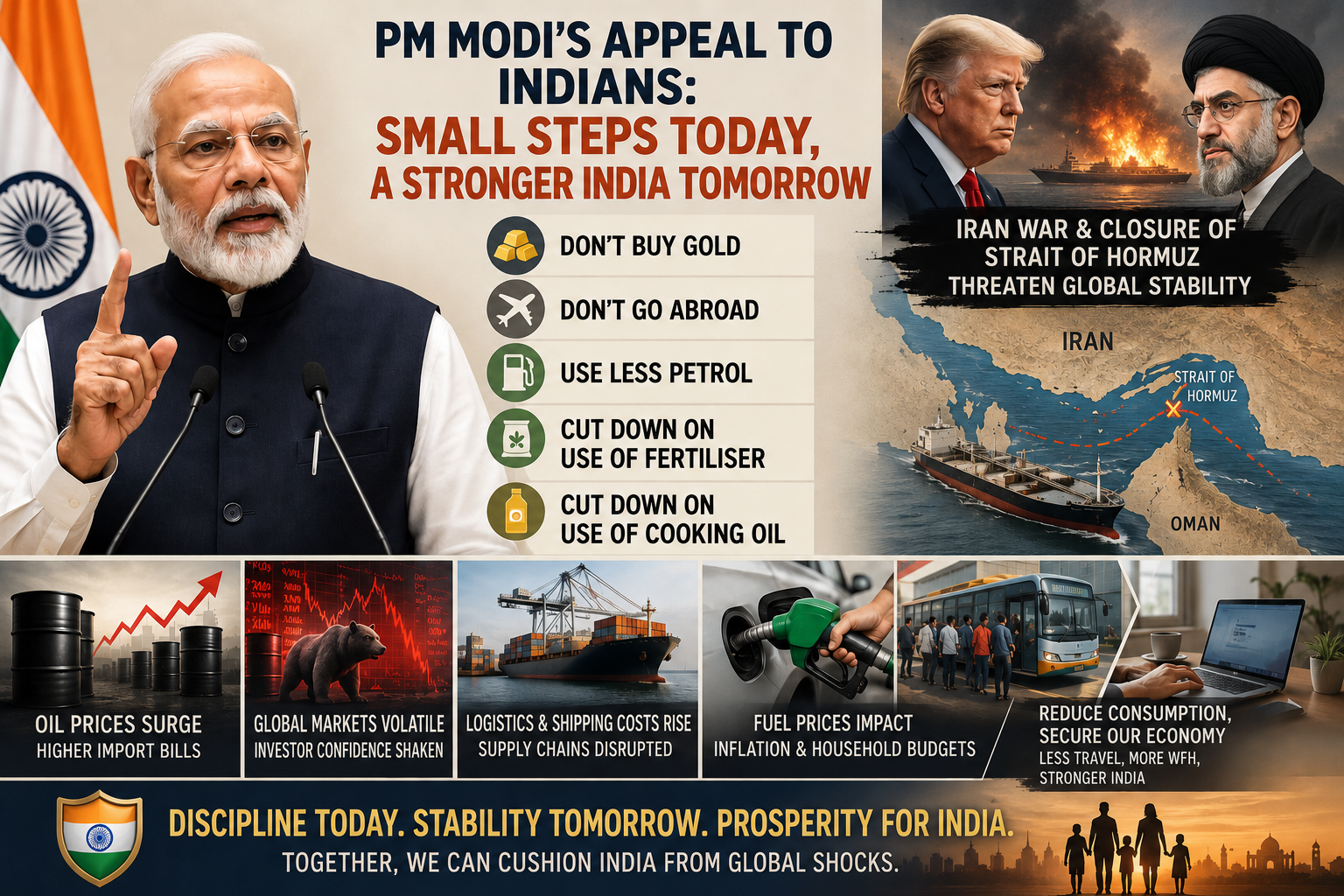
On Sunday, May 10, Indian Prime Minister Narendra Modi requested Indians to make lifestyle changes and help cushion the country from the economic repercussions of the Iran war. PM Modi requested fellow Indians that they shouldn’t buy gold, shouldn’t go abroad, should use less petrol, and should cut down on the use of fertiliser and cooking oil.
While opposition is attacking PM Modi for giving such advice, fact of the matter is that it is a very practical one in the current global scenario. The Iran war and the closure of Strait of Hormuz has thrown the entire world into turmoil, and in these circumstances, such measures have to be taken by citizens as well as their respective governments.
The continuing confrontation between the United States and Iran, coupled with the collapse of the latest peace efforts, has once again exposed how fragile the global strategic and economic order has become. After US President Donald Trump rejected Tehran’s latest response to Washington’s peace proposal as “totally unacceptable,” hopes of a negotiated settlement have dimmed sharply.
As diplomacy struggles and tensions rise across the Strait of Hormuz, the world economy is already beginning to feel the pressure. Oil prices have surged, global markets have turned volatile, and countries heavily dependent on imported energy — like India — face serious economic risks.
It is in this context that Prime Minister Narendra Modi’s recent suggestions appear not merely symbolic, but deeply practical.
Speaking amid fears of prolonged instability in West Asia, Modi urged Indians to conserve fuel, rely more on public transport, revive work-from-home practices where possible, and avoid unnecessary travel. While critics may dismiss these suggestions as overly cautious, the reality is that they reflect an understanding of how modern wars impact economies far beyond the battlefield.
India imports over 80 percent of its crude oil requirements, and any disruption in the Strait of Hormuz directly affects fuel prices, inflation, logistics costs, and eventually household budgets. Unlike previous regional conflicts, the current US-Iran confrontation carries the danger of prolonged maritime disruption and uncertainty in global energy markets. The latest breakdown in peace talks only increases that risk.
Modi’s recommendations are therefore rooted in economic realism rather than political optics.
The idea of reviving work-from-home arrangements, for example, is not about returning to pandemic-era restrictions. It is about reducing fuel consumption at a time when every barrel of imported oil matters. Millions of daily office commutes in major Indian cities translate into enormous petrol and diesel demand. Even a temporary reduction in non-essential travel can ease pressure on imports and help stabilize foreign exchange outflows.
Modi’s appeal for restraint also reflects a broader strategic mindset. India has traditionally avoided taking extreme positions in West Asian conflicts while maintaining relations with all major actors — the US, Iran, Israel, and Gulf nations alike. In a deeply polarized geopolitical environment, this balanced approach allows India to protect its economic interests without becoming trapped in the rivalry of other powers.
More importantly, the Prime Minister’s message acknowledges a truth many governments hesitate to communicate openly: Global crises now directly affect domestic economic stability. The age when wars remained geographically contained is over. A conflict thousands of kilometers away can instantly affect fuel prices in Delhi, transport costs in Mumbai, or food inflation in rural India.
The failure of US-Iran negotiations further demonstrates that military deterrence alone rarely produces durable peace. Despite repeated sanctions, threats, and strikes, Washington and Tehran remain locked in a cycle of distrust. As long as neither side is willing to compromise on core strategic interests, periodic escalations are likely to continue.
In an interconnected world shaped by energy insecurity and geopolitical volatility, practicality often matters more than grandstanding. And at this moment, India’s response appears guided more by realism than illusion.

