
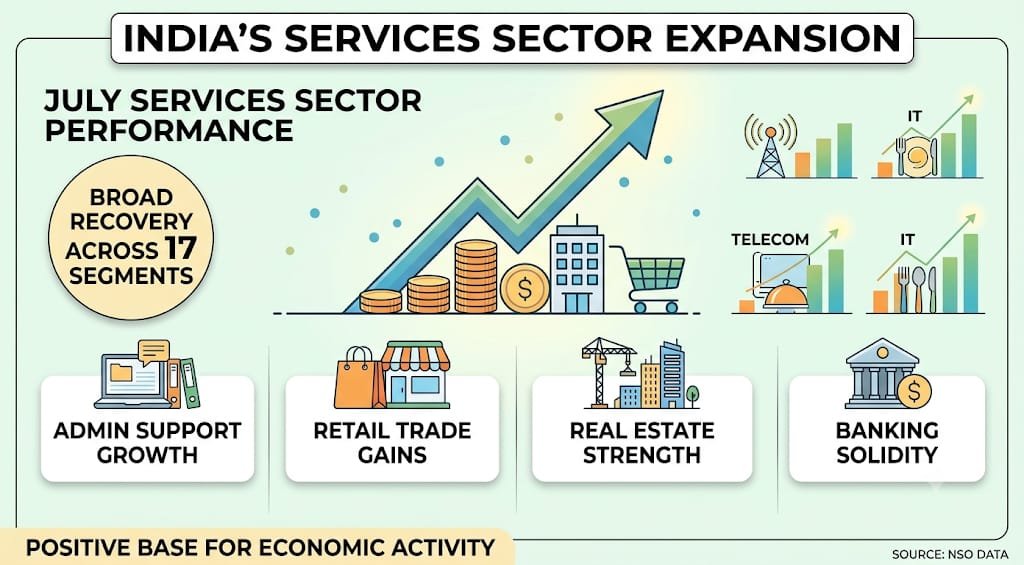
India’s services economy showed a wider and more encouraging recovery in July 2026, with activity expanding across 17 of the 19 service segments tracked by the government’s Index of Services Production.
The latest figures suggest that growth was not limited to only a few areas. Instead, many parts of the services economy recorded stronger year-on-year performance, creating a broader base for economic activity and offering positive signs for businesses, workers and consumers.
According to data released by the National Statistics Office on Tuesday, 10 of the 19 service sub-sectors recorded double-digit growth in July. This was an improvement over June, when eight sectors had achieved such growth.
The figures also showed that 11 sub-sectors recorded a higher growth rate in July than in June. Such a pattern indicates that the recovery was gaining strength across several everyday and business-related services.
Administrative and support services recorded the fastest growth, rising 20.9 per cent in July compared with 14.4 per cent in June. This sector includes several activities that support companies, offices and institutions, and its stronger performance points to increasing demand for organised business services.
Retail trade followed closely, growing 18.5 per cent after recording 18 per cent growth in June. The continued strength of retail activity reflects steady purchasing and improving movement through markets, shops and other consumer-facing businesses.
Real estate also performed well, although its growth slowed slightly to 14.4 per cent from 24.7 per cent in June. Food services recorded 12.6 per cent growth, while banking expanded 12.3 per cent.
Telecommunications grew 11 per cent, and information technology and computer-related services increased 10.7 per cent. Professional, scientific and technical services, including research and development, grew 10.4 per cent, while broadcasting recorded 10 per cent growth.
The leading service groups also showed a healthy improvement when measured by their weight in the index. Information technology and computer-related services, which have the largest weight of 22.47, grew 10.7 per cent in July compared with 13.5 per cent in June.
Retail trade, with a weight of 16.4, improved to 18.5 per cent from 18 per cent. Administrative and support services rose to 20.9 per cent from 14.4 per cent. Banking increased to 12.3 per cent from 11.4 per cent, while road transport grew 9.9 per cent after recording 9.7 per cent growth in June.
Transport services also delivered several positive signals. Postal and courier services accelerated to 8.7 per cent growth from 7.7 per cent in June. Railway transport growth rose sharply to more than double, reaching 7.5 per cent compared with 3.3 per cent earlier.
However, warehousing and support activities for transportation slowed to 9.8 per cent from 11.8 per cent. This suggests that some parts of the logistics chain improved, while others experienced a temporary moderation.
Repair services recorded the sharpest slowdown. Growth fell by 12.5 percentage points to a contraction of 5 per cent, compared with 7.5 per cent growth in June.
Air transport also remained under pressure, contracting for the fourth consecutive month. Its decline widened to 8.4 per cent from 6 per cent in June. These weak areas show that the recovery was broad but not completely even.
A comparison with the first release for April showed that 13 of the 19 sub-sectors recorded a decline in performance during the period. Six sectors did not experience a similar fall: water transport, railway transport, air transport, postal and courier services, information and broadcasting, and banking. In index terms, accommodation and food services recorded the highest level at 144.
Overall, the July figures present a hopeful picture of India’s services economy. Stronger retail activity, rising administrative support, stable banking growth, improving rail and courier services, and continued expansion in technology-related work point to a recovery with a wider reach.
Although repair and air transport services need attention, the larger trend remains positive because growth is spreading across more sectors and creating a stronger foundation for future economic progress.

