
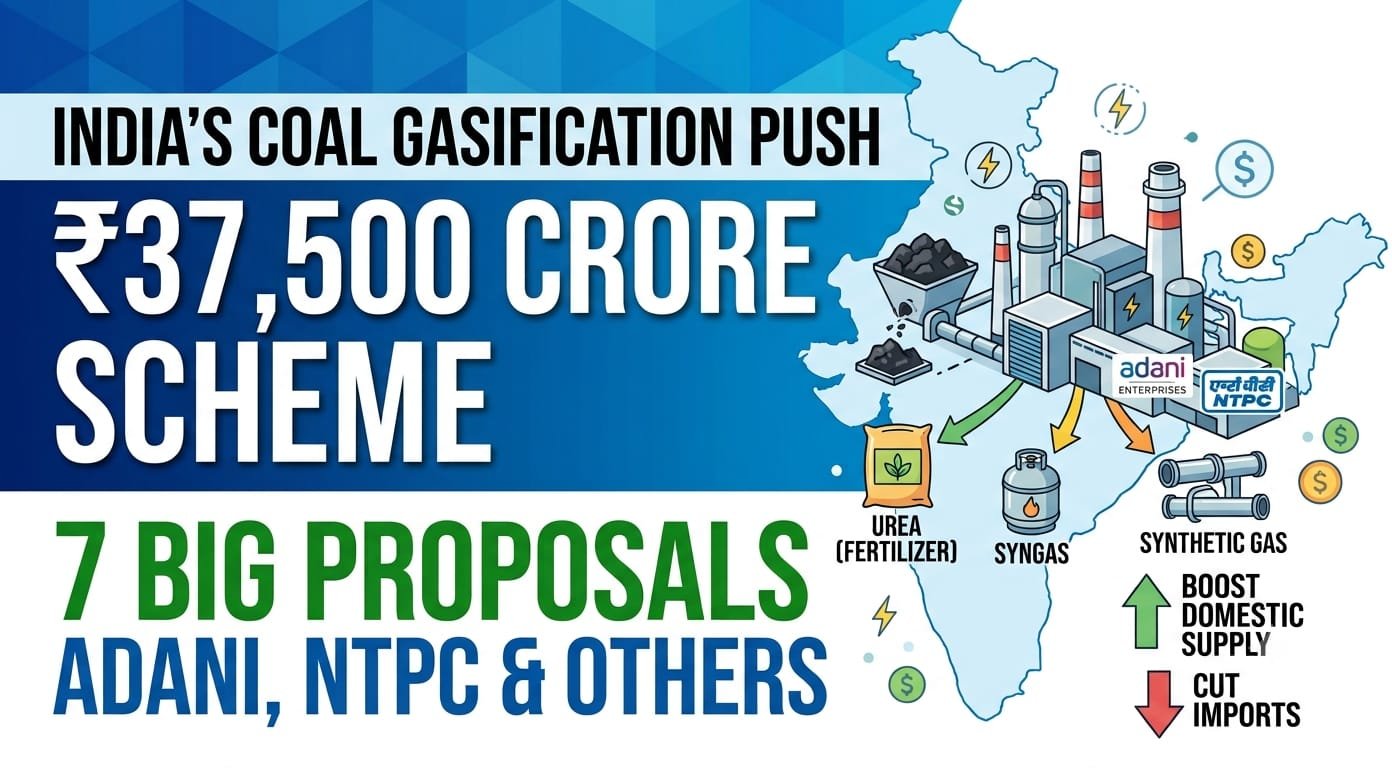
India’s ambitious plan to turn coal into cleaner, higher-value fuels and fertilisers has taken a big step forward with seven major applications in the first round of a ₹37,500 crore government scheme. The move comes as the country looks to rely less on expensive imports like LNG and urea while making better use of its own coal reserves.
The applications were submitted by some of India’s biggest industrial names. Adani Enterprises alone sent in three separate proposals, all focused on producing urea, a key fertiliser that India currently imports in large quantities. Alongside Adani, public sector giant NTPC has proposed a project to make synthetic natural gas, which could help replace some of the imported LNG used for power and industry.
Talcher Fertilisers, another major player in the fertiliser space, has also applied with a urea project, while Gallantt Ispat is looking at producing direct reduced iron (used in steelmaking) and syngas, a versatile fuel and chemical feedstock. Shyam Sel & Power has thrown its weight behind a syngas project as well.
The scheme, approved by the Union Cabinet in May 2026, is designed to encourage companies to set up coal and lignite gasification plants across India. Gasification is a process where coal is heated with limited oxygen to produce a gas mixture called syngas, which can then be converted into products like urea, methanol, ammonia, hydrogen and synthetic natural gas. By doing this domestically, India hopes to cut its import bill, which stood at around ₹2.77 lakh crore in FY25 for items like LNG, urea, ammonia and methanol.
What makes this scheme particularly attractive is the financial support on offer. The government has set aside ₹37,500 crore to back these projects, with a cap of ₹5,000 crore for any single project and up to ₹12,000 crore for a single company across multiple projects.
This support is meant to lower the risk for companies investing in gasification technology, which can be capital-intensive but offers long-term strategic benefits.
The first round of applications closed on September 7, 2026, and the seven proposals received will now go through a detailed evaluation process. But the government isn’t stopping there. A second round of applications opened on September 8, with windows set to open every two months to keep the momentum going.
Officials have expressed confidence that more companies will come forward, with expectations that the scheme could eventually catalyse investments of ₹2.5 to ₹3 lakh crore across nearly 25 projects.
The bigger picture here is about energy security and self-reliance. India has set a target of achieving 100 million tonnes of coal gasification capacity by 2030, a significant jump from current levels. This aligns with broader national goals of reducing dependence on foreign energy sources and making the most of domestic resources.
For a country that imports a large share of its fertilisers and natural gas, developing homegrown alternatives through gasification could mean more stable prices, better supply security and new job opportunities in regions with coal reserves.
The response from industry so far suggests that companies see potential in this approach. Adani’s multiple urea proposals, for instance, indicate a strategic push to expand domestic fertiliser production, which could help farmers and reduce the government’s subsidy burden on imported urea.
NTPC’s move into synthetic natural gas reflects a similar logic, aiming to create a domestic alternative to imported LNG that could be used in power generation, city gas networks and industrial processes.
As the evaluation of these first seven applications proceeds, attention will also turn to how quickly projects can move from paper to ground. Gasification plants take time to build, but with government support and clear policy direction, the timeline could accelerate. The opening of subsequent application rounds every two months ensures that the pipeline of projects keeps growing, giving more companies a chance to participate.
For ordinary citizens, the impact may not be immediate, but over time, successful gasification projects could mean more affordable fertilisers for farmers, lower gas prices for households and industries, and reduced pressure on India’s foreign exchange reserves from energy imports. The scheme also fits into the larger narrative of using India’s coal resources more efficiently and sustainably, turning a traditional fuel into a source of modern, value-added products.
With the first round done and the second underway, the coal gasification scheme is moving from announcement to action. The seven applications signal serious interest from both private and public sectors, and if the momentum holds, India could be well on its way to meeting its 2030 gasification target while strengthening its energy and industrial base.

