
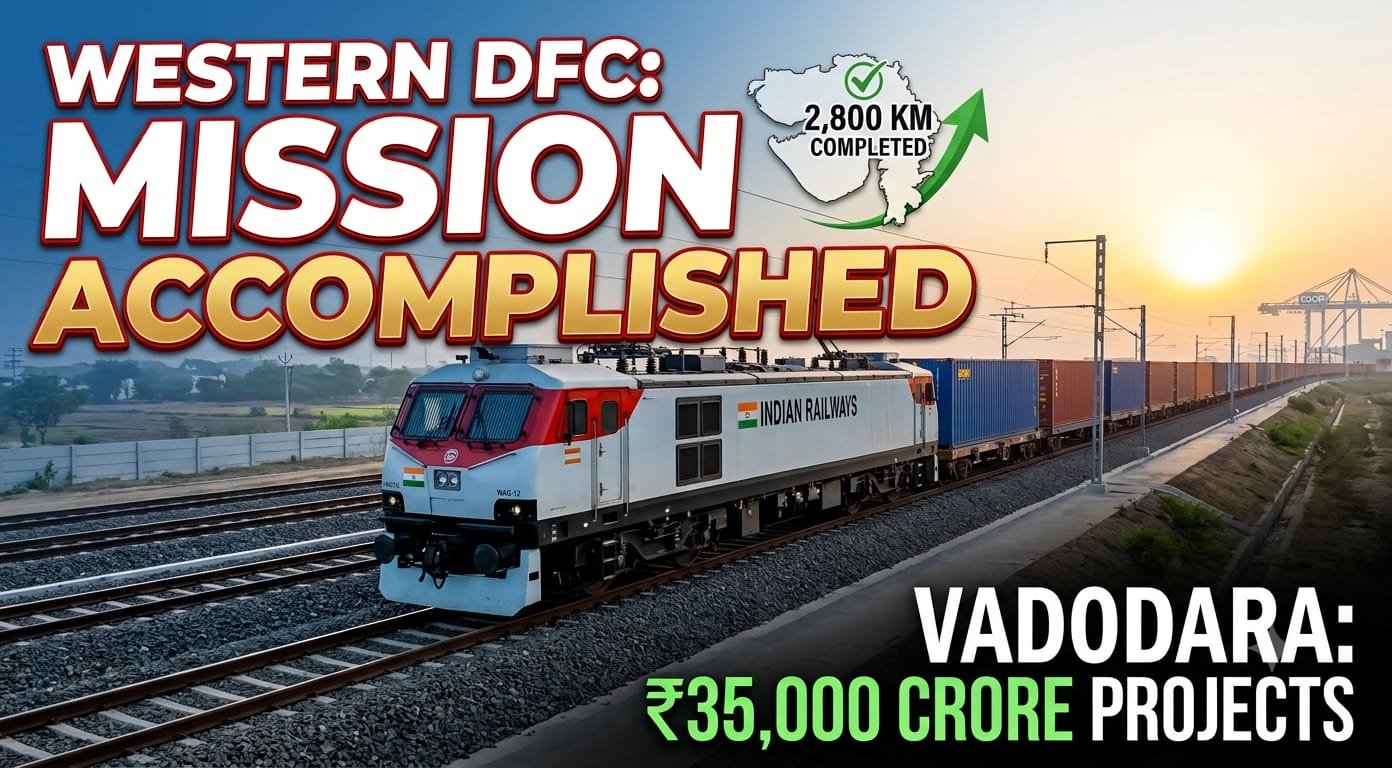
Prime Minister Narendra Modi’s visit to Vadodara on 8 September 2026 turned into a major milestone for India’s freight and logistics system, as the last missing links of the Western Dedicated Freight Corridor were opened for goods trains. With this, the entire 2,800 km Dedicated Freight Corridor network across the country became fully operational, something described as a historic achievement for twenty-first century India. The three new rail sections that were dedicated cover 326 route kilometres and have been built at a cost of more than ₹20,700 crore.
These sections run from New Sanand (North) to New Makarpura in Gujarat, from New Umbergaon to New Saphale on the Gujarat–Maharashtra border, and from New Saphale to the Jawaharlal Nehru Port Authority near Mumbai. Once fully functional, export and import cargo moving through JNPT will be able to reach industrial centres in Gujarat and beyond much faster, cutting transport time and cost for businesses.
As part of the same programme, freight services were flagged off from New Sanand (North), New Makarpura, New Umbergaon and New JNPT, showing how the corridor is now ready to handle large volumes of containers and bulk goods.
Alongside freight, a new passenger train between Tanda Road and Vadodara’s Pratapnagar was also started, giving better rail connectivity to people in the region.
The Jobat–Tanda Road new rail line, which forms part of the Chhota Udepur–Dhar project, was dedicated to improve access for remote and tribal areas of Alirajpur district to the wider railway network. Foundation stones were laid for three more railway projects stretching over 329 km and costing more than ₹9,700 crore.
These include adding third and fourth lines between Vadodara and Ratlam to decongest the existing route, converting the Miyagam Karjan–Choranda–Malsar section to broad gauge, and doubling the Vishwamitri–Dabhoi section to allow more trains to run smoothly.
Road infrastructure also received a push, with three highway projects worth around ₹1,780 crore being launched. One of the key schemes is the six-laning of the Kamrej–Chalthan stretch on National Highway 48, which lies on a busy corridor connecting Surat and other industrial towns. Better highways are expected to ease truck movement, reduce travel time and support the growing flow of goods linked to the new freight corridor.
On the renewable energy front, a 110 MW floating solar plant at Kadana Dam was among the projects inaugurated, showing how large water bodies are being used to generate clean power without占用 agricultural or forest land. Such projects help Gujarat move closer to its clean energy targets while also stabilising the local grid.
Urban development got attention too, with the second phase of the Vadodara Urban Development Authority ring road being launched to improve city traffic flow and connect emerging suburbs. A new office building for the Vadodara Municipal Corporation was also dedicated, signalling efforts to strengthen civic administration as the city expands.
Housing and basic services were not left out. Several housing projects under the Pradhan Mantri Awas Yojana were inaugurated, aiming to provide affordable homes to urban families in and around Vadodara.
A water supply project covering 11 villages in eastern Vadodara was also started, promising more reliable drinking water for rural households. Projects worth around ₹2,600 crore by the Gujarat government were included in the day’s announcements, reflecting coordination between central and state plans for balanced regional growth.
Taken together, the Vadodara event was not just about cutting ribbons on individual schemes but about connecting dots across rail, road, energy, housing and urban planning. The completion of the Western Dedicated Freight Corridor, in particular, is expected to change how goods move between western ports and the industrial heartland, making Indian exports more competitive and reducing logistics costs for manufacturers.
With new passenger trains, upgraded highways, floating solar capacity and expanded housing and water schemes, the package of over ₹35,000 crore aims to support both economic growth and everyday quality of life in Gujarat.

