
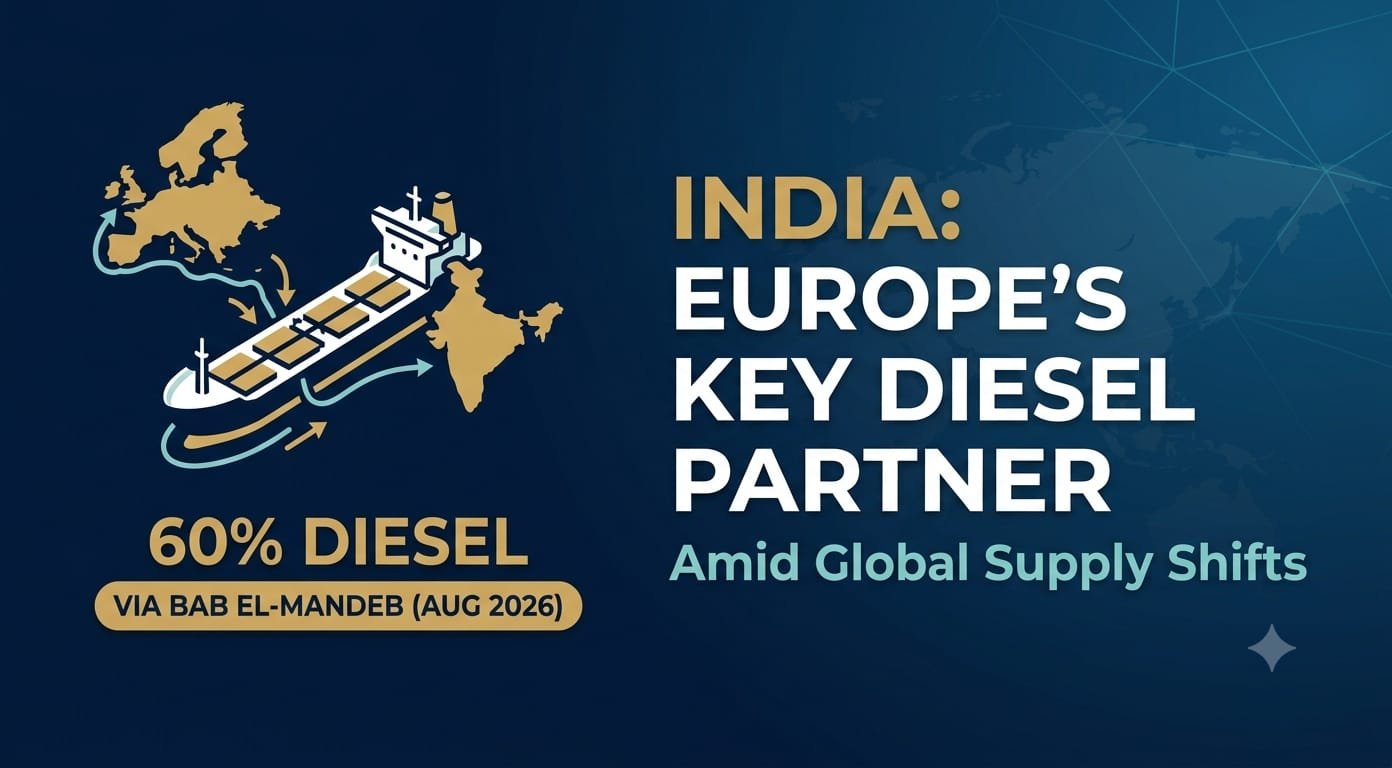
India has quietly become one of the most important players in Europe’s diesel market, a role that was once dominated by Russia and the United States. Recent data from August 2026 shows that Indian refineries supplied about 60 percent of all diesel shipments passing through the Bab el-Mandeb strait and heading to Europe.
This shift comes at a time when Russian diesel exports have fallen sharply due to ongoing disruptions, and American shipments have also started to weaken. The result is a new chapter in global energy trade, where India’s refining capacity is being relied upon more than ever before.
The story begins with the Bab el-Mandeb, a narrow but vital shipping route connecting the Red Sea to the Gulf of Aden. In August, around 2,00,000 barrels of diesel per day moved through this passage on vessels bound for Europe. This volume was close to what was seen a year earlier, after flows had nearly stopped in March and April due to regional tensions.
What stood out was the source of this fuel. Indian refineries accounted for roughly 60 percent of the total, making them the largest single supplier of diesel to eastern Europe during this period. This was not a one-off event but part of a broader trend that has been building over the past year.
Russian diesel, which used to be a major source of supply for Europe, has largely disappeared from the market. In the first 25 days of August, Russia’s seaborne diesel and gasoil exports averaged only about 1,50,000 barrels per day. This was down by more than 6,00,000 barrels per day compared to the same time last year and stood 81 percent below the five-year seasonal average.
The decline was so severe that Russia itself began importing gasoline to meet domestic needs. In August, Russia’s seaborne gasoline imports hit a record 1,25,000 barrels per day, with India, Turkey and Morocco among the suppliers. This reversal highlighted how much the global energy landscape had changed.
At the same time, the United States, which had been another major source of incremental diesel supply for Europe, also showed signs of pulling back. American shipments, which had helped fill the gap left by Russia in earlier years, began to weaken in 2026.
This created an opening that Indian refineries were quick to occupy. The ability of Indian plants to process large volumes of crude oil, including discounted Russian barrels, and turn them into refined products like diesel gave them a competitive edge. This was not just about volume but also about timing and reliability, which mattered greatly to European buyers.
The rise of India as a diesel supplier to Europe was not sudden. It had been building since 2023, when the European Union banned direct imports of Russian petroleum products. Over time, India’s exports of fuels like diesel to the EU grew significantly.
By the first three quarters of 2024, these exports had jumped by 58 percent compared to the previous year. Much of this fuel was likely refined from Russian crude, which India continued to import in large quantities. This created a situation where Russian oil, though banned directly, was still reaching Europe in refined form through Indian refineries.
The trend accelerated in 2025 and 2026 as the EU prepared for a stricter ban. From January 2026, the EU prohibited not just direct Russian oil but also fuels refined from Russian crude in third countries. This rule change created uncertainty for Indian exporters, especially those like Reliance Industries, which processed large amounts of Russian oil.
In response, European buyers began stockpiling diesel ahead of the ban, leading to a surge in Indian exports. In August 2025 alone, India’s diesel shipments to Europe rose by 137 percent compared to the previous year, reaching an 11-month high.
This pattern continued into 2026, with India maintaining its position as a key supplier. The country’s refineries, particularly those on the west coast, became crucial for Europe’s energy security. They filled part of the gap left by Russia at a time when other sources were also retreating.
This was especially important for eastern Europe, which had been more dependent on Russian supplies. Indian diesel helped keep markets stable and prices in check during a period of transition.
The broader picture shows how India’s role in global energy trade has evolved. From being a net importer of oil, it has become a major exporter of refined products. This shift was driven by investments in refining capacity, access to discounted crude, and the ability to respond quickly to market changes.
It also reflected a deeper integration into global supply chains, where India’s refineries acted as a bridge between crude producers and fuel consumers.
For Europe, relying on Indian diesel was a double-edged sword. On one hand, it provided an alternative to Russian supplies and helped avoid shortages. On the other, it meant that European demand was still indirectly supporting Russian oil exports, since much of the crude processed in India came from Russia. This created a complex dynamic where sanctions and market realities did not always align.
Looking ahead, the situation remains fluid. The EU’s 2026 ban on fuels refined from Russian crude could affect future Indian exports if stricter enforcement is applied.
However, India’s refining sector has shown resilience and adaptability in the past. Whether through diversifying crude sources or finding new markets, Indian refineries are likely to remain important players in the global energy landscape.
The story of India’s diesel exports to Europe is more than just about numbers. It reflects how geopolitical shifts, market forces and industrial capacity can reshape trade patterns in unexpected ways.
From supplying West Africa in early 2026 to becoming Europe’s key diesel partner by August, India’s refineries have demonstrated their strategic value. This role may evolve further in the coming years, but for now, it stands as a clear example of how energy flows are being redefined in a changing world.

