
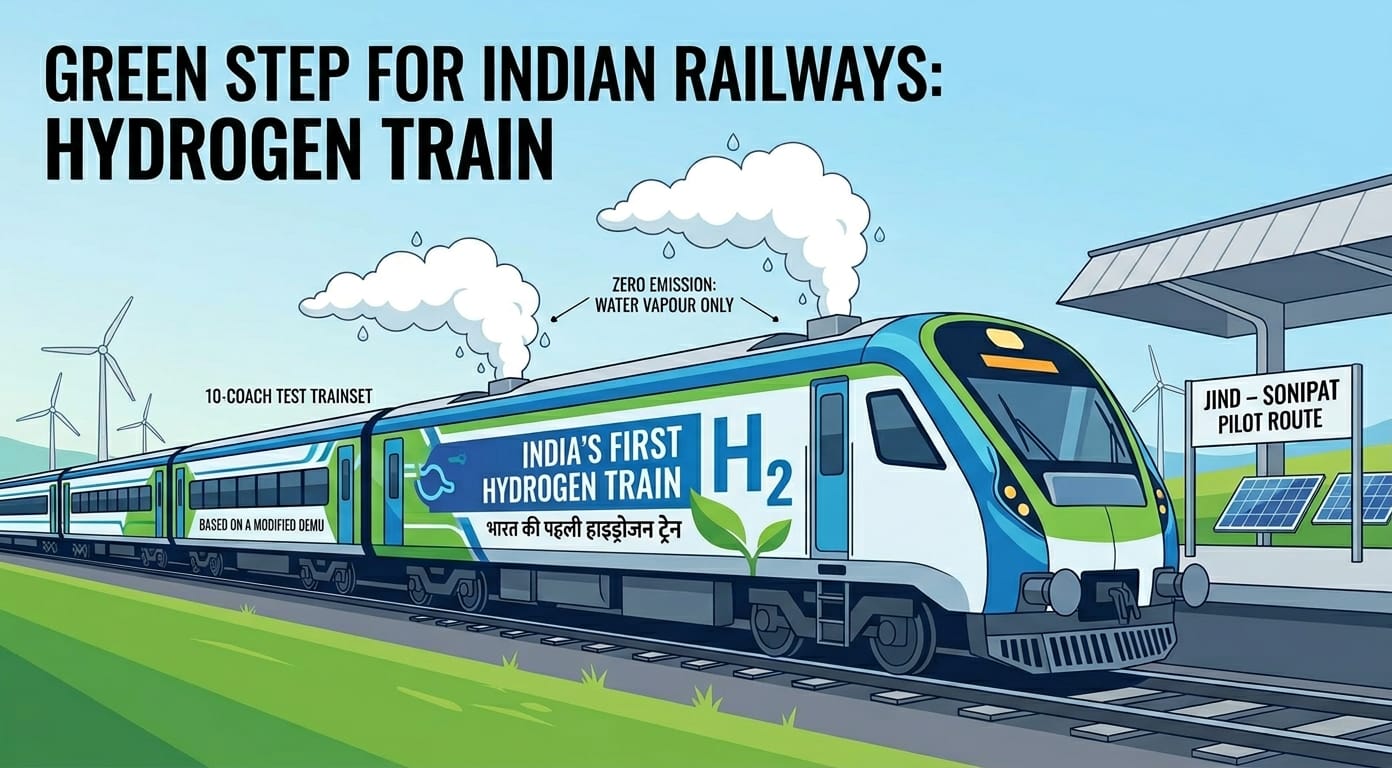
The government is getting ready for an important change in its railway system, and this change is about cleaner travel. The country’s first hydrogen train is now close to rollout, and it is expected to begin service on the Jind–Sonipat route in Haryana.
This is not just another train project. It is a sign that Indian Railways is trying to move toward a more modern and environmentally friendly future. The idea behind this train is simple: use hydrogen as fuel instead of diesel, and reduce pollution while keeping rail travel strong and reliable.
This train has been developed as a 10-coach hydrogen fuel cell-based trainset. It is designed to run at a maximum speed of 75 kilometres per hour on the Jind–Sonipat section. The train is powered by a 1,200-kilowatt hydrogen fuel cell propulsion system. In easy words, this means the train makes electricity from hydrogen and uses that power to move.
Since the main emission from this process is water vapour, the train is being seen as a cleaner transport option. For many people, this sounds like a small technical change, but in reality it is a major step for Indian railways and for green mobility in the country.
The government has allocated about ₹2,800 crore in the initial phase of the project. This shows that the plan is not just experimental talk; it is a serious investment. The article also mentions that development of 35 such trains is in the pipeline. That means this is only the beginning.
If the project succeeds, more hydrogen trains may appear in the future, which could change the way people think about train travel in India. Instead of depending only on older fuel systems, the country may slowly move toward cleaner energy in transport.
The Jind–Sonipat route has been chosen carefully. It is being treated as a pilot route for the operation of this new technology. The train has already been fitted on an existing diesel electric multiple unit base, which means India is testing a new power system on a familiar rail structure.
This approach is practical because it helps railway officials understand how hydrogen technology works in real conditions. The train is expected to run soon, and it is likely to become a key example for future green rail projects.
At the same time, the project is not without challenges. Hydrogen is a clean fuel during use, but it needs special care in storage, transport, and refuelling. Safety is very important because hydrogen is highly flammable. That is why the approval process includes strict safety rules, regular inspections, round-the-clock monitoring of the refuelling system, and trained staff for critical operations.
In simple terms, the train may be green, but it still needs strong protection and careful handling. This is one reason why such projects take time before full rollout.
The article also explains that India is now among a small group of countries exploring hydrogen rail transport, along with nations such as Germany, Japan, China, and the United States. This matters because it places India in an important global group working on new railway technology.
It shows that the country is not just following old systems, but is also trying to build future-ready solutions. For a country with such a large railway network, even one successful hydrogen route can create big learning for the future.
For ordinary people, the most important part of this development is simple: cleaner trains can mean cleaner air, lower dependence on fossil fuels, and a more modern transport system. It also shows that public transport can become more responsible toward the environment without losing its usefulness.
If this project works well, passengers may one day travel on trains that are not only fast and efficient, but also much kinder to the planet. This is why the rollout of India’s first hydrogen train is being watched with so much interest and hope.

