
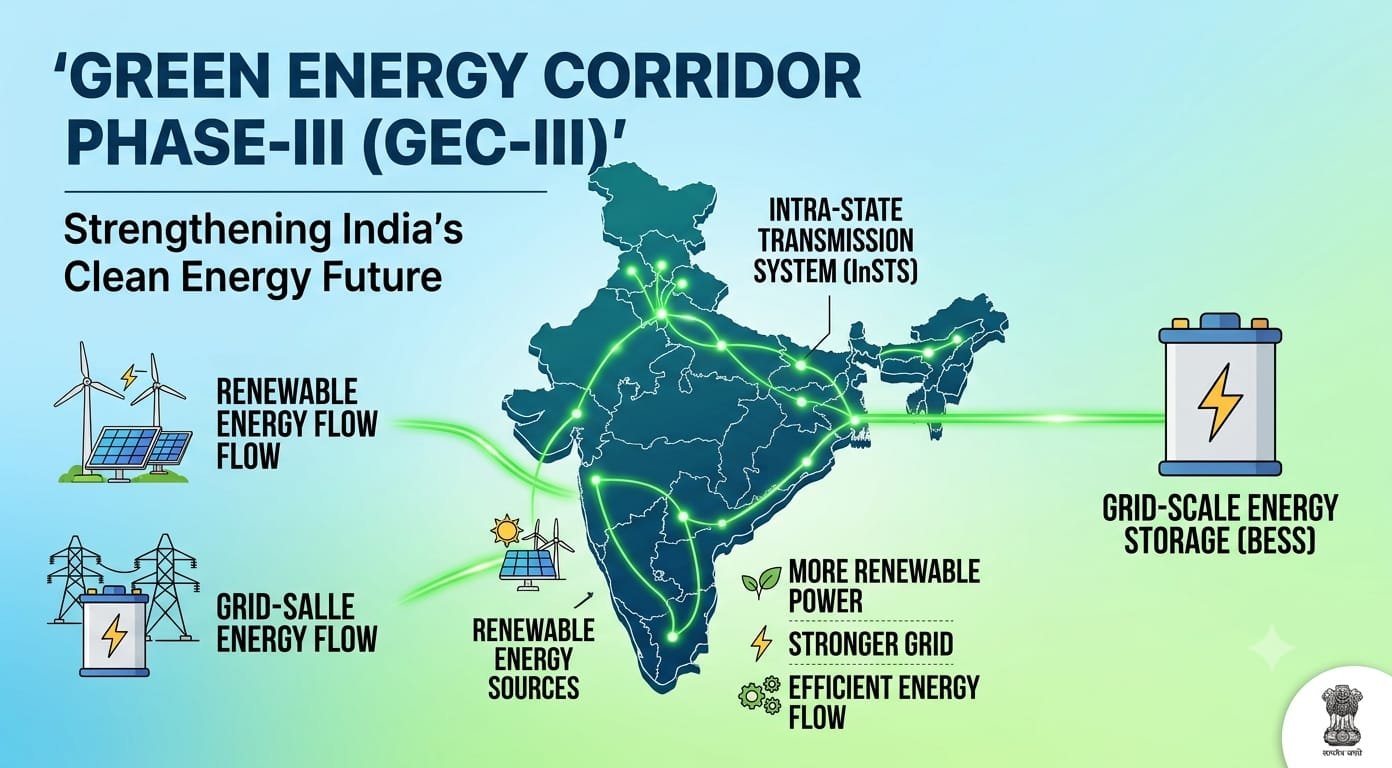
India’s transition towards clean energy is entering a crucial phase, with the focus increasingly shifting from expanding renewable energy generation to ensuring its efficient transmission, storage and integration into the national power grid. Recognising this need, the Union Cabinet, chaired by Prime Minister Narendra Modi, has approved the Green Energy Corridor Phase-III (GEC-III) scheme, marking a significant step towards strengthening India’s renewable energy infrastructure.
The scheme aims to develop the Intra-State Transmission System (InSTS) across States and Union Territories, enabling the evacuation of up to 135 Gigawatt (GW) of renewable energy. With a total project outlay of ₹1,86,405 crore, GEC-III reflects the Government’s sustained commitment to building a reliable, affordable and environmentally sustainable energy ecosystem.
The expansion of solar and wind power brings a fundamental challenge: renewable energy generation is inherently variable. Solar power generation peaks during daylight hours, while wind energy depends on weather conditions. Without adequate transmission infrastructure and storage capacity, this variability can lead to grid congestion, power curtailment and inefficient utilisation of generated electricity.
Green Energy Corridors address this critical infrastructure gap by strengthening transmission networks that connect renewable energy generation centres with consumption areas.
Under GEC-III, the Government has also provided for the deployment of 50 Gigawatt-hours (GWh) of Battery Energy Storage Systems (BESS). These systems will help store surplus renewable electricity and make it available during non-solar hours and periods of peak demand.
By improving grid flexibility, reducing transmission bottlenecks and supporting better utilisation of renewable energy, the scheme will contribute to a more stable and resilient electricity network.
The scheme allocates ₹1,36,378 crore towards the development of intra-state transmission infrastructure and ₹50,000 crore for battery energy storage systems. The total Central Financial Support stands at ₹54,082 crore.
This financial assistance will help offset intra-state transmission charges, thereby supporting efforts to keep electricity costs affordable for consumers.
Targeted for implementation by FY 2032-33, GEC-III demonstrates the importance of long-term infrastructure planning in achieving India’s energy transition objectives.
A key feature of the scheme is its clearly defined implementation framework.
Greenfield transmission projects will be developed through Tariff-Based Competitive Bidding (TBCB), while brownfield upgrades and network-strengthening works will follow the Cost Plus Basis model.
State Transmission Utilities will serve as the overall implementing agencies, while Transmission Service Providers will undertake competitively bid projects under the Build-Own-Operate-Maintain (BOOM) model.
This institutional architecture combines government support, state-level coordination and private-sector participation, creating a structured mechanism for infrastructure development and long-term operations.
Beyond energy infrastructure, the scheme is expected to generate direct and indirect employment across power, manufacturing and construction sectors. Battery storage deployment will also support the growth of India’s domestic energy storage industry and create skilled employment opportunities in operations, maintenance and grid management.
Ultimately, the significance of Green Energy Corridor Phase-III lies in its integrated approach. By aligning infrastructure investment, financial assistance, technological advancement and institutional coordination, India is building the foundations for a clean energy system that is not only greener, but also more reliable, affordable and capable of supporting its long-term economic growth.

