
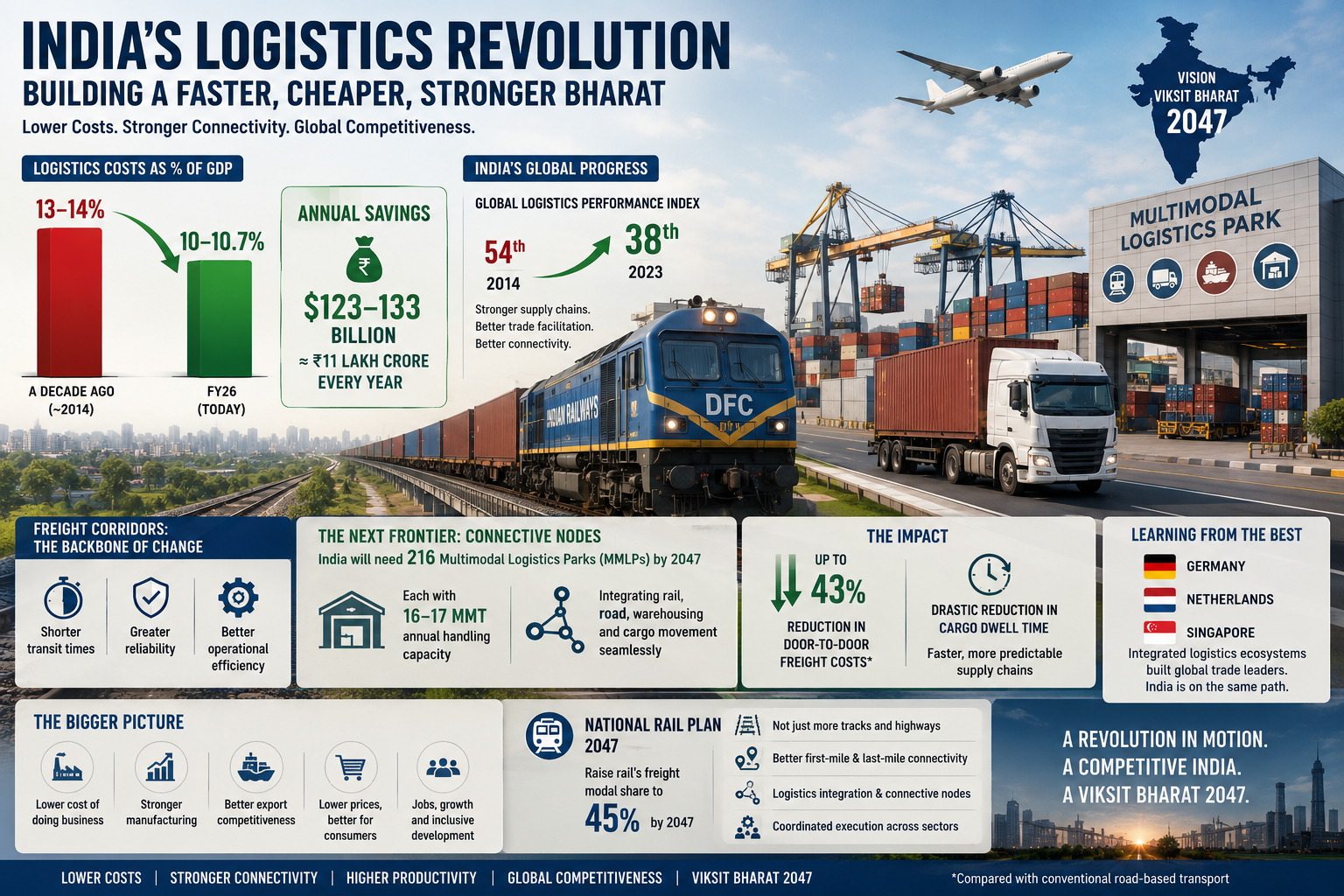
Imagine an economy where simply moving goods across the country consumes 13–14% of national output every year. That was India’s reality barely a decade ago. Transporting coal, containers, manufactured products, and agricultural goods involved delays, high costs, fragmented networks, and heavy dependence on roads.
Today, that picture is changing rapidly
According to a recent CII–Knight Frank report, India’s cumulative infrastructure investment of nearly $360 billion over the past decade has helped reduce logistics costs from 13–14% of GDP to approximately 10–10.7% in FY26. That reduction translates into estimated annual savings of $123–133 billion for the economy — roughly ₹11 lakh crore every year. Those savings do not remain confined to transport companies; they flow through manufacturing, exports, warehousing, retail supply chains, and ultimately influence the prices consumers pay.
The global impact of this transformation is also becoming visible
India’s position in the Global Logistics Performance Index improved from 54th place in 2014 to 38th in 2023, reflecting stronger supply chain performance, improved trade facilitation, and better national connectivity. While rankings alone do not define economic success, they indicate that India’s logistics ecosystem is becoming more competitive and efficient on the global stage.
One of the major drivers behind this shift has been the development of freight-focused infrastructure, particularly the Dedicated Freight Corridors (DFCs).
These corridors were designed to separate cargo movement from passenger traffic and improve reliability and speed. The result is shorter transit times, greater predictability, and improved operational efficiency. Freight corridors are increasingly being positioned as the backbone of India’s long-term industrial and export ambitions.
But despite these gains, experts argue that India’s logistics transformation is only partially complete.
The latest report identifies a new challenge: infrastructure alone is no longer enough. The next phase requires stronger “connective nodes” — systems that integrate rail, road, warehousing, and cargo movement into a seamless network. This is where Multimodal Logistics Parks (MMLPs) become critical.
According to the report, India will require 216 MMLPs by 2047, each with an average annual handling capacity of 16–17 million metric tonnes, to meet long-term freight modal shift targets. These facilities are expected to connect transport modes efficiently, reduce handling delays, and improve cost competitiveness.
The potential gains are substantial
Integrated MMLPs operating alongside freight corridors could reduce total door-to-door freight costs by as much as 43% compared with conventional road-based transport. Cargo dwell time — the time goods remain idle during transfer — could also fall dramatically, making supply chains faster and more predictable for sectors such as FMCG, automotive, manufacturing, and e-commerce.
Countries such as Germany, the Netherlands, and Singapore built their global trade advantages through integrated logistics ecosystems rather than isolated infrastructure projects. India now appears to be following a similar path.
The broader objective is reflected in the National Rail Plan, which aims to raise rail’s freight modal share to 45% by 2047. Achieving that target will require not just new tracks and highways but better first-mile and last-mile connectivity, logistics integration, and coordinated execution across sectors.
India’s logistics revolution, therefore, is not merely a story of trains, roads, and warehouses. It is a story about lowering the cost of doing business, strengthening manufacturing, improving export competitiveness, and building the foundation for the vision of Viksit Bharat 2047.

