
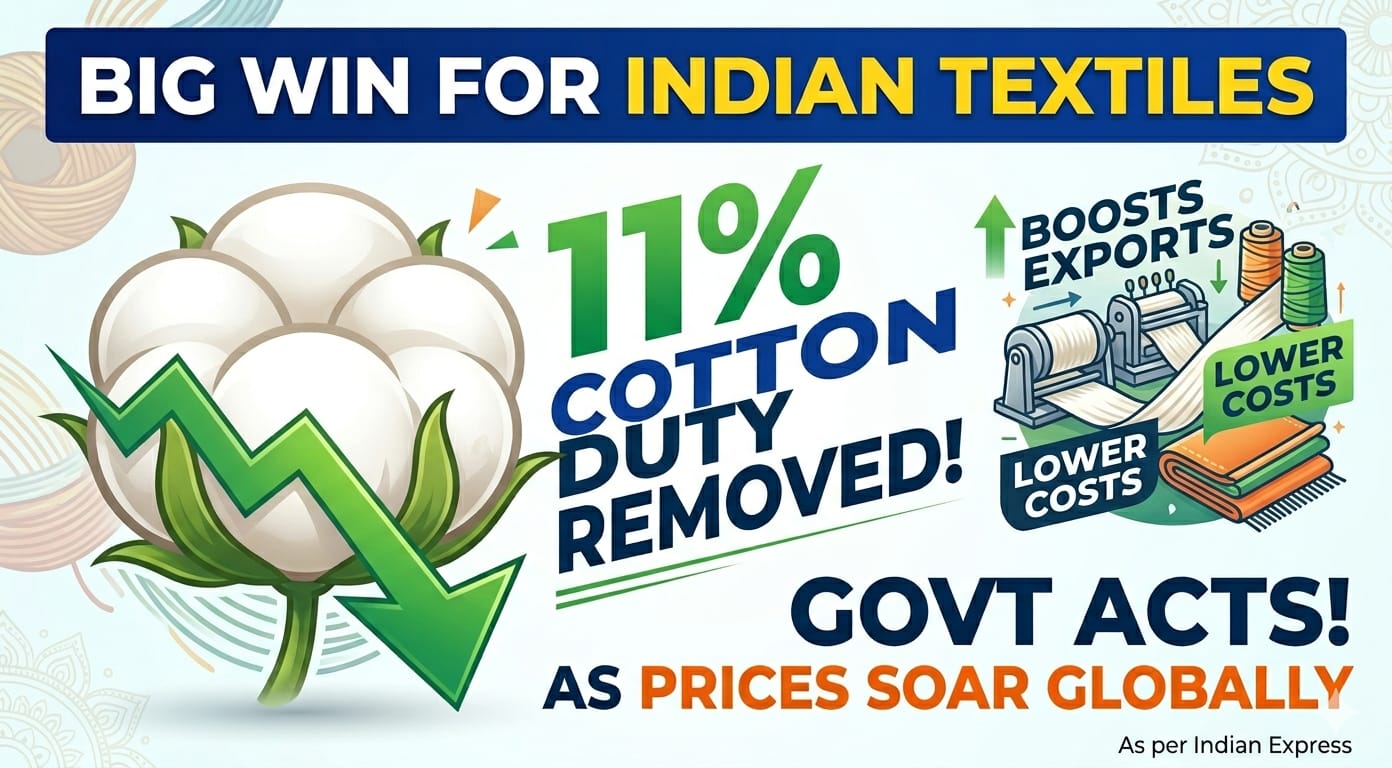
The Union government is about to take a big step that will directly help millions of people working in India’s textile industry. As reported by Indian Express, the Centre is set to remove the 11% import duty on cotton until October 2026.
This decision comes at a critical time when cotton prices have surged sharply because of the ongoing war in West Asia, which has disrupted global supply chains and pushed up raw material costs across the world.
Why does this matter to us? If we wear cotton clothes, buy home textiles, or follow news about Indian jobs and exports, this news touches your life. Cotton is the main raw material for India’s textile sector, which employs over 45 million people and contributes heavily to India’s exports.
When cotton becomes expensive, yarn becomes costly, fabric prices rise, and eventually, the final garment you buy becomes pricier. The 11% duty was adding extra cost on top of already soaring global cotton prices, making Indian textile products less competitive against countries like Bangladesh, Vietnam, and Pakistan, which do not charge such duties on cotton imports.
According to Indian Express, the government’s move to remove this duty will cut input costs for textile manufacturers by around 7–8%. This saving will not stay with the factory alone; it will flow down the chain.
When input costs drop by 7–8%, the final pricing of cotton products can also come down by a similar margin, making Indian fabrics and garments cheaper both for domestic buyers and for foreign customers. This is exactly what the government wants: to make Indian textiles competitive globally so that orders stay in India and jobs are protected.
The timing is crucial. Cotton prices have jumped nearly 25% in just two months, according to industry reports, because domestic supply is short and the West Asia conflict has increased freight and logistics costs.
Synthetic fibres, oil-based raw materials, dyes, and chemicals have also become more expensive. In Tiruppur, a major textile hub in Tamil Nadu, fabric output has fallen by half due to these pressures, and yarn prices have risen from ₹235 per kg to ₹300 per kg in just a month. Spinning mills and powerloom units have reduced production by up to 50% because buyers are waiting for prices to stabilise.
The Cotton Association of India had long urged the government to withdraw this 11% duty, saying that Indian cotton is now selling at 15% higher prices than international cotton. Without duty-free access to imported cotton, Indian manufacturers could not match global prices, hurting exports of value-added textile products.
The Confederation of Indian Textile Industry (CITI) also highlighted that competitors like Sri Lanka, Bangladesh, Vietnam, and Pakistan do not have such restrictions, putting India at a disadvantage.
This is not the first time the government has taken such a step. The 11% duty on cotton was temporarily waived from August to December 2025 to ease pressure from high US tariffs, and it was reinstated on January 1, 2026.
Now, with the West Asia war creating fresh supply shocks, the government has decided to exempt cotton imports from duty again, this time until October 2026. The exemption covers both the basic customs duty and the Agriculture Infrastructure and Development Cess (AIDC), ensuring that the relief reaches the entire textile chain – yarn, fabric, garments, and made-ups.
For you as a reader, this means that the price rise you might have expected in cotton clothes and home textiles could be slowed down or even reversed in the coming months. For textile workers, this means more stable production and a better chance of job security.
For India’s economy, this means stronger exports and a more competitive position in the global market. As Indian Express puts it, the move is aimed at offering “relief to textile manufacturers facing increased costs” and keeping India’s textile sector viable in a difficult global environment.
In simple terms, the government is removing a tax that was making cotton expensive, so that Indian factories can buy raw material at fair prices, keep making clothes and fabrics, and continue selling them at competitive rates around the world. This is a practical, timely decision that connects global events like the West Asia war directly to your wardrobe, your job, and India’s economic strength.

