
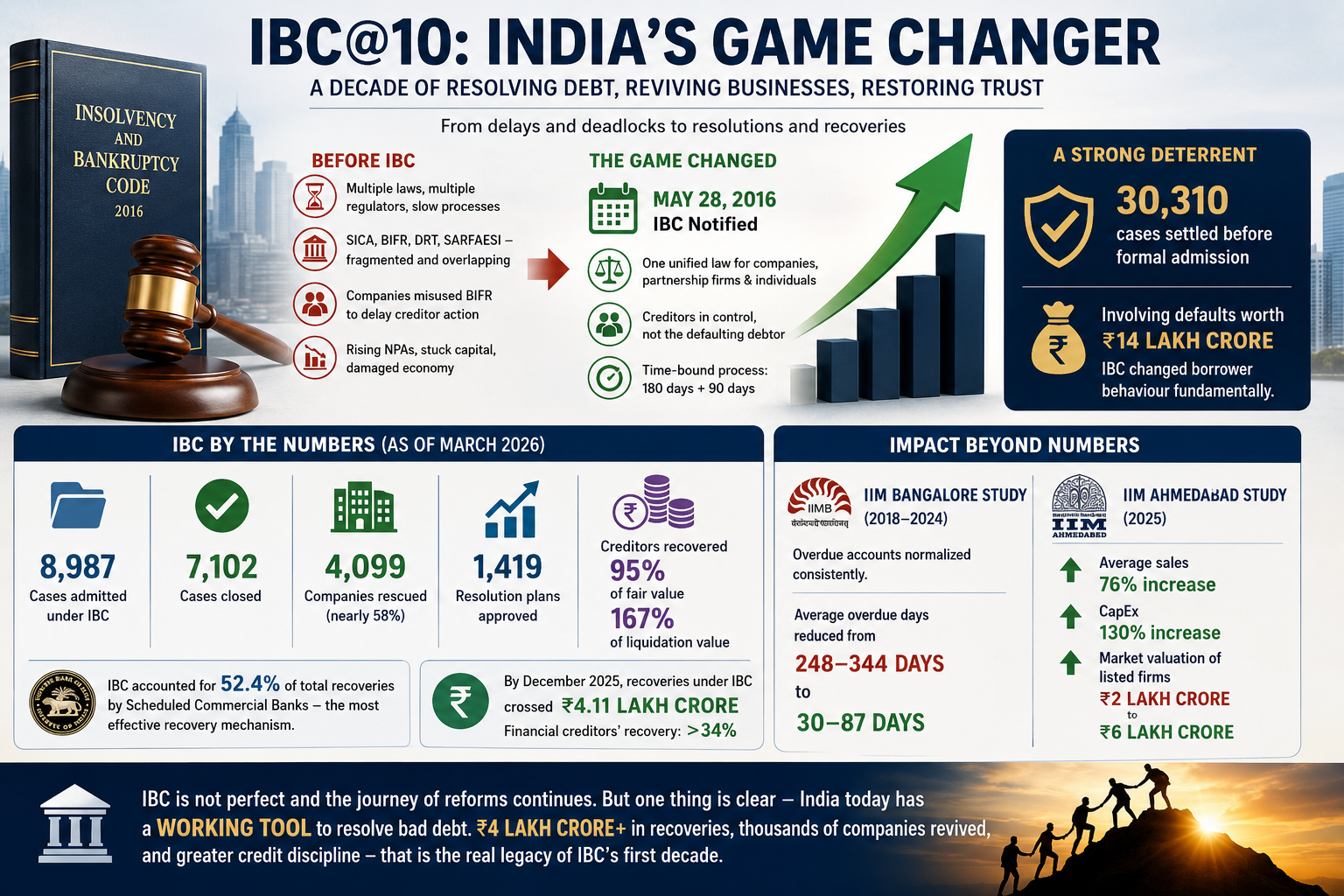
Imagine lending money to someone, only to spend years watching court hearings drag on without any resolution. That was the reality of corporate and industrial lending in India before 2016. Banks were trapped in endless legal battles, companies continued operating despite mounting defaults, and bad loans kept piling up on balance sheets. Then came a law that fundamentally changed the system — the Insolvency and Bankruptcy Code (IBC).
Before the introduction of IBC, India did not have a unified framework for insolvency resolution. Instead, the system was fragmented across multiple laws and institutions. The Sick Industrial Companies Act (SICA) and the Board for Industrial and Financial Reconstruction (BIFR) were meant to rehabilitate financially distressed companies. Debt Recovery Tribunals (DRTs) handled debt recovery cases, while the SARFAESI Act empowered secured creditors to recover assets.
However, these mechanisms were slow, overlapping, and often ineffective. Many companies approached BIFR not to genuinely revive their businesses, but simply to delay creditor action. As cases dragged on for years, banks remained stuck with rising Non-Performing Assets (NPAs), reducing their ability to lend productively and hurting the broader economy.
Recognizing the need for a modern and time-bound insolvency framework, the Government of India notified the Insolvency and Bankruptcy Code on May 28, 2016. The IBC created a single, consolidated mechanism to deal with insolvency for corporate entities, partnership firms, and individuals under one framework.
The most transformative shift introduced by IBC was the transfer of control from debtors to creditors. Under the earlier system, defaulting promoters often continued controlling companies even after failing to repay loans. Under IBC, once a default occurs, creditors can initiate the Corporate Insolvency Resolution Process (CIRP), and management control shifts away from the promoters.
Ten years later, the results indicate that the law has significantly reshaped India’s credit ecosystem.
According to Insolvency and Bankruptcy Board of India (IBBI) Chief Ravi Mital, by March 2026, a total of 8,987 cases had been admitted under IBC, of which 7,102 cases had already been closed. Out of these, 4,099 companies — nearly 58 percent — were successfully rescued through resolution rather than liquidation.
Recovery rates have also shown strong outcomes. Through 1,419 approved resolution plans, creditors recovered nearly 95 percent of the fair value and 167 percent of the liquidation value of stressed assets. This suggests that resolving distressed firms as going concerns often delivers significantly better outcomes than simply liquidating them.
Data from the Reserve Bank of India further highlights IBC’s growing importance in India’s banking system. According to RBI figures, IBC accounted for 52.4 percent of total recoveries made by Scheduled Commercial Banks, making it the most effective recovery mechanism available to lenders. By December 2025, recoveries under the framework had crossed ₹4.11 lakh crore, while financial creditors achieved recovery rates exceeding 34 percent.
The impact of IBC has not been limited to numerical recoveries alone. It has also changed borrower behaviour. The very threat of losing control of a company has acted as a powerful deterrent against wilful defaults. In fact, around 30,310 cases involving defaults worth nearly ₹14 lakh crore were settled even before formal admission into the insolvency process. This demonstrates that IBC’s influence extends beyond courtroom resolutions — it has altered incentives across the financial system.
Academic studies also point toward improving credit discipline after the implementation of IBC. A study by IIM Bangalore found that between 2018 and 2024, the normalization of overdue accounts improved steadily, while the average duration of overdue accounts fell sharply from 248–344 days to just 30–87 days.
Another 2025 study by IIM Ahmedabad revealed that companies resolved under IBC witnessed an average 76 percent increase in sales and a 130 percent rise in capital expenditure. The market valuation of listed resolved firms reportedly increased from ₹2 lakh crore to nearly ₹6 lakh crore, indicating that successful resolutions can revive businesses rather than merely close them down.
Of course, the IBC is not perfect. Delays continue to remain a challenge, tribunals face capacity constraints, and the law has undergone several amendments over the years. More reforms will likely be needed to further improve timelines and recovery rates.
Yet, despite its shortcomings, the broader picture is clear. India today finally possesses a functioning institutional mechanism to deal with bad industrial debt. More than ₹4 lakh crore in recoveries, the revival of thousands of companies, and a visible improvement in borrower discipline together form the true legacy of IBC’s first decade.
For a country once burdened by endless insolvency disputes and mounting NPAs, that represents a structural transformation.

