
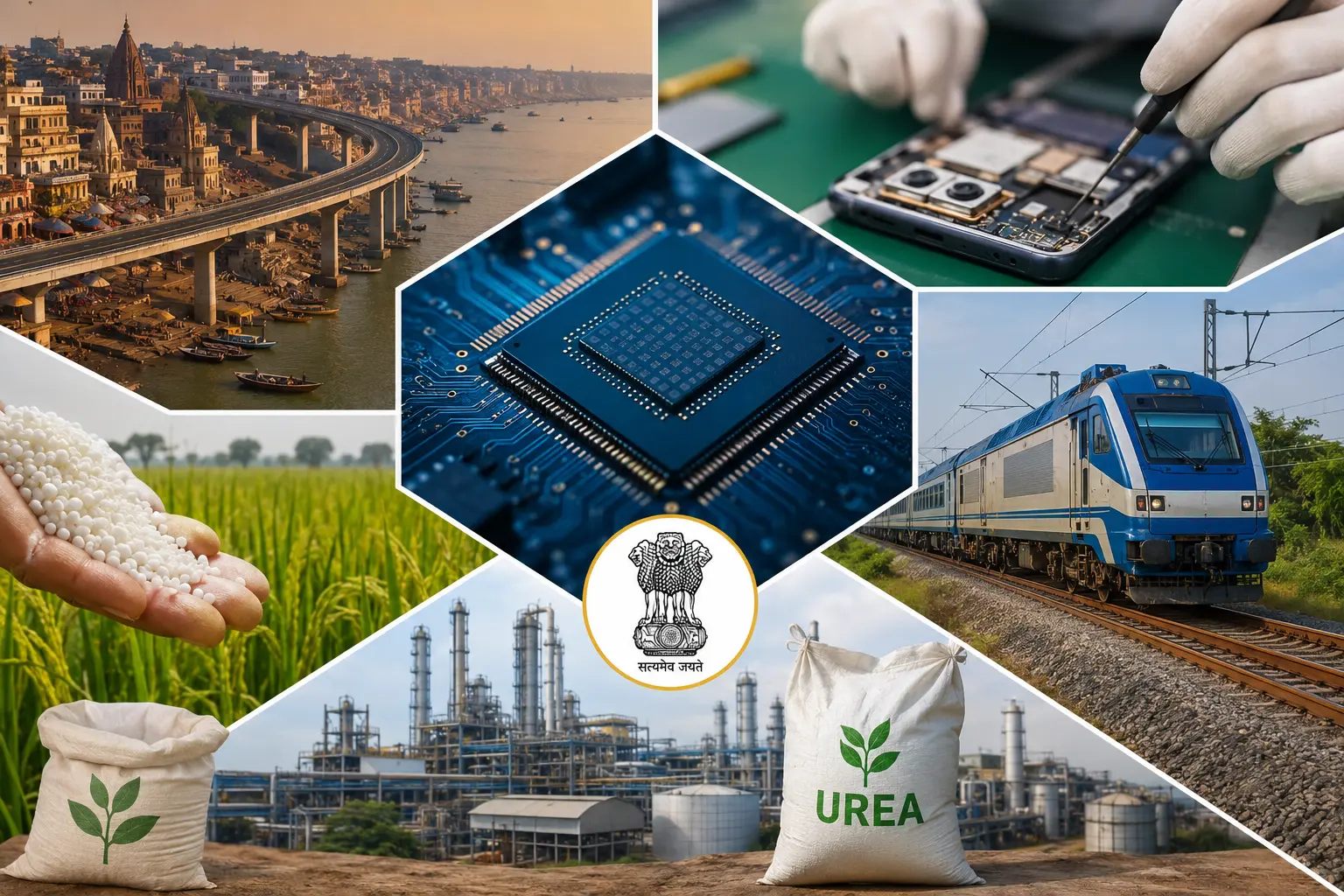
The Union Cabinet has approved seven big projects ranging from fertiliser, elevated corridor on rivers in Varanasi to semiconductor and mobile phone manufacturing. Union Minister Ashwini Vaishnaw shared the details, and together these seven projects add up to a massive Rs 2,19,353 crore.
The first two decisions are about Varanasi, also called Kashi. Two elevated corridors have been approved: one along the River Varuna costing Rs 10,998 crore, and another along the River Ganga costing Rs 14,448 crore.
The Cabinet also approved “Semicon 2.0,” a scheme worth a whopping Rs 1,27,500 crore, aimed at building a stronger semiconductor ecosystem. The scheme rests on six pillars: chip design, machines and materials, setting up more fabs (factories that make chips), strengthening packaging units, research and development, and talent development. Each pillar comes with its own incentive. For example, setting up silicon fabs gets 40% government support, while other fabs get 35%. Machines and materials get 30% support, and research plus talent development can get up to 75% support, shared between central and state governments.
Already, more than 68,000 students across 315 universities have been trained in chip design, and over a hundred startups have gained access to professional design tools. This scheme is basically trying to make sure that fewer chips need to be imported from elsewhere in the future, and more can be designed and built right here.
Alongside chips, the Cabinet also approved the Mobile Phone Manufacturing Scheme, with an allocation of Rs 62,500 crore. This scheme sits nicely alongside Semicon 2.0, because once chips are made locally, they can be assembled into components and finally into finished mobile phones, cameras, and other electronic gadgets. It’s like a relay race: raw materials pass the baton to chip makers, who pass it to component assemblers, who pass it to phone manufacturers, ending with the finished product in your hands.
The cabinet also cleared the National Investment Policy for Urea-2026. This is a policy decision rather than a straight cash allocation, but its goal is important: reducing dependence on imported urea and encouraging local production. Since urea is one of the most widely used fertilizers, this move is expected to matter a great deal for farming communities and food production in the years ahead.
Finally, two railway infrastructure projects rounded off the announcements. The doubling of the Paradeep–Haridaspur line was approved at Rs 2,542 crore, and a fourth railway line between Dangoaposi and Rajkharsawan got the go-ahead at Rs 1,365 crore. Doubling or adding new lines usually means trains can run more frequently and carry more freight, which helps industries that depend on rail transport for moving goods like minerals, steel, or coal.
At first glance, these might look like just numbers in a government table. But together, they tell a bigger story: an attempt to build stronger local chip-making abilities, support electronics manufacturing, help farmers with fertilizer self-reliance, and improve transport infrastructure in both a spiritually significant city and industrial railway corridors. Whether someone who uses a smartphone daily, works in agriculture, or simply commutes to work by train, these seven decisions are quietly aimed at shaping things that touch daily life.
This round of Cabinet approvals shows a clear pattern: invest early in the building blocks (chips, materials, fertilizer production), and the benefits are expected to show up later in everyday products and services people rely on.

