
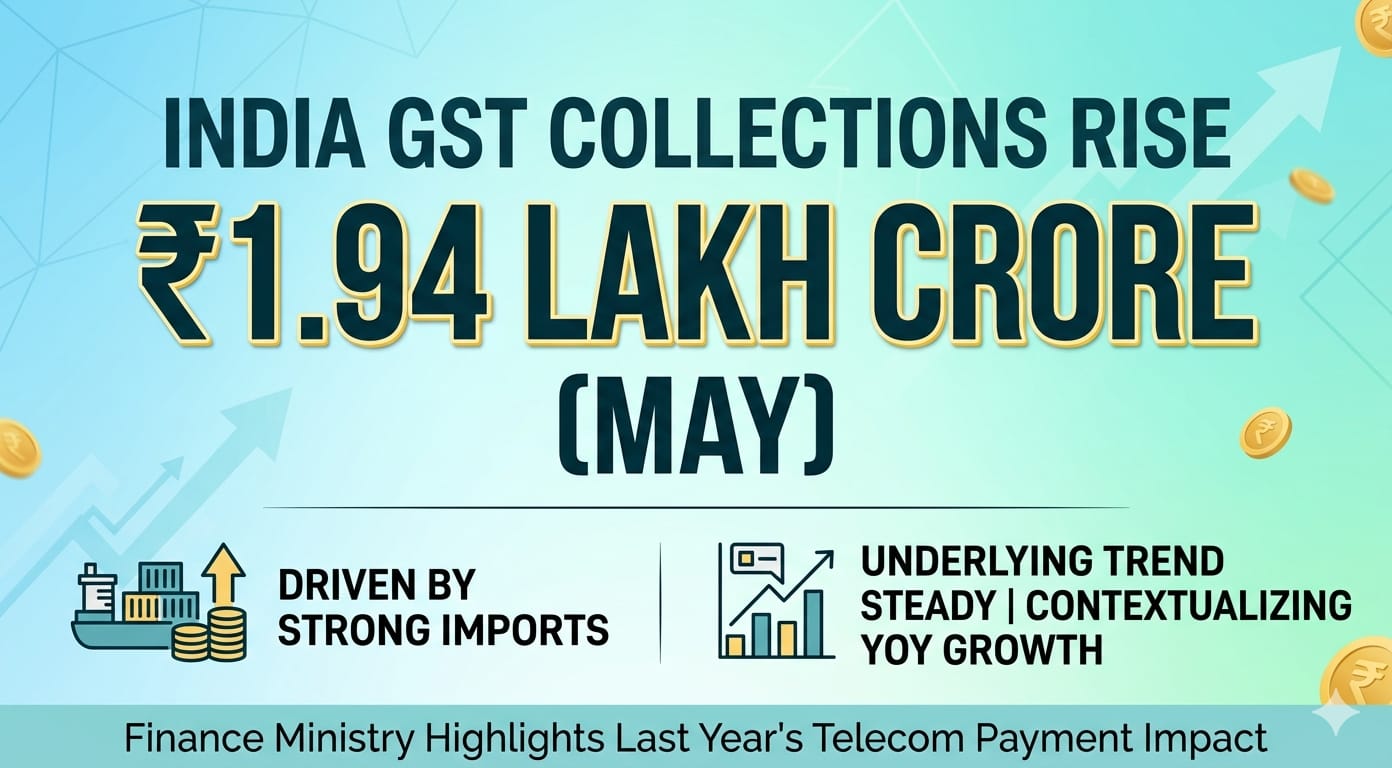
Goods and Services Tax (GST) collections for May in India stood at ₹1.94 lakh crore, reflecting a steady rise compared to the same period last year. The increase has been supported largely by stronger import revenues and consistent domestic economic activity.
At first glance, the growth appears moderate, but a closer look suggests that the underlying trend remains stable and encouraging.
It has been indicated that the year-on-year growth rate is around 3 percent. However, this number needs to be understood in context. The Finance Ministry has clarified that last year’s GST collections included an additional ₹10,000 crore paid by a telecom operator as part of its dues.
This one-time payment had artificially raised the base for comparison. When this factor is considered, the current growth reflects a more balanced and realistic expansion rather than a slowdown.
Import-related GST revenues have shown a noticeable increase, rising by about 19 percent compared to the previous year. This suggests that import activity has remained strong, possibly driven by higher demand for goods and improved trade flows.
It also indicates that consumption patterns and industrial requirements are holding up, even amid global uncertainties. Domestic GST collections, on the other hand, have grown at a relatively steady pace, pointing toward stable internal demand and business activity.
The government has consistently emphasized the importance of compliance and improved tax administration in driving GST growth.
Over time, measures such as better tracking of invoices, stricter enforcement, and technological integration have helped reduce leakages and improve revenue collection. These efforts appear to be contributing to the sustained performance seen in recent months.
From a broader perspective, GST collections are often seen as a reflection of economic health. When businesses produce and sell more, and when consumers spend more, tax collections tend to rise.
In this case, the current numbers suggest that economic activity is continuing at a steady pace, even if the growth rate seems modest on paper. The adjustment for last year’s telecom payment makes it clear that the base effect plays a crucial role in interpreting such data.
It is also being observed that monthly GST collections have remained close to or above the ₹1.7 lakh crore mark for several months now. This consistency indicates that the tax system has matured and is delivering reliable revenue for the government.
Such stability is important for fiscal planning, as it allows policymakers to better manage expenditure and investment priorities.
For businesses and consumers, the steady GST trend may signal a relatively stable economic environment. While challenges such as global market volatility and inflationary pressures continue to exist, the resilience in tax collections suggests that domestic fundamentals remain intact.
It also reflects the ongoing formalization of the economy, where more transactions are being recorded within the tax system.
Overall, the latest GST data presents a picture of cautious optimism. While the headline growth figure may appear limited, the underlying factors, including the adjustment for last year’s one-time payment and the strong performance of import revenues, point toward a more positive narrative.
The Finance Ministry’s clarification helps in understanding the true trajectory of GST collections, ensuring that the data is interpreted in the right context.

