
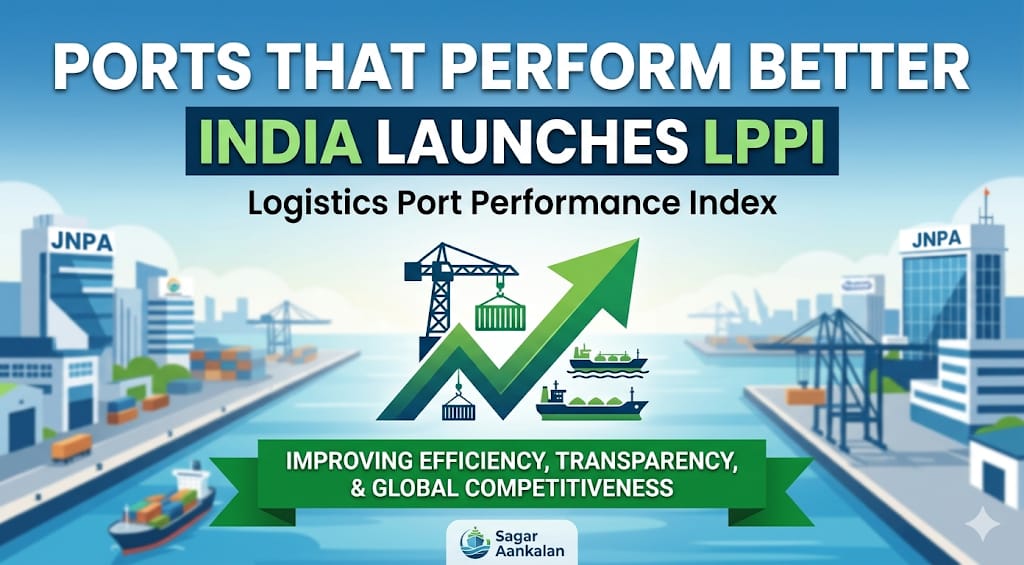
The government has taken a meaningful step forward in strengthening its maritime future by introducing the Logistics Port Performance Index, commonly called LPPI, for the fiscal year 2024-25.
This new index was officially launched by Union Shipping Minister Sarbananda Sonowal during the 37th Foundation Day of the Jawaharlal Nehru Port Authority in Mumbai on May 29, 2026 . The idea behind LPPI is simple yet powerful: to measure how well Indian ports are performing and to encourage them to keep improving.
It works like a report card for ports, helping everyone from shipping companies to everyday consumers who rely on imported and exported goods understand which ports are doing well and where improvements are needed .
The LPPI was developed under a government framework known as Sagar Aankalan, which is designed to bring clarity and accountability to port operations. It evaluates ports based on three main types of cargo: dry bulk (like coal and iron ore), liquid bulk (such as oil and gas), and container cargo (the standard boxes carrying everything from electronics to clothes) .
What makes this index especially useful is that it looks at real, measurable factors that directly affect how quickly and smoothly goods move through ports. These include how long a ship waits before being unloaded (pre-berthing waiting time), how long it stays at the berth without working (berth idle time), how fast ships turn around completely (vessel turnaround time), how long containers sit idle before being picked up (container dwell time), and how much cargo a berth can handle in a day (ship berth day output) .
What’s particularly encouraging is that the LPPI doesn’t just reward ports that are already performing well. It also gives credit to those that show consistent improvement over time. This means even a port that starts behind can climb up the rankings if it keeps getting better year after year .
This approach encourages all ports to strive for progress, not just maintain the status quo. The index supports larger national goals like the PM Gati Shakti National Master Plan, Maritime India Vision 2030, and Maritime Amrit Kaal Vision 2047, all of which aim to make India a leading maritime power with world-class logistics .
Alongside the LPPI, the government also introduced four digital initiatives to make the shipping sector more transparent and user-friendly. These include a 24/7 grievance redressal module on the e-Navik platform, so seafarers and workers can report issues anytime; a ship registration module on the e-Samudra platform to simplify paperwork; a medical practitioner module to ensure proper healthcare for maritime workers; and a unified ship recycling credit note module to make ship recycling more organized and accountable .
Another important reform is the launch of a unified ship recycling portal, which is part of a larger ₹70,000-crore maritime development package announced in 2025 .
For ordinary people, these changes might seem technical, but they have real-life impacts. Faster port operations mean goods reach stores quicker, shortages are less likely, and prices stay more stable. Better transparency means less corruption and more trust in the system.
And as Indian ports become more competitive globally, more international businesses will want to trade with India, creating jobs and boosting the economy.
Minister Sonowal himself said that the LPPI is a major step toward improving efficiency, transparency, and global competitiveness of Indian ports, and that by promoting continuous improvement and global benchmarking, it will strengthen India’s position as a leading maritime power .
In essence, the LPPI is not just a number or a ranking it’s a tool for change. It invites every port to do better, helps businesses plan more efficiently, and ensures that India’s ports are ready to meet the demands of tomorrow’s global trade.
By making performance visible and measurable, the government is sending a clear message: improvement is expected, progress is tracked, and excellence is rewarded. As India continues to build its maritime future, initiatives like LPPI show that even complex systems can be made simpler, fairer, and more effective for everyone involved .

