
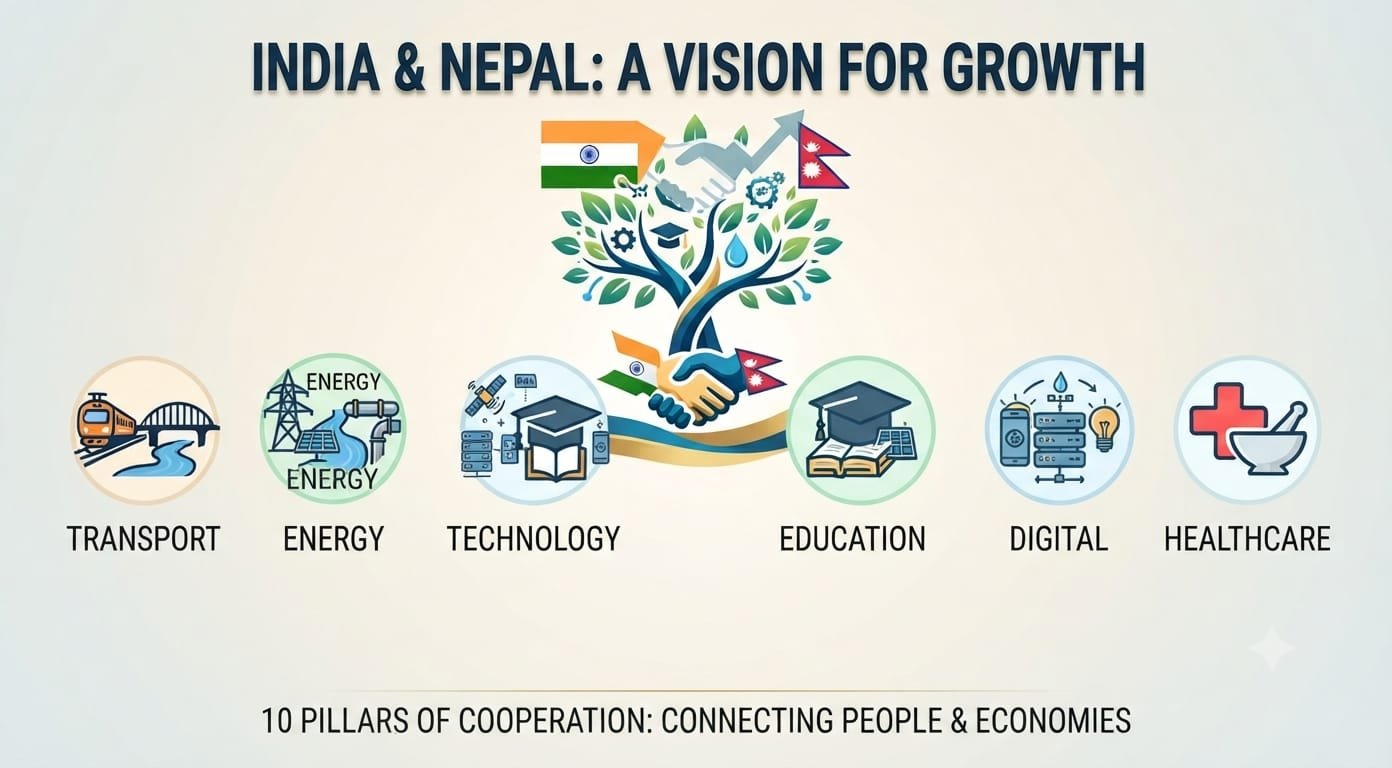
India and Nepal have agreed on a development roadmap aimed at making their close relationship more useful for ordinary people. Prime Minister Narendra Modi and Nepalese Prime Minister Balendra Shah adopted “Viksit Bharat and Samunnat Nepal: Re-imagining the Partnership” during Shah’s November 22–23, 2026, state visit. The document connects India’s developed-nation goal with Nepal’s aspiration for prosperity.
Its ten pillars cover economic development; physical and digital connectivity; energy, water and climate resilience; governance; technology; education and skills; sports; culture and tourism; health; and agriculture. The aim is to connect cooperation with daily needs, including easier travel, affordable medicines, better training and stronger business opportunities.
Transport announcements included the launch of the Ayodhya–Janakpur Sarayu-Kamala Express and the inauguration of the Dharchula–Darchula motorable bridge across the Mahakali River. The train supports religious tourism, while the bridge improves direct access between western Nepal and India. Both countries also agreed to speed up railway links and Integrated Check Posts, where border movement and trade are managed.
Trade plans include cross-border special economic zones, industrial parks and improved transit routes. India announced access through Deendayal Port in Gujarat, with Paradip Port access to follow once the necessary infrastructure is ready. These measures are intended to strengthen supply chains and expand opportunities for manufacturers and traders.
Energy cooperation combines completed infrastructure with future projects. The leaders dedicated Phase II of the Motihari–Amlekhgunj petroleum pipeline and laid the foundation stone for the 669 MW Lower Arun hydropower project. They also called for early work on the Siliguri–Jhapa petroleum pipeline. Wider plans include electricity trade, transmission links, flood warnings and disaster preparedness.
Digital cooperation focuses on speeding up cross-border retail payments, building on links between India’s UPI and Nepal’s payment system. Proposed facilities include a Startup Centre of Excellence in Kathmandu and a Digital Nomads and Innovation Hub in Pokhara. Artificial intelligence cooperation includes developing a Nepali-language model, alongside collaboration in satellites, data centres and advanced telecommunications.
Education plans include an IIT campus in Nepal, additional scholarships in law, technology and artificial intelligence, and vocational training. India will support a national cricket training academy and training opportunities for Nepali players. Tourism cooperation will develop Ramayana, Buddhist and Shiv–Shakti circuits, linking shared religious destinations and supporting cultural exchanges.
Healthcare commitments include establishing India–Nepal Jan Aushadhi Kendras for affordable medicines, upgrading Nepal’s National Medical Laboratory and training health professionals. An Indian-supported agro-industrial park in Chitwan is planned to help add value to farm products. Agricultural research and farmer training will support this effort. Governance cooperation includes training civil servants and sharing digital-service experience.
India also committed ₹15,000 crore in development assistance: ₹3,500 crore in grants for reconstruction and infrastructure, and ₹11,500 crore through a credit line for energy projects. Specific projects and funding arrangements still require consultations.
Implementation will be reviewed by a High-Level Monitoring Group led by Nepal’s Foreign Secretary and India’s Ambassador, meeting at least every six months. Existing agreements, including the 1950 Treaty, may be reviewed by mutual consent, while boundary questions remain subject to dialogue. The document is therefore a roadmap, not proof that every commitment has already been delivered.

