
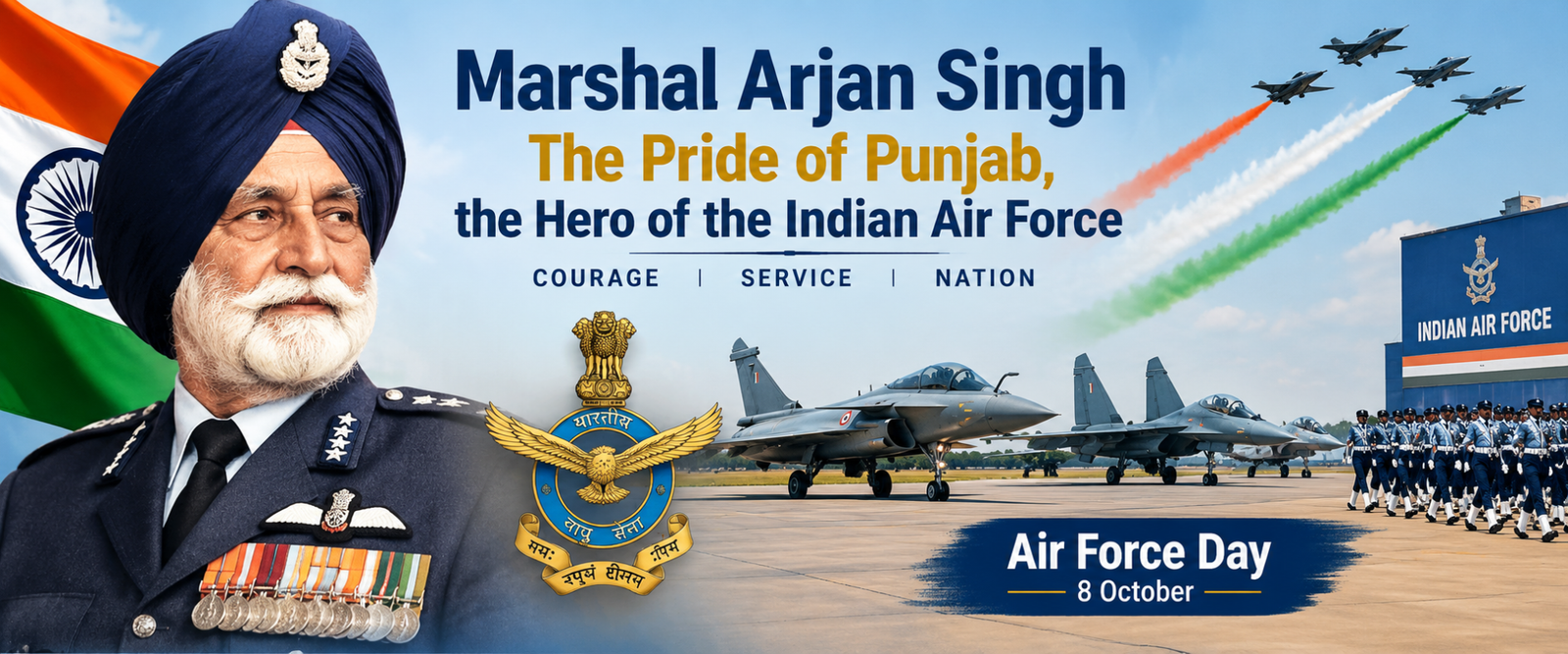
Few days back on October 8, Indian Air Force celebrated its 94th anniversary with the ceremonial parade taking place at Hindan Air Force Station in Ghaziabad, Uttar Pradesh. Fighter jets Rafale, Su-30 MKI and Jaguar were on display.
In his ceremonial address, Air Chief Marshal A.P. Singh said, IAF now ranks among the finest in the world. For Sikh families in Punjab and across the diaspora, the day carries a special pride, because the story of the IAF cannot be told without a son of Punjab who became its only five-star officer: Marshal of the Air Force Arjan Singh, who holds Distinguished Flying Cross
Bhagat Kabir Ji’s words in Sri Guru Granth Sahib Ji (Ang 1105) define the true warrior: “Soora so pehchaaniai jo larai deen ke het” — he alone is recognised as brave who fights for the sake of the helpless. Arjan Singh’s life was a long commentary on that line.
From Lyallpur to the Skies of Burma
Born on April 15, 1919, in Lyallpur (now Faisalabad in Pakistan), Arjan Singh was selected at 19 for training at the Royal Air Force College, Cranwell, in Lincolnshire, England, and was commissioned as a Pilot Officer in December 1939. In 1944 he led No. 1 Squadron into combat in the Arakan campaign against the Japanese, flying close air support during the crucial Imphal campaign. For his leadership, skill and courage he was awarded the Distinguished Flying Cross.
On August 15, 1947, as a new nation woke to freedom, it was Arjan Singh who was given the unique honour of leading a fly-past of more than a hundred IAF aircraft over the Red Fort. A Sikh from West Punjab, whose birthplace had just become part of another country, led free India’s first salute from the sky.
“In an Hour”: The Test of 1965
On August 1, 1964, Arjan Singh took over as Chief of the Air Staff at the age of just 44. In September 1965, Pakistan launched Operation Grand Slam, an armoured thrust aimed at the vital town of Akhnoor. Summoned to the Defence Minister’s office and asked how soon the IAF could be ready, he replied, with characteristic calm, “in an hour.” The Air Force struck the Pakistani offensive within that hour, gained air superiority and helped the Army secure vital gains.
The nation honoured him with the Padma Vibhushan for his leadership in the war, and he became the IAF’s first Air Chief Marshal. After retiring in 1969, he served India as Ambassador to Switzerland, the Holy See (the Vatican) and Liechtenstein, as High Commissioner to Kenya, as a member of the Minorities Commission and as Lieutenant Governor of Delhi. In January 2002, the Government of India conferred on him the rank of Marshal of the Air Force, making him the first and only five-star officer in IAF history. In 2016, Air Force Station Panagarh in West Bengal was renamed Air Force Station Arjan Singh. When he passed away on September 16, 2017, aged 98, the country mourned an icon.
A Lineage of Sikh Air Warriors
Arjan Singh was not alone. Air Chief Marshal Dilbagh Singh, the second Sikh to head the IAF (1981–84), flew operations from Srinagar in 1947–48 and raised India’s first supersonic squadron with the MiG-21. Flying Officer Nirmal Jit Singh Sekhon, of Isewal near Ludhiana, remains the only IAF officer awarded the Param Vir Chakra, for taking off under attack and engaging a raid of six Pakistani Sabres over Srinagar on December 14, 1971. These names remind us that the Republic’s highest ranks and honours have been open to, and earned by, Sikhs.
This is worth remembering when voices abroad claim that Sikhs have no place in India. The record of the IAF says the opposite: the force trusted a young Sikh with its first fly-past over the Red Fort, its leadership in war and its highest rank.
As young Punjabis today weigh their futures, the Air Force and the armed forces still offer what Arjan Singh found: a life of seva, honour and adventure in service of the land of the Gurus. On this Air Force Day, the best tribute to the Marshal is to keep that tradition flying high.

