
I remember when Lionel Messi first played for Argentina, in a friendly against Hungary in 2005, he was sent off within a minute of coming on to the pitch as a substitute. It was a terrible beginning to what would become one of the greatest international careers football has ever witnessed.
But perhaps that beginning was strangely appropriate because Messi’s Argentina story was never supposed to be easy.
For years, I watched him carry a burden that no footballer should have had to carry alone. Every time Argentina lost, the questions returned. Why couldn’t Messi win a major trophy for his country? Why couldn’t he be like Diego Maradona? Why did the magic he produced for Barcelona disappear in an Argentina shirt? He gave Argentina everything, yet for years, it seemed that everything he gave was never enough.
When he made his first appearance at a World Cup, in 2006, he came on as a substitute, scoring and assisting as an 18-year-old. In 2010 World Cup, he couldn’t score and provided 1 assist as Argentina got knocked out in the Quarter Finals. But then I watched him reach the 2014 World Cup final, Messi was mesmerising during that tournament, as he often is. But then Argentina lost the final to Germany thanks to Mario Götze’s brilliantly taken goal.
I watched Messi walk away from the Copa América finals of 2007,2015, and 2016 without the trophy. I watched the disappointment in his face grow heavier with every defeat. By 2016, after losing another final to Chile, Messi announced his retirement from international football. For a moment, it felt like Argentina had lost him.
Thankfully, he came back. And that decision changed everything about Argentinian Football.
What followed was perhaps the most beautiful second act in sporting history.
In 2021, at the Maracanã, Messi finally lifted his first major international trophy with Argentina. The Copa América victory over Brazil wasn’t merely a trophy. It was an emotional release for a player who had spent years being told that he could never deliver for his country.
I remember seeing Messi celebrating with his teammates, tears in his eyes. That night, the weight on his shoulders seemed to have been lifted.
But Messi wasn’t finished, he was just getting started. The Finalissima trophy followed in 2022. Then came Qatar.
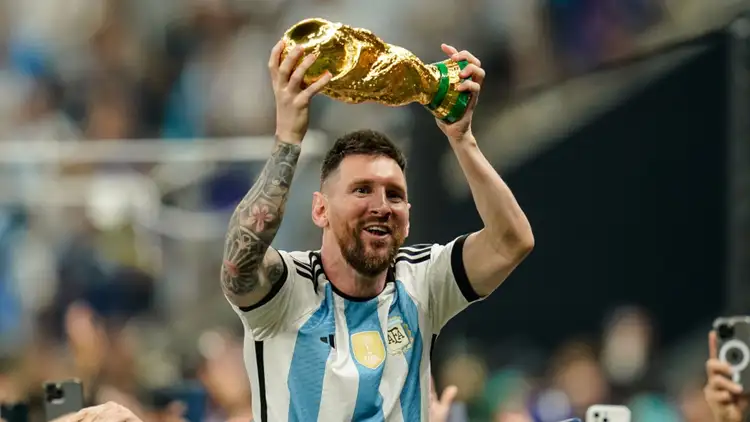
The 2022 World Cup was Messi’s masterpiece with Argentina. At 35, he led his country through one of the most dramatic World Cup campaigns imaginable. From the shock defeat to Saudi Arabia to the victories over Mexico, the Netherlands, Croatia and finally France in one of the most dramatic World Cup finals. Messi seemed determined to write the ending that football had denied him for so long.
In the final, Argentina led, France came back. Argentina led again. France came back again. Messi scored twice. Kylian Mbappé scored a hat-trick. And eventually, the World Cup was decided by penalties.
When Gonzalo Montiel scored the winning penalty, Messi dropped to his knees. I think every football fan understood what that moment meant.
The boy from Rosario had finally become a world champion, and finally any doubt about him being the greatest ever disappeared.
The comparisons with Maradona no longer mattered. The criticism no longer mattered. The old questions had finally disappeared. Messi had done it.
But what makes his Argentina career even more remarkable is that he didn’t stop there.
He led Argentina to another Copa América title in 2024, giving the country back-to-back continental championships. And when he finally walked away from the national team in 2026, his legacy had become almost impossible to measure. His final tally of 207 appearances and 125 goals makes him both Argentina’s most-capped player and its all-time leading scorer, by some distance. He won four major senior titles with Argentina, the 2021 Copa América, 2022 Finalissima, 2022 World Cup and 2024 Copa América. Throw in the Olympics Gold in 2008 as well for good measure.
He also played in six World Cups and appeared in three finals, winning one and finishing runner-up twice. He also featured in 5 Copa America Finals, winning 2 of them.
And then came his final goodbye.
On October 6, 2026, at the Monumental in Buenos Aires, Messi walked onto the pitch wearing Argentina’s famous blue and white for the last time. Against Benin, he assisted twice and scored a penalty as Argentina won 3-0. More than 85,000 people came simply to say goodbye.
Even though Messi was again at his best, I don’t think anyone was really watching the score. We were watching an era end.
For more than two decades, Messi gave Argentina his youth, his genius, his tears, his frustration, his failures and, eventually, his greatest triumphs.
Messi lost finals. He walked away. He returned. He lost again. He kept going, and eventually, he won everything.
So, Lionel, thank you. Thank you for the goals, the impossible dribbles, the celebrations, the tears and the memories.
Thank you for refusing to give up when the world told you that you had already failed. Argentina no longer has to ask whether Messi fulfilled his destiny, the entire world knows that he did.
When history remembers world’s greatest footballers, one name will always be mentioned first- Lionel Messi.
Gracias, Leo.
Gracias por todo.

