
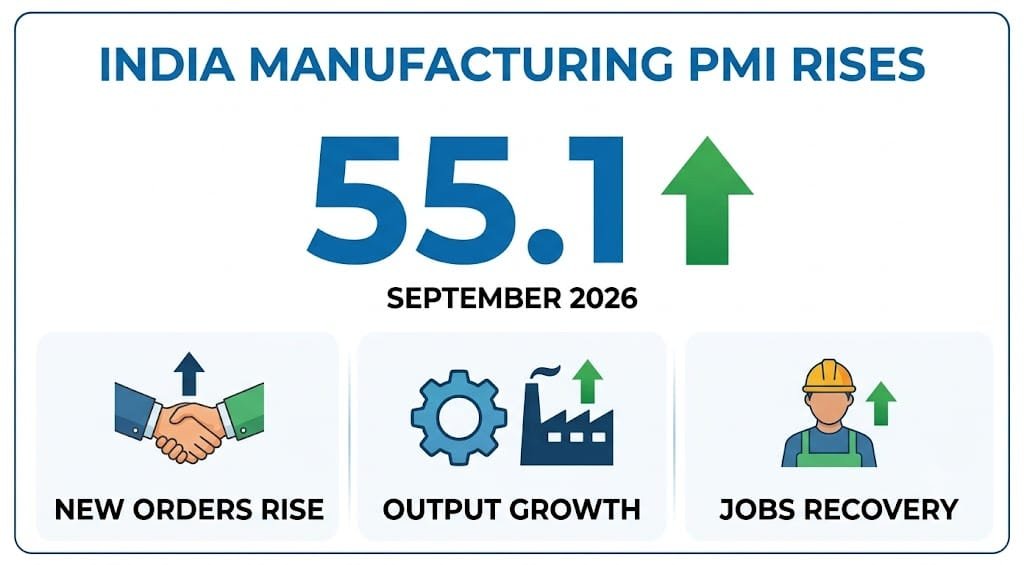
India’s manufacturing sector ended the September quarter on a stronger note, offering a positive signal for the wider economy. The HSBC India Manufacturing Purchasing Managers’ Index, or PMI, rose to 55.1 in September 2026 from 52.8 in August. This was the highest reading in seven months and showed that factory activity improved at a healthy pace.
A PMI reading above 50 indicates expansion, while a reading below 50 points to contraction. The latest number therefore suggests that many factories received better business, increased production and created more employment opportunities.
The improvement came mainly because demand became stronger in both domestic and overseas markets. Companies reported that new orders increased at the fastest pace in seven months. When more orders reach factories, production lines become busier, raw material purchases rise and more workers may be needed.
This creates a positive chain across the economy, from suppliers and transport services to small units that provide parts, packaging and other support services. September’s output growth was the strongest in four months, showing that manufacturers responded quickly to improved demand.
Several important industries supported this recovery. Demand was stronger for electronic goods, food products, pharmaceutical items and textiles. Intermediate goods, which are materials and components used by other businesses to make final products, performed especially well.
This is important because improvement in intermediate goods often signals that production activity may continue in coming months. When companies buy more components, machinery parts, chemicals or industrial materials, it usually means they expect future orders and production to remain strong.
Export demand also improved during September. Indian manufacturers received stronger orders from countries and regions such as Brazil, Europe, the United Arab Emirates and the United States. Better overseas demand is encouraging for Indian industry because it helps companies expand beyond local markets.
It can support foreign exchange earnings, strengthen supply chains and create opportunities for firms of different sizes. Global demand can sometimes change quickly due to trade rules, currency movements or weak growth in other economies, but the September data showed that Indian manufacturers found more support from international buyers.
Employment growth was another encouraging part of the survey. Factory hiring picked up after a softer August and expanded at the fastest rate since May. More hiring indicates that businesses were not only receiving orders but were also confident enough to add staff to meet expected demand.
For workers and families connected with industrial areas, this can bring hope because manufacturing supports a wide range of jobs, including factory work, logistics, warehousing, maintenance, transport and local services.
Business confidence also moved higher, reaching a four-month high. Manufacturers became more positive about future production, helped by stronger sales conditions and improved demand. This optimism matters because confidence affects business decisions.
A company expecting stable growth may plan to increase output, buy more material, hire workers or invest in capacity. Such decisions can gradually strengthen economic activity across many sectors.
At the same time, costs remained an area to watch. Companies faced higher prices for electronic components, pharmaceutical products and steel. Selling prices also increased, although the rise remained moderate.
This suggests that manufacturers were managing cost pressures carefully instead of passing the entire burden immediately to customers. Stable cost conditions will remain important for sustaining consumer demand and keeping production growth balanced.
The September PMI reading was below the early flash estimate of 55.7, but it still marked a clear improvement from August and the strongest overall performance since February. The average PMI for the July-September quarter stood at 53.8, the lowest for the same period since 2021, indicating that the recovery has come after a relatively softer quarter.
Even so, the September momentum offers a constructive beginning for the next quarter. India’s factories appear to be entering the coming months with stronger orders, improved output, better hiring and renewed optimism.

