
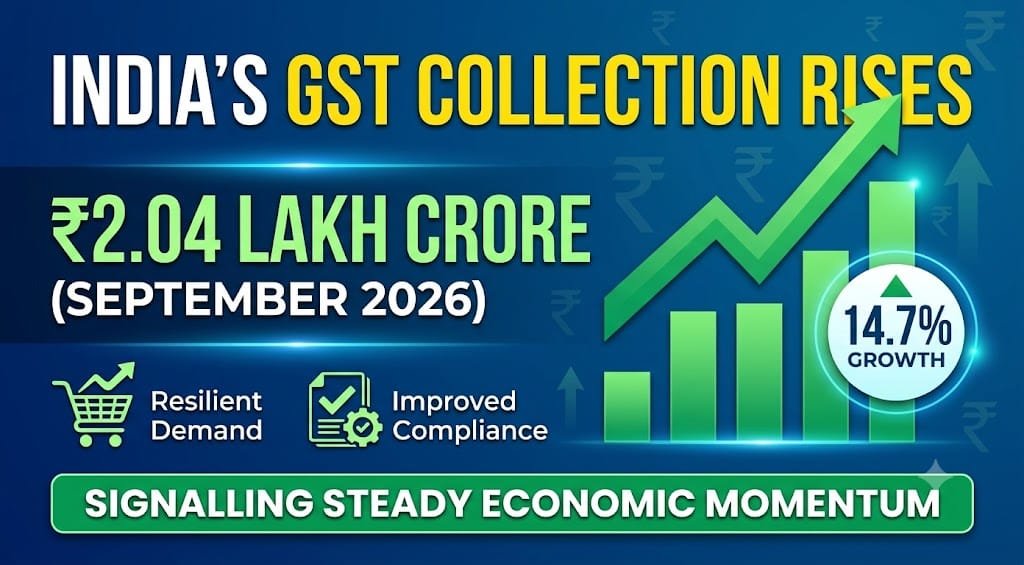
India’s goods and services tax (GST) system continued to show steady strength in September 2026, with gross collections rising 14.7% compared to the same month last year to reach ₹2,03,521 crore. This performance reflects sustained momentum in economic activity, better compliance, and a broad-based recovery across many parts of the country.
The data, shared through official channels, also highlighted that cumulative gross GST collection for the first half of the current financial year (April to September) stood at ₹12,46,278 crore, marking an 11.6% increase over the corresponding period a year ago. Such numbers suggest that the underlying engine of domestic consumption and business turnover remains in good shape, even as global conditions stay uncertain.
The composition of September’s GST collection tells a detailed story about how revenue is shared between the Centre and the States. Out of the total gross collection, Central GST (CGST) came to ₹37,762 crore, State GST (SGST) to ₹45,363 crore, and Integrated GST (IGST) to ₹1,20,396 crore. IGST, which applies to inter-state supplies and imports, formed the largest share, indicating healthy movement of goods and services across state borders as well as steady import-linked activity.
After accounting for refunds, which were down 3% year-on-year at ₹27,001 crore, the net GST revenue for September rose 18.1% to ₹1,76,520 crore. Lower refunds often point to smoother processing and fewer pending claims, which in turn improves the government’s cash position and supports planned spending.
Domestic revenue trends within the GST framework also looked encouraging. India’s gross domestic revenue jumped 10.1% from ₹1,25,334 crore to ₹1,37,996 crore, while net domestic revenue grew 13.5% to ₹1,24,491 crore. These figures capture the portion of GST that stays within the country from domestic transactions, separate from IGST on imports.
A double-digit rise in domestic revenue suggests that local business activity, retail sales, and services consumption have been holding up well. For ordinary households, this translates into more jobs, steadier incomes, and greater confidence to spend on everything from daily needs to bigger purchases.
State-wise performance added further depth to the picture. Maharashtra continued to lead all states with a GST collection of ₹29,986 crore in September, up 15% from a year earlier. Karnataka followed with ₹13,884 crore, registering 16% growth, while Gujarat’s GST revenue rose 17% to ₹12,222 crore.
Uttar Pradesh recorded an 18% increase to ₹8,882 crore, and Telangana also reported 18% growth, with collections rising to ₹5,327 crore. Punjab’s GST revenue increased 18% to ₹2,549 crore.
Among larger states, Assam stood out with an exceptional 88% jump in GST collections to ₹2,415 crore, while smaller northeastern states like Manipur (145% rise), Arunachal Pradesh (46%), and Nagaland (39%) also posted strong growth. Such widespread gains indicate that economic momentum is not limited to a few industrial hubs but is spreading across regions.
At the same time, a few states saw GST collections decline in September. Sikkim experienced the sharpest fall, with revenue dropping 51% to ₹194 crore. Jammu and Kashmir’s collections declined 29% to ₹487 crore, while Uttarakhand recorded a 23% fall to ₹1,277 crore and Himachal Pradesh saw a 21% decline to ₹640 crore.
Tamil Nadu’s GST revenue fell 5% to ₹10,188 crore, Goa’s collections declined 7% to ₹494 crore, Puducherry recorded a 31% fall to ₹179 crore, and Meghalaya’s collections declined 14% to ₹164 crore.
These dips could be due to a mix of factors such as changes in industrial output, seasonal patterns, or shifts in the timing of large transactions. Even so, the overall national picture remained positive, with many major economies posting solid gains.
Other key states contributed steadily to the national total. Kerala recorded 11% growth in GST revenue to ₹3,328 crore, West Bengal grew 6% to ₹5,549 crore, Odisha rose 10% to ₹4,356 crore, and Madhya Pradesh reported 5% growth to ₹3,198 crore. Rajasthan’s collections were largely unchanged at ₹4,151 crore compared with ₹4,165 crore last year.
When viewed together, these numbers show a diverse but generally upward-moving landscape, where most regions are adding to the tax pool that funds infrastructure, health, education, and welfare schemes.
The September GST data, seen alongside the half-year cumulative figure of ₹12.46 lakh crore, sends a message of cautious optimism. Steady growth in both gross and net collections, moderation in refunds, and healthy performance across many states point to an economy that is absorbing shocks and continuing to expand. For businesses, this environment supports planning and investment.
For governments, it creates space for development spending without excessive stress on finances. And for citizens, it underpins the public services and infrastructure that shape everyday life. In that sense, the GST numbers are not just about tax; they are a window into how economic activity is unfolding on the ground.

