
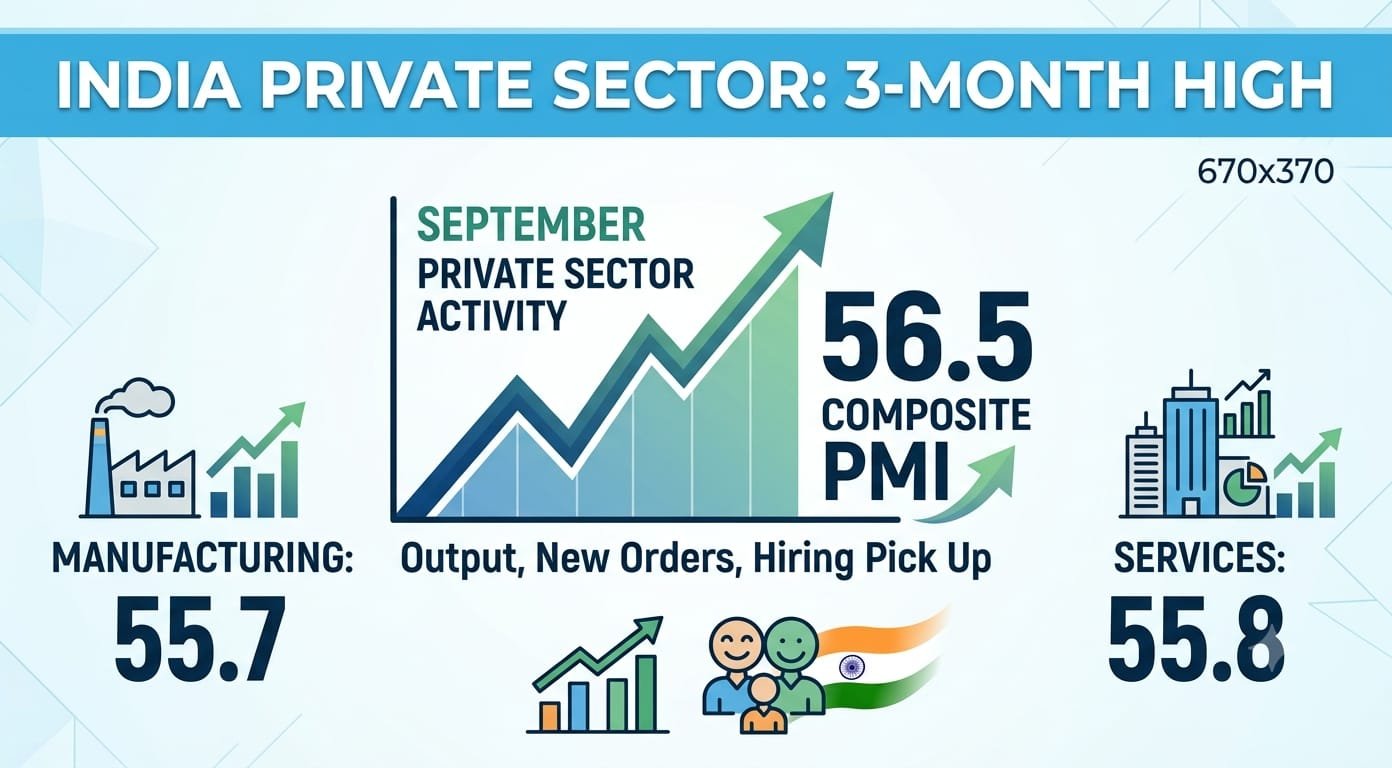
India’s business activity picked up speed in September, reaching the strongest level seen in three months. A closely watched survey by HSBC showed that both manufacturing and services firms expanded output, received more new orders, and added workers at a faster pace.
The improvement came even as global uncertainties, including renewed tensions in the Middle East, encouraged companies to build buffers and manage risks more actively. This broad-based uptick signals that domestic demand remained resilient and that private businesses continued to drive growth across the economy.
The HSBC Flash India Manufacturing PMI climbed to 55.7 in September from 52.8 in August, while the Services Business Activity Index rose to 55.8 from 54.1. Taken together, the composite index stood at 56.5, up from 54.3 the previous month, and stayed above the 50-point threshold that separates expansion from contraction for the 62nd month in a row.
New business inflows accelerated, with sales growth in goods-producing sectors hitting a seven-month high and outpacing services. Demand was reported across a wide range of areas, including aluminium, electronics, food, pharmaceuticals, and new product models on the manufacturing side, and property, transport, travel, software, and digital solutions on the services side.
Employment conditions also improved as firms responded to higher output and order books by hiring more staff. Job creation was recorded in both manufacturing and services, with expansion rates broadly similar across the two sectors.
At the same time, price pressures showed signs of easing. Input cost inflation across the private sector slowed to its lowest level since January, helped by softer cost growth in services that more than offset a rise among manufacturers.
Companies that reported higher costs pointed to spending on electrical components, food items, fuel, metals, pharmaceutical ingredients, and technology resources.
Selling price inflation at the overall level remained steady in September. Factory gate prices rose more sharply as manufacturers tried to protect margins, while service providers increased their charges at a slower rate.
Input purchases also picked up, and inventories of finished goods reached the highest level in more than 11 years, suggesting that firms were building stock in anticipation of future demand or to guard against supply disruptions.
Export orders continued to grow, but the pace of expansion slowed to the weakest in almost three years, indicating that overseas demand may be losing some momentum even as domestic activity strengthens.
The flash PMI figures are based on around 90 per cent of monthly survey responses and serve as an early read on the final PMI numbers. The final manufacturing PMI is scheduled for release on October 1, and the final services PMI on October 6.
Taken together, the September data pointed to a private sector that remained firmly in expansion mode, supported by stronger domestic demand, improved hiring, and manageable cost pressures, even as external demand growth moderated.

