
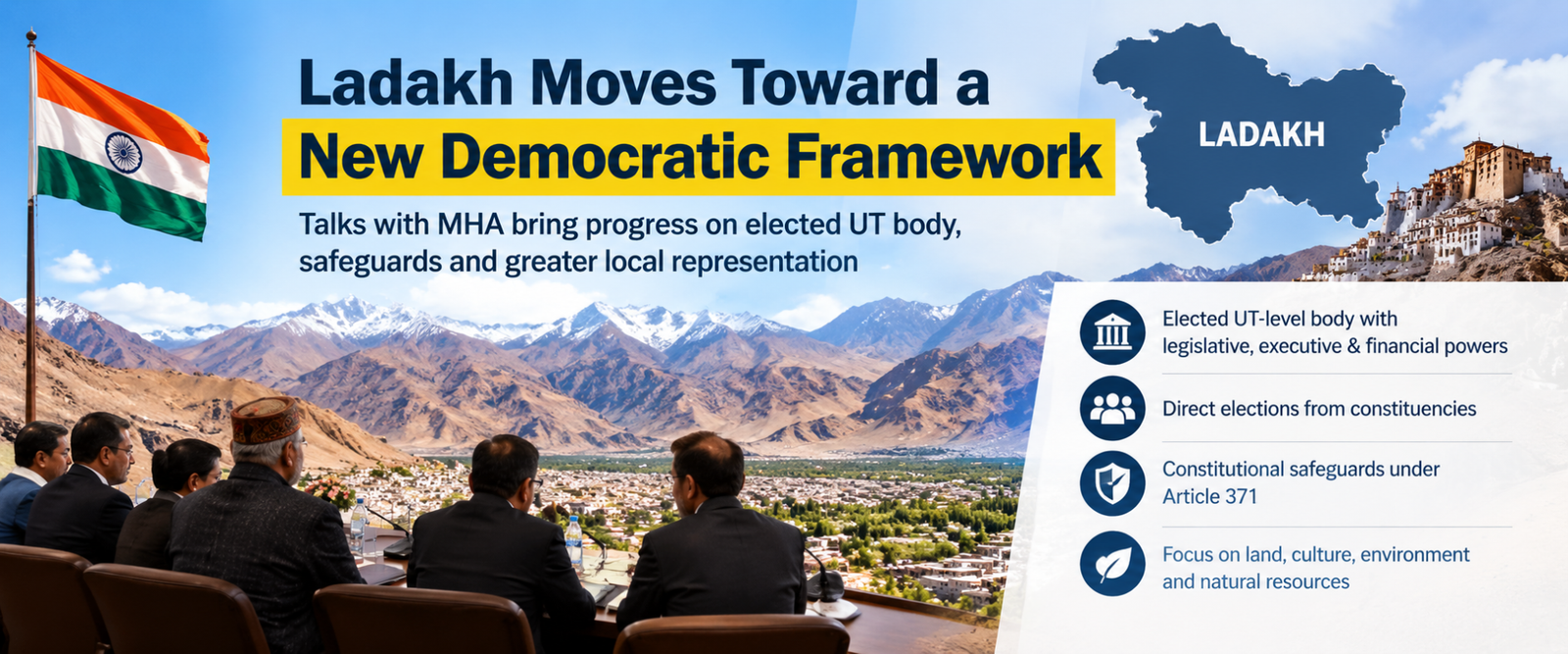
Ladakh, as a Union Territory, today stands at an important crossroads in its journey towards strengthening its democratic and administrative framework.
Very recent discussions between representatives from the Ladakh region and a sub-committee of the Union Ministry of Home Affairs on September 9, 2026, have underscored meaningful progress toward stronger democratic institutions and lasting safeguards.
These talks build on earlier understandings and address long-standing concerns over representation, local control, and protection of the region’s unique identity, land, culture, and environment. Voices with deep experience in Ladakh’s public life, including former Member of Parliament Thupstan Chhewang and former Leh Hill Council chairman Tashi Gyalson, have highlighted the constructive nature of these engagements.
The key September 9 meeting produced clarity on several foundational elements. There is agreement on establishing a Union Territory-level elected body that will exercise legislative, executive, and financial powers. Members of this body will be chosen through direct elections from constituencies, a demand pressed by representatives of both the Leh Apex Body and the Kargil Democratic Alliance and accepted by the Centre.
Separate delimitation for Ladakh has also been accepted. Constitutional protection for land, culture, heritage, environment, and natural resources will be provided under a special provision of Article 371. This framework creates a customised, sui generis model of governance tailored to Ladakh’s needs.
These outcomes rest on earlier advances already delivered through sustained dialogue. Eighty-five per cent of government posts are reserved for locals, with even eighty per cent of those reserved for Scheduled Tribes. A domicile framework is in place. Five official languages have been notified. One-third of hill council seats are reserved for women.
The administration has moved to constitute Autonomous Hill Development Councils across seven districts, expanding from the earlier two. Processes for panchayat elections have begun with revision of electoral rolls across 193 panchayats—ninety-five in Leh and ninety-eight in Kargil. Recruitment under the new reservation rules, long awaited by young people, is a priority. Partial withdrawal of cases linked to earlier unrest has occurred, with further review underway, alongside commitments on compensation for affected families.
Former MP Thupstan Chhewang, who previously led the Leh Apex Body, has described the talks as fruitful. He has pointed out that points of consensus reached in the room were not fully placed before the public and that delays have stemmed more from internal differences over sequencing within the groups than from any lack of seriousness on the part of the Home Ministry. He has questioned the necessity of a fresh agitation when dialogue is producing results. MP Mohmad Haneefa Jan has similarly affirmed that the Ministry is serious about the legislative setup and Article 371 safeguards, while underscoring the urgency of restarting recruitment. Tashi Gyalson august presence at the meeting further signals broad institutional engagement.
The remaining work centres on practical details, particularly the precise division of powers between the new territorial body and the existing hill councils. Subjects such as land, forests, and local administration cannot be held concurrently in two places. Questions on this division were shared for further discussion, with the next round of talks expected in early October. This sequential approach—locking in agreed elements first—is the practical path forward. An all-or-nothing insistence risks freezing progress on multiple fronts: empty panchayat and hill council seats, delayed fund flows, postponed councils for the five newer districts, stalled recruitment, delayed domicile certification, and slowed infrastructure and winter health postings.
Some participants have expressed dissatisfaction, noting the absence of a full draft text at the September 9 meeting and signalling plans for a padyatra later in the month if further assurances do not arrive quickly. In the end, the measure of success will be institutions that work for Ladakh’s residents—elected representatives with real powers, protected land and culture, open recruitment pathways for youth, and functioning local bodies that deliver services. By consolidating the gains already secured and addressing the remaining questions in the scheduled October round, Ladakh can move steadily toward a governance model that deepens democracy while safeguarding what makes the region unique.

