
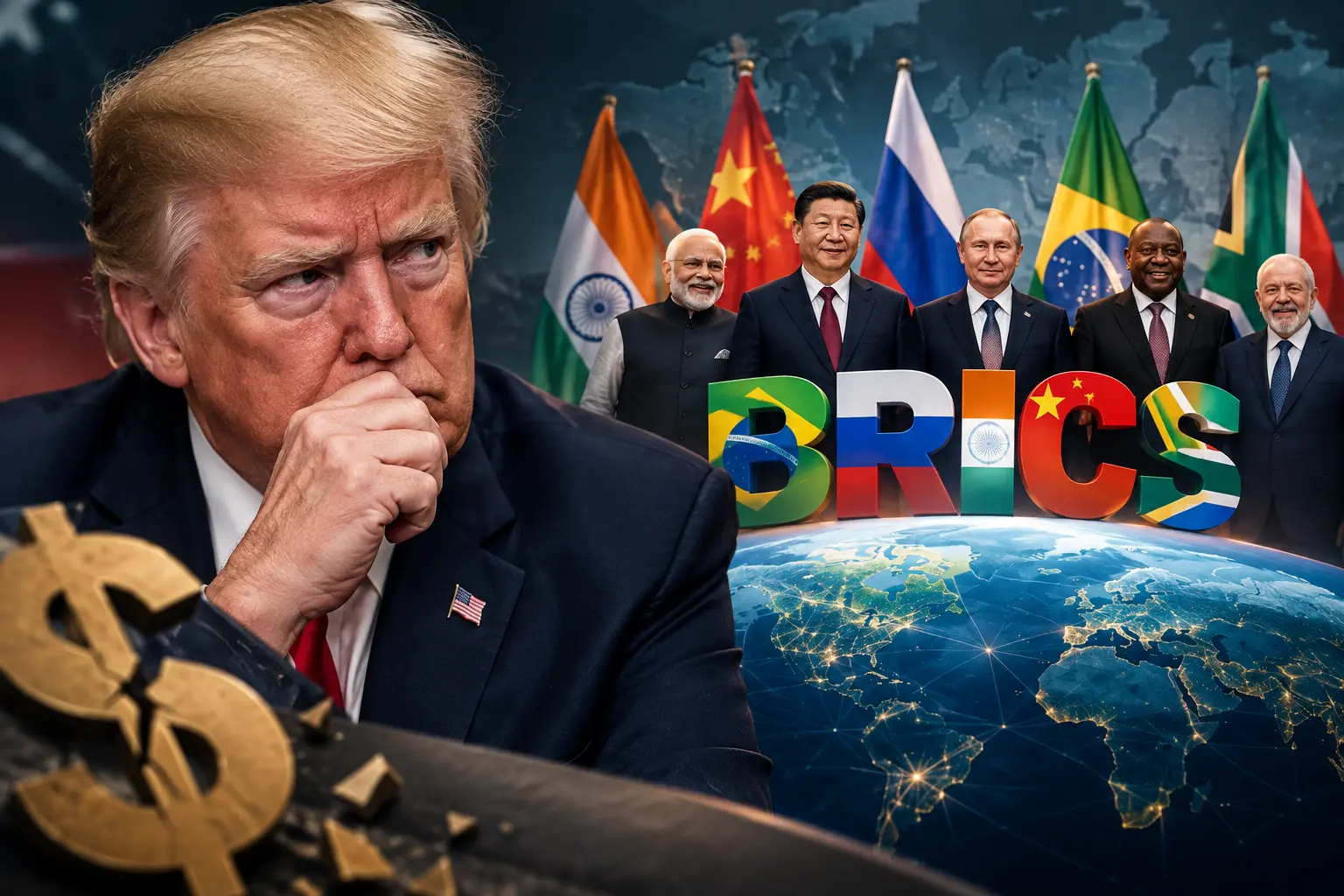
If there is one thing that makes Donald Trump particularly uncomfortable about BRICS, it is not the photographs of Narendra Modi, Vladimir Putin and Xi Jinping sitting together. It is not the camaraderie between these major global leaders. It is the possibility that the countries sitting around that table could gradually build an economic system that gives the United States less leverage over the rest of the world, and that is precisely why Trump has repeatedly warned BRICS. He has tried to bully each of these countries separately, but none of them has bowed down before him.
The BRICS grouping has expanded dramatically and now has 11 members, representing nearly half of the world’s population and a 40% of the global economy. Its growing size alone gives it considerable economic and political weight.
But the real issue is the US dollar.
For decades, the dollar has been at the centre of global trade and finance. Countries use it for international transactions, commodities are largely priced in dollars, and central banks hold huge amounts of their reserves in the currency. This gives Washington an enormous economic advantage, and along with it, considerable geopolitical influence.
BRICS countries, particularly India, Russia and China, have increasingly discussed ways to conduct more trade in their own currencies and develop alternative payment mechanisms. At the New Delhi summit, the discussion around local-currency transactions and linking national payment systems has again brought the issue into focus. Trump clearly sees the danger for the US if that happens, after all, he is a businessman at his core.
In 2024, before returning to the White House, Trump threatened BRICS countries with 100 per cent tariffs if they attempted to create a new currency or support another currency as an alternative to the dollar. He repeated the warning in February 2025, saying BRICS countries would face tariffs if they “play games with the dollar.”
But there is an important reality check, BRICS does not have a common currency and is nowhere close to replacing the dollar. Yet, the American President is freaked out by just the possibility of such a currency that can replace the Dollar.
In fact, India has repeatedly favoured greater use of national currencies for trade without advocating the creation of a BRICS currency. Russia itself recently said it was not pursuing “de-dollarisation” as such and remained open to different payment methods, so why does Trump worry?
Because the threat may not be a sudden BRICS currency replacing the dollar. It is the development of alternatives.
If more countries trade in rupees, yuan, roubles or other national currencies, if payment systems become interoperable, if BRICS institutions finance more projects without relying on Western financial infrastructure, and if countries gain the ability to bypass dollar-based systems when necessary, American financial influence would gradually weaken.
BRICS is therefore not yet a replacement for the dollar. But it represents something Washington cannot ignore, a world where countries have more choices, and that scares the United States.
And for a country that has enjoyed enormous influence from being at the centre of the global financial system, that possibility is bound to make Donald Trump nervous.

